



.svg)
 Shop floor execution
 Maintenance
 Production
 Skills
.png?width=60&height=60&name=chart-line-up%20(1).png) Manufacturing Intelligence
Manufacturing Intelligence
 Automotive
 Building materials
 Packaging
 CMMS/EAM
 MES
MES
 Connected Worker
 Manufacturing Intelligence
 Case studies
 Blog
Blog
 Ebooks & Guides
 Webinars
 Events
.svg) OEE Calculator
OEE Calculator
 Downtime Cost Calculator
 About Us
 Partners
 Newsroom
 Support
 Careers
 Trust center


.svg)

What is manufacturing operations management (MOM)?
Manufacturing operations management (MOM) is a methodology that coordinates the activities that turn raw materials into finished goods, specifically covering production, quality, maintenance, and inventory operations. Rather than managing a facility as isolated departments, manufacturing operations management unites all plant floor functions to ensure teams operate cohesively. When organizations establish a unified system, they bridge the execution gap between detecting operational signals and orchestrating the correct frontline response.
This guide details the standard manufacturing operations management model, compares MOM with MES and ERP systems, explores manufacturing operations management software, and outlines exactly how organizations can implement a unified solution on the plant floor.
The manufacturing operations management model
The standard manufacturing operations management model relies on four core operational areas functioning together. This framework ensures plant leaders have total visibility across every aspect of the facility.
Production operations management
Production operations management involves scheduling, dispatching, and executing production plans. This area ensures that teams meet throughput targets and adhere to operational timelines while managing machine availability.
Quality operations management
Quality operations management focuses on in-process checks, defect tracking, and corrective action. By monitoring quality in real time, organizations can prevent defects before an entire batch is completed, reducing scrap and unnecessary rework.
Maintenance operations management
Maintenance operations management covers asset care, work orders, and equipment uptime. This connects to a computerized maintenance management system to shift facilities from reactive repairs to scheduled, proactive equipment care.
Inventory operations management
Inventory operations management provides visibility into materials, spare parts, and work-in-progress components tied to production. Efficient inventory management ensures that operators and technicians always have the required materials exactly when a job starts.
MOM vs MES vs ERP
Manufacturing environments rely on multiple systems, making it essential to understand how different software layers interact.
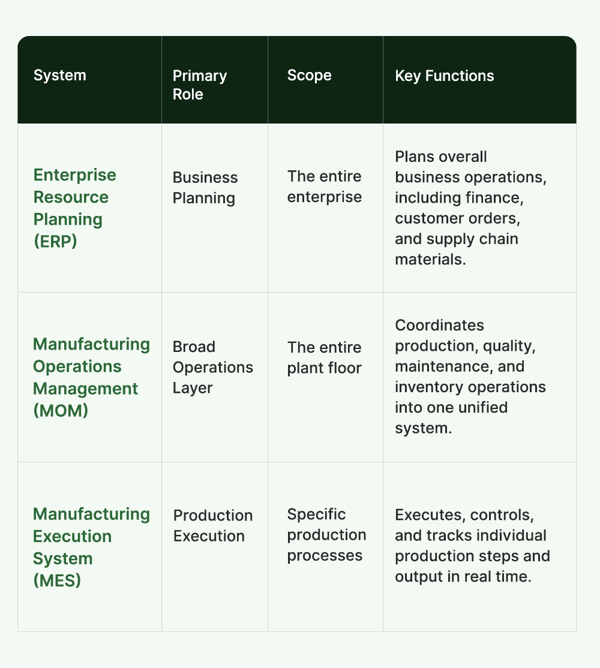
MOM is the broad operational layer that orchestrates production, quality, maintenance, and inventory. It functions as a system of action for the entire plant floor.
MES is a specialized manufacturing execution system that specifically tracks and documents the production process. An MES often functions as one component within the broader MOM framework.
ERP is the enterprise resource planning system that manages finance, procurement, and customer orders. ERP systems focus on high-level enterprise data rather than real-time plant floor execution.
The benefits of connected manufacturing operations management
Moving beyond a simple ‘system of record’ and embracing a connected approach to manufacturing operations provides organizations with several measurable advantages.
- Plant-wide visibility: Consolidating data gives leaders a unified view across the entire enterprise, eliminating fragmented spreadsheets and manual tracking.
- Less downtime: Coordinating maintenance and production reduces the diagnostic lag between a breakdown and the repair, increasing overall equipment effectiveness.
- Better product quality: Standardizing digital workflows ensures that operators follow precise quality protocols, reducing variation across different shifts.
- Higher throughput: Exposing hidden production constraints enables manufacturing leaders to optimize cycle times and unlock uncaptured plant capacity.
- Faster data-driven decisions: Transitioning from passive record-keeping to real-time analytics allows organizations to optimize operations instantly rather than waiting for monthly reports.
Manufacturing operations management software: What to look for
Selecting the right manufacturing operations management software determines how effectively an organization can scale best practices. When evaluating a MOM system, manufacturers should prioritize a platform that moves beyond passive data collection to actively orchestrate the shop floor. Decision-makers should evaluate manufacturing operations management software against the following foundational pillars:
- Frontline-first design: The ultimate metric of success for a MOM system is ease of adoption for the workers using it. The platform must be intuitive and mobile-first to reduce the administrative burden on operators, ensuring that data is captured accurately and immediately at the source.
- Cross-departmental integration: A connected platform must serve as the link between maintenance, production, and quality. Rather than operating in isolated software environments, the system should integrate seamlessly with existing ERP and MES tools to provide a single, shared scoreboard of live data.
- Visibility and real-time orchestration: The software must be capable of automatically dispatching the correct resources the moment a machine signal indicates a problem. By automating resource coordination, organizations eliminate the manual communication delays that lead to major downtime events.
- Prescriptive intelligence: Instead of merely providing analytical dashboards, modern manufacturing operations management software must offer prescriptive guidance. The system should deliver input on the next best action, supplying technicians with verified solutions and step-by-step troubleshooting workflows based on historical data.
- Cloud-native scalability: To move beyond site-specific silos, the operational core must be cloud-based. This allows enterprise leaders to establish a baseline of operational excellence and instantly deploy updated digital workflows to every facility worldwide.
The bottom line is connectivity. Modern MOM systems cannot operate in a vacuum, or even at partial connectivity.
How to implement manufacturing operations management
Adopting a new system requires a structured roadmap to establish operational stability before scaling improvements. Manufacturers can follow a phased method to implement these systems successfully.
- Stabilize the shop floor: Replace manual paper processes and fragmented communication with a single digital system to establish baseline operational stability.
- Target the biggest loss areas: Identify the top disruption types, such as breakdowns, material shortages, or changeover delays, and focus initial efforts on those specific constraints.
- Standardize best practices: Deploy digital standard operating procedures and checklists directly into the frontline workflow to ensure consistent execution across all shifts.
- Connect existing systems: Integrate legacy equipment and existing ERP or MES software to synthesize data rather than performing a complete system replacement.
- Optimize through intelligence: Use prescriptive analytics to anticipate issues, recommend corrective actions, and drive continuous improvement across the entire enterprise network.
A connected approach to manufacturing operations management
Traditional systems often operate in isolated silos, leaving frontline workers disconnected from the data they need to perform efficiently. Modern manufacturers, especially those operating at a large scale, need the power of a true connected manufacturing operations platform. Manufacturing operations management works best when production, quality, and maintenance run on one connected workforce layer in real time. By uniting CMMS, MES, and connected worker tools into a single platform, these platforms eliminate performance drag and protect baseline margins while profitably meeting market demand.

Frequently asked questions about manufacturing operations management
What is manufacturing operations management?
Manufacturing operations management is a discipline and software category that coordinates production, quality, maintenance, and inventory operations to run a plant efficiently. This approach aligns different departments to ensure organizations turn raw materials into finished goods with maximum productivity and minimal waste.
What is the difference between MOM and MES?
MOM serves as the broad operations layer covering production, quality, maintenance, and inventory across the entire facility. Conversely, an MES is a specific system within that framework that focuses exclusively on executing, tracking, and recording the actual production process.
What is included in manufacturing operations management?
Manufacturing operations management includes production, quality, maintenance, and inventory operations. The practice involves planning, executing, tracking, and improving each of these specific areas in a highly coordinated manner to eliminate operational silos and increase overall plant throughput.
What is MOM software?
MOM software is a technology platform that unifies and digitizes manufacturing operations. A MOM system connects data and workflows across production, quality, maintenance, and inventory, turning fragmented plant signals into coordinated actions for frontline workers and management teams.
How does MOM relate to ERP?
An ERP system plans the business aspects of a company, including orders, finance, and long-term materials forecasting. MOM runs the actual plant floor execution. The two systems integrate so that real-time plant data flows back to the ERP for accurate financial and business planning.

"What makes L2L so unique is the fact that the product was developed by real manufacturing users. People that truly understand the day-to-day issues and concerns that drive the production floor."
Looking to replace your CMMS?
Contact us!
Read More About Connected Manufacturing Operations


Their words speak for us.