 Automotive
 Industrial materials
 Packaging
 CMMS/EAM
 MES
 Connected Worker
 Manufacturing Intelligence
 Maintenance
 Continuous Improvement
 Operations
 IT
 Executive Leadership
 Case studies
 Blog
 Ebooks & Guides
 Webinars
 Events
 OEE Calculator
 Downtime Cost Calculator
 About Us
 Partners
 Newsroom
 Support
 Careers
 Trust center




Artificial intelligence (AI) is changing how manufacturers manage production, maintain equipment, improve quality, and support their workforce. From predicting equipment failures to helping frontline employees solve problems faster, AI offers new opportunities to increase productivity and operational efficiency.
But realizing these benefits takes more than implementing sophisticated algorithms or generating better reports. Manufacturers must connect AI-driven insights to the people, processes, and systems responsible for daily operations.
This guide explores how AI works in manufacturing, its most valuable applications, related challenges, and opportunities to turn AI investments into measurable business results.
What is AI in manufacturing?
AI in manufacturing refers to the application of artificial intelligence technologies to improve production processes, equipment performance, quality, and operational decision-making. By analyzing manufacturing data, identifying patterns, and generating recommendations, AI helps manufacturers anticipate problems, improve operational efficiency, and make better decisions.
Traditional software follows predefined instructions. Conversely, AI identifies relationships in data, recognizes emerging conditions, and generates insights that would be difficult or time-consuming to uncover manually.
AI in manufacturing encompasses several key technologies:
- Machine learning: Analyzes historical and real-time data to identify patterns, predict outcomes, and improve performance.
- Predictive AI: Forecasts potential events, such as equipment failures or production disruptions, based on available data.
- Generative AI: Creates content, summarizes information, and provides natural-language responses to help employees access knowledge and solve problems.
- Computer vision: Uses AI to interpret visual information, like images of manufactured products, to identify defects or monitor processes.
- Prescriptive AI: Recommends actions based on operational conditions, predictions, and defined business objectives.
Together, these technologies can help manufacturers transition from reactive problem-solving toward more proactive, data-driven operations.
However, AI’s effectiveness depends heavily on how much accurate, relevant operational data is available and how well it’s integrated into manufacturing workflows.
AI vs. traditional automation in manufacturing
Manufacturers have relied on automation for decades. Industrial robots, programmable logic controllers (PLCs), and automated production equipment perform repetitive tasks with speed and consistency.
AI builds on these capabilities by helping manufacturing systems interpret information, adapt to changing conditions, and support more complex decisions.
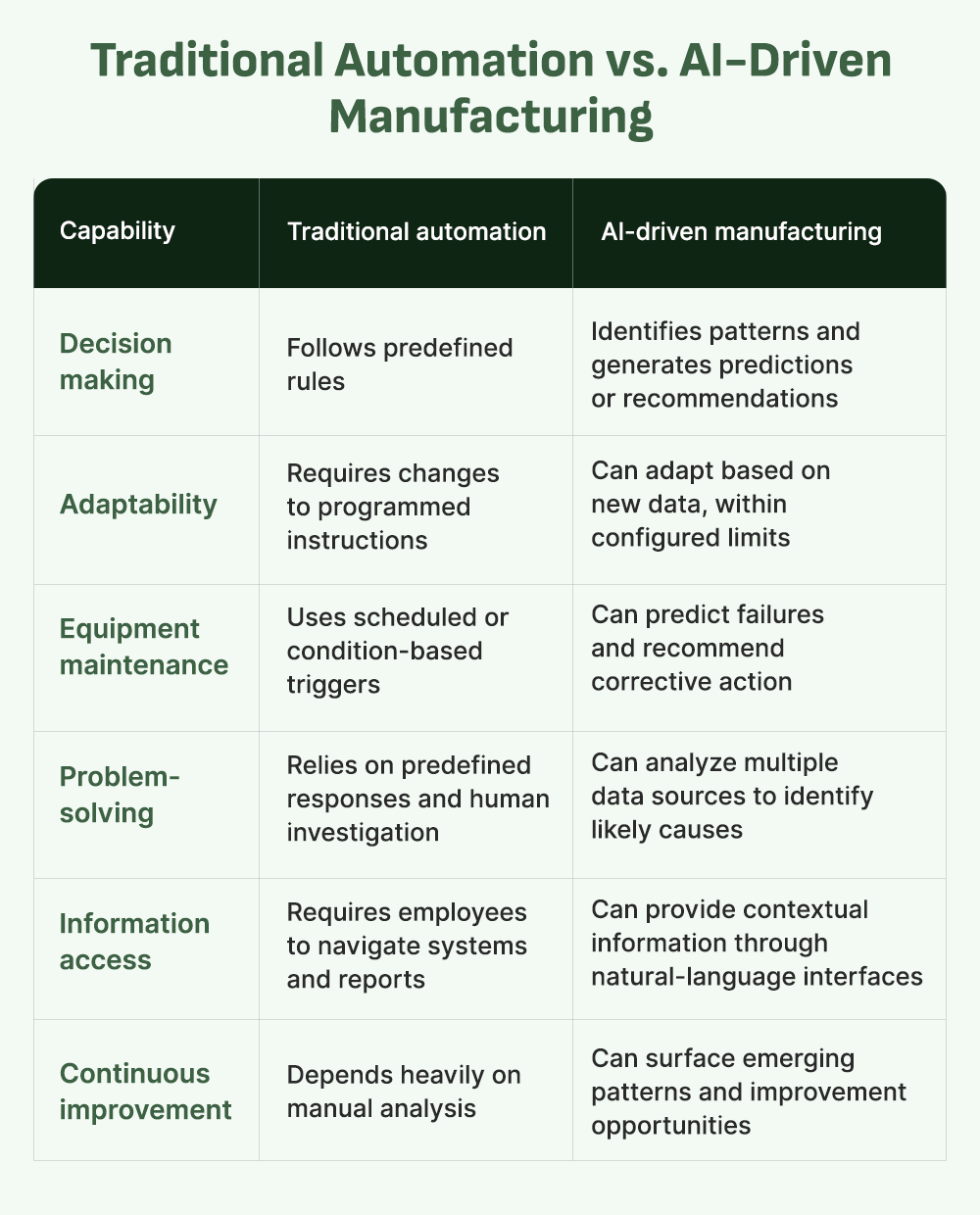
For example, traditional automation might stop a machine when a sensor detects excessive vibration. AI could analyze vibration patterns alongside maintenance history and operating conditions to identify an emerging problem before it causes a shutdown. It could then connect that insight to maintenance execution so the appropriate employee can investigate and resolve the issue.
Here’s why the distinction matters: Automation performs tasks according to established instructions, while AI can help manufacturers determine what actions are needed and when. This capability supports a system of action that can adapt to changes in real time while guiding teams on what to do next.
Key applications and benefits of AI in manufacturing
AI supports a wide range of manufacturing activities, from equipment maintenance and production optimization to quality assurance and workforce development. The most valuable applications address specific operational challenges and integrate into the processes manufacturers already use.
1. Predictive maintenance
Unplanned equipment downtime can disrupt production schedules, increase maintenance costs, and reduce manufacturing capacity.
Predictive maintenance uses AI to analyze equipment data and identify conditions that may indicate an impending failure. Depending on the application, AI models can evaluate vibration, temperature, operating hours, historical failures, and other performance indicators to estimate equipment health and identify emerging problems.
Benefits include:
- Fewer unexpected equipment failures
- Reduced emergency maintenance
- Better planning of maintenance activities
- Longer equipment life
- Improved asset availability
However, predicting a failure is only part of the process. Manufacturers must also ensure that maintenance teams can act on the information. That means connecting predictions with relevant work orders, equipment histories, troubleshooting resources, and employee workflows. An effective AI-enabled maintenance strategy connects early warnings with timely corrective action.
2. Downtime root-cause analysis
Equipment failures and production disruptions often involve multiple contributing factors. Identifying the underlying cause can require maintenance and production teams to review work orders, operator notes, equipment histories, and performance reports.
AI can accelerate this process by analyzing large volumes of operational data and identifying recurring patterns. For example, AI might identify that a particular production line experiences similar failures after certain changeovers or operating conditions. Rather than manually reviewing months of records, employees can use AI-generated insights to narrow their investigation and determine which factors deserve attention.
AI-assisted root-cause analysis can help manufacturers:
- Reduce time spent investigating recurring problems
- Identify relationships between equipment failures and operating conditions
- Improve collaboration between maintenance and production
- Prevent repeated disruptions
- Support more effective continuous improvement initiatives
The best AI platforms can recommend these corrective actions that address the underlying problem.
3. Production and process optimization
Manufacturing performance depends on the effective coordination of equipment, employees, materials, and production schedules.
AI can analyze operational data to identify inefficiencies, bottlenecks, and opportunities to improve throughput. This can include identifying recurring sources of minor stoppages, evaluating cycle-time variation, detecting performance trends across shifts, and helping teams prioritize improvement activities.
For example, a manufacturer might use AI to identify recurring production losses associated with specific equipment or product changeovers. This capability frees operations leaders to focus improvement efforts on the issues with the greatest potential impact.
Combined with accurate production data and effective execution processes, AI can help manufacturers improve overall equipment effectiveness (OEE), increase output, and better use existing capacity.
4. Generative AI for frontline manufacturing workers
One of the most promising applications of AI in manufacturing is making operational information easier for frontline employees to access and use. Manufacturing employees frequently need information from equipment manuals, maintenance histories, standard operating procedures, production records, and experienced colleagues.
But finding the right information can be difficult when it’s scattered across multiple systems or stored in documents that are not easily searchable.
Generative AI can help employees retrieve and interpret relevant information using natural-language questions. For example, a maintenance technician might ask:
“What caused this machine to stop the last three times, and how was it repaired?” An AI assistant connected to relevant operational data could summarize previous incidents, identify recurring patterns, and surface documented repair procedures.
Other applications of generative AI in manufacturing include:
- Summarizing equipment and production histories
- Helping employees troubleshoot common problems
- Retrieving work instructions and maintenance procedures
- Explaining operational trends in plain language
- Supporting onboarding and employee training
- Capturing and sharing institutional knowledge
These capabilities can be particularly valuable as experienced manufacturing employees retire and organizations struggle to preserve critical operational knowledge. Generative AI should support employees' expertise rather than replace their judgment: recommendations must be grounded in reliable information and subject to appropriate safeguards and human oversight.
5. AI-assisted troubleshooting and decision-making
Manufacturers collect troves of operational data, but teams still spend significant time interpreting that information and determining what to do next. AI can help bridge the gap between identifying a problem and resolving it.
For instance, a production line may experience repeated short stops. A conventional reporting system might show when the stops occurred and how much production time was lost. However, an AI-enabled system could go further by analyzing the events, identifying possible causes, summarizing relevant maintenance history, and recommending investigative or corrective steps. From there, teams can then evaluate the recommendations and take appropriate action.
This approach is especially valuable when AI capabilities are integrated with manufacturing execution, maintenance management, and other operational systems. Instead of introducing another dashboard, AI becomes part of the workflow employees use to manage daily operations.
6. AI-powered quality control
AI-powered computer vision systems can analyze images and video to identify defects, verify product characteristics, and detect inconsistencies during production. For example, a manufacturer might use computer vision to inspect products for surface imperfections, missing components, or assembly errors.
AI can also analyze quality and process data to identify conditions associated with higher scrap or rework rates. This enables earlier defect detection, more consistent inspections, less scrap, and higher product quality.
While computer vision requires specialized imaging technology, broader manufacturing operations platforms can help organizations connect quality findings with production records and corrective workflows.
7. Robotics, digital twins, and supply chain planning
Other AI applications extend beyond day-to-day shop floor decision-making.
- Robotics and collaborative robots: AI can help robotic systems recognize objects, adapt to changing conditions, and perform certain tasks with more flexibility.
- Digital twins: Virtual representations of equipment, production lines, or facilities can use operational data to simulate conditions, evaluate changes, and support performance optimization.
- Supply chain and demand planning: AI can analyze historical demand, inventory levels, and external factors to improve forecasts and support production planning.
These technologies address different parts of manufacturing operations, but they share a common requirement: access to reliable information and the ability to translate that information into useful decisions.
Why manufacturers struggle to realize AI’s full potential
Despite AI's potential, implementing it successfully remains challenging.
Many manufacturers have invested in digital technologies without achieving the operational improvements they expected. The obstacles often have less to do with AI algorithms themselves and more to do with the manufacturing environment in which those algorithms operate.
Fragmented data and disconnected systems
Manufacturing information frequently resides in separate systems, including enterprise resource planning (ERP), manufacturing execution systems (MES), computerized maintenance management systems (CMMS), and production equipment.
When these systems are disconnected, AI applications may lack the context needed to generate accurate, actionable recommendations. For example, equipment sensor data might indicate an abnormal operating condition, but maintenance records could contain the information needed to understand its likely cause. Connecting these sources helps create a more complete view of manufacturing operations.
Data quality and availability
AI depends on accurate, relevant information. Incomplete maintenance histories, inconsistent downtime codes, missing production records, and poorly structured data can limit the effectiveness of AI applications.
Manufacturers do not necessarily need perfect data before beginning an AI initiative. However, they do need sufficient data quality for the intended use case, along with processes for maintaining and improving that quality.
Legacy technology and integration challenges
Many manufacturing facilities rely on equipment and systems installed over several decades.
Connecting these technologies to modern AI applications can require additional integration work, particularly when equipment uses proprietary communication protocols or lacks modern connectivity.
Organizations should assess integration requirements early and prioritize approaches that build on existing infrastructure where practical.
Cybersecurity and operational risk
Connecting additional systems and introducing AI into manufacturing workflows creates new security and governance considerations. It’s crucial to protect sensitive operational information, control system access, and establish appropriate oversight for AI-generated recommendations.
Applications that influence equipment or production processes require particular care, including validation, authorization, and guardrails against unsafe actions.
Workforce adoption and trust
Even technically successful AI initiatives can fall short when employees do not understand or trust the technology. Manufacturers should involve frontline teams in identifying use cases, validating recommendations, and designing workflows. Employees need to understand what an AI system can do, where its limitations are, and when human judgment is required.
The gap between insights and action
One of the most overlooked barriers to AI value is the disconnect between generating insights and executing improvements.
An AI system might accurately identify a recurring production problem. But if that insight remains buried in a dashboard, someone still needs to interpret it, coordinate a response, and ensure the problem is resolved.
This creates a critical distinction between AI that informs manufacturing decisions and AI that helps employees act on those decisions. To realize measurable value, manufacturers need to connect AI insights with operational workflows, employee responsibilities, and corrective actions.
How to implement AI in manufacturing operations
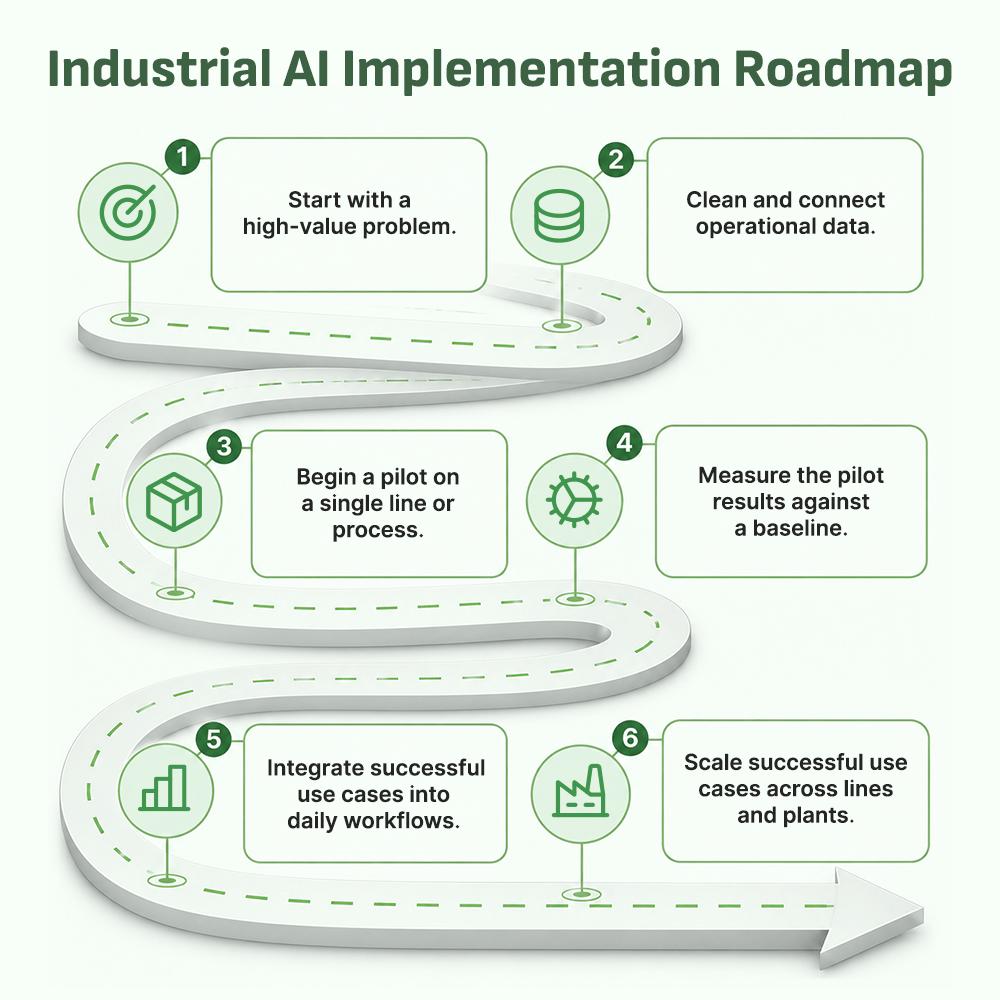
Successful AI implementation begins with a clearly defined operational problem, not a technology purchase. Manufacturers should focus on use cases that offer measurable value, can be supported by available data, and fit within existing operational processes.
Step 1: Identify a high-value operational problem
Start by identifying a recurring issue that affects performance. Examples include:
- Excessive unplanned downtime
- Repeated equipment failures
- Prolonged troubleshooting
- High scrap rates
- Inconsistent production output
Prioritize problems based on their business impact, the availability of relevant data, and the feasibility of implementing a solution. A narrowly defined problem provides a clearer foundation for measuring success than a broad objective such as “implement AI across the factory.”
Step 2: Assess data and system readiness
Identify which systems contain the information needed to address the problem. Depending on the use case, this may include equipment data, maintenance records, production histories, operator observations, or quality information.
Evaluate data quality, accessibility, integration requirements, and security considerations.
Where possible, build on the systems and information already available rather than introducing unnecessary complexity.
Step 3: Start with a focused pilot
Begin a pilot with a manageable application, like improving troubleshooting on one production line or analyzing recurring downtime on a critical asset. Then, establish a baseline before deployment and define what success looks like. The pilot should test whether the AI produces useful information and, more importantly, if employees can use that information effectively in their daily work.
Step 4: Measure operational results
Evaluate performance against the baseline using relevant operational metrics. For example, a troubleshooting application might be measured by reductions in investigation time or MTTR, while a production optimization initiative might focus on OEE or throughput.
Consider the full costs of implementation, including integration, training, maintenance, and ongoing oversight.
A successful pilot should demonstrate a credible connection between the AI application and measurable business improvements.
Step 5: Integrate AI into daily workflows
Avoid treating AI as a standalone analytical tool. Instead, determine how employees will receive recommendations, evaluate information, initiate actions, and document results. Integrating AI with maintenance management, production execution, and other operational workflows can reduce friction between identifying a problem and resolving it.
Step 6: Scale across lines and facilities
Once an application demonstrates measurable value, evaluate whether it can be expanded to other equipment, production lines, or facilities.
Scaling requires more than replicating the technology. Manufacturers must account for differences in equipment, data quality, operating procedures, employee skills, and local conditions.
Establishing common performance metrics, governance standards, and improvement processes can help organizations scale successful applications more consistently.
Frequenlty asked questions about using AI in manufacturing
What is an example of AI in manufacturing?
One example is AI-assisted equipment troubleshooting. An AI system can analyze equipment histories, production events, and previous maintenance records to identify likely causes of recurring downtime and recommend investigative steps. Maintenance employees can use those recommendations to resolve problems faster.
What is the difference between AI and automation in manufacturing?
Traditional automation performs tasks according to predefined rules or programmed instructions. AI uses data-driven techniques to recognize patterns, make predictions, generate information, or recommend actions. The two technologies can work together to support more intelligent manufacturing processes.
What are the biggest benefits of AI in manufacturing?
Potential benefits include reduced downtime, increased throughput, improved product quality, lower operating costs, faster problem resolution, and greater workforce productivity. Actual results depend on the application, data quality, implementation, and operational environment.
How is generative AI used in manufacturing?
Generative AI in manufacturing can help employees retrieve technical information, summarize production events, troubleshoot equipment, access work instructions, and analyze operational records using natural-language questions. Its usefulness increases when connected to relevant, reliable manufacturing data.
What is predictive maintenance in manufacturing?
Predictive maintenance uses equipment and operational data to identify patterns associated with potential failures. This helps maintenance teams investigate emerging issues and plan corrective work before unexpected breakdowns occur.
Can small manufacturers use AI?
Yes. Manufacturers do not need enterprise-wide AI programs to begin. A focused application that addresses a measurable operational problem can provide a practical starting point, provided the organization has appropriate data, resources, and implementation support.
Does AI require a fully automated smart factory?
No. Manufacturers can begin with targeted applications using data from existing production, maintenance, or quality systems. The level of integration and data readiness required depends on the specific use case.
What are the biggest challenges of implementing AI in manufacturing?
Common challenges include fragmented operational data, inconsistent data quality, legacy-system integration, cybersecurity, employee adoption, and difficulty connecting AI-generated insights to operational workflows.
How can manufacturers measure AI ROI?
Manufacturers should establish baseline performance metrics and compare them with results after implementation. Depending on the application, relevant measures may include downtime, MTTR, OEE, scrap, throughput, labor productivity, and maintenance costs. ROI calculations should account for implementation and ongoing operating expenses.
Will AI replace manufacturing workers?
AI may automate certain tasks and change job responsibilities, but many manufacturing applications are designed to augment employees rather than replace them. AI can help workers access knowledge, make informed decisions, and resolve problems more efficiently, while human expertise remains essential for oversight and complex operational decisions.
Turn AI insights into operational results with L2L
AI can help manufacturers uncover opportunities to improve performance. Realizing those opportunities requires connecting intelligence with the people and processes responsible for daily operations.
L2L's Connected Manufacturing Operations Platform unifies manufacturing operations and helps frontline teams access the information they need to identify problems, coordinate work, and improve performance. L2L Execution AI extends these capabilities by helping manufacturing employees turn operational information into actionable guidance within their workflows.
Explore L2L Execution AI to learn how connected manufacturing operations can help your teams move from insights to action.

"What makes L2L so unique is the fact that the product was developed by real manufacturing users. People that truly understand the day-to-day issues and concerns that drive the production floor."