


.svg)
 Shop floor execution
 Maintenance
 Production
 Skills
.png?width=60&height=60&name=chart-line-up%20(1).png) Manufacturing Intelligence
Manufacturing Intelligence
 Automotive
 Building materials
 Packaging
 CMMS/EAM
 MES
MES
 Connected Worker
 Manufacturing Intelligence
 Case studies
 Blog
Blog
 Ebooks & Guides
 Webinars
 Events
.svg) OEE Calculator
OEE Calculator
 Downtime Cost Calculator
 About Us
 Partners
 Newsroom
 Support
 Careers
 Trust center


.svg)

What is lean manufacturing?
Lean manufacturing is a systematic operational methodology focused on the continuous elimination of waste (muda) within a production system while maximizing value for the customer. By identifying and removing non-value-added activities, manufacturers optimize process flow, improve product quality, and significantly lower operational costs.
At its core, lean isn't merely a set of cost-cutting measures or a collection of isolated shop-floor tools. It's an enterprise-wide philosophy that aligns people, processes, and technology to deliver maximum customer value using the fewest possible resources. In a lean facility, value is strictly defined from the customer's perspective: if an activity doesn't transform raw materials into a finished good in a way the end customer is willing to pay for, it's considered waste.
A brief history of lean (the Toyota Production System)
The roots of modern lean manufacturing trace back to mid-20th-century Japan, specifically within the facilities of the Toyota Motor Corporation. Faced with post-World War II material shortages, capital constraints, and a smaller domestic market, Toyota leaders Industrial Engineer Taiichi Ohno and Executive Eiji Toyoda recognized that traditional American mass production models—pioneered by Henry Ford—were too capital-intensive and wasteful.
Instead of producing massive batches of standardized components to maximize machine utilization, Ohno developed the Toyota Production System (TPS). TPS prioritized small-batch production, rapid tool changeovers, strict quality control at the source, and a "pull" system driven directly by customer demand. The methodology gained widespread global adoption in 1990 following the publication of The Machine That Changed the World by James P. Womack, Daniel T. Jones, and Daniel Roos, which codified TPS into the universal framework known today as lean manufacturing.
The 8 wastes of lean
In lean methodology, waste is categorized as any activity that consumes time, labor, or materials without adding direct value to the end product. The canonical DOWNTIME acronym outlines these eight operational wastes on the shop floor:
.png?width=1200&height=628&name=The%208%20Wastes%20(DOWNTIME).png)
1. Defects
Defects occur when a product or component fails to meet established quality specifications, requiring rework, repair, or complete scrapping. Beyond the direct material loss, defects consume valuable line capacity, inflate labor costs, and disrupt production schedules.
2. Overproduction
Overproduction is the practice of manufacturing items before they're needed or in quantities exceeding actual customer demand. Lean practitioners consider overproduction the most critical waste because it masks all other operational inefficiencies, forcing facilities to store, move, and manage excess inventory.
3. Waiting
Waiting represents idle time for workers, equipment, or materials. It occurs when operators are forced to wait for upstream parts, maintenance dispatches, material replenishment, or administrative sign-offs. Waiting directly reduces Overall Equipment Effectiveness (OEE) and throughput.
4. Non-utilized talent
This human waste occurs when an organization fails to engage the problem-solving abilities, insights, and continuous improvement ideas of its frontline workforce. When operators are treated as passive laborers rather than active problem solvers, plants lose crucial domain knowledge.
5. Transportation
Transportation is the unnecessary physical movement of raw materials, work-in-progress (WIP) parts, or finished goods between process steps, lines, or facilities. Material handling adds material handling risk and labor cost without enhancing product quality.
6. Inventory
Excess inventory consists of unused raw materials, accumulated WIP stock, and unsold finished goods sitting in warehouses. Holding excess inventory ties up working capital, increases carrying costs (often adding up to 20% of the part's value annually), and risks component damage or obsolescence.
7. Motion
Unlike transportation, which focuses on materials, motion refers to the excess physical movement of equipment or personnel. Operators walking across a plant floor to locate tools, chase down maintenance supervisors, or fetch paper SOPs represent pure waste that causes fatigue and productivity loss.
8. Extra-processing
Extra-processing occurs when teams perform more work, use higher-precision equipment, or include more features than the customer explicitly required or requested. It stems from poorly defined engineering tolerances, outdated standard operating procedures, or over-engineering.
The 5 principles of lean manufacturing
To operationalize waste elimination, lean leaders rely on five fundamental management principles established by Womack and Jones. These steps provide a structured methodology for transforming chaotic shop-floor workflows into streamlined, value-driven operations.
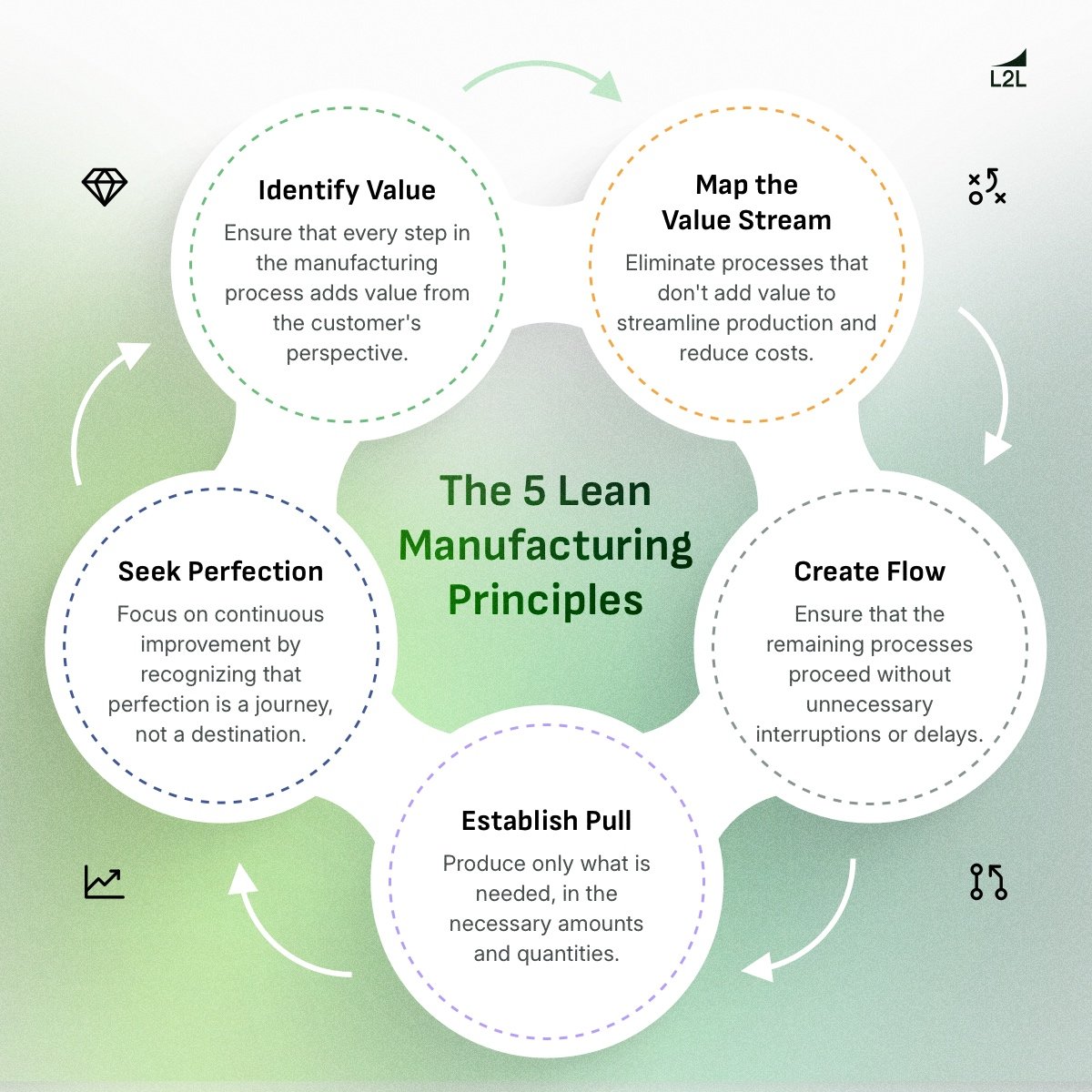
1. Identify value
Value can only be defined by the ultimate end customer. A manufacturer must determine what specific features, tolerances, delivery windows, and price points the customer expects. Any manufacturing step that doesn't directly contribute to satisfying those requirements is flagged as a potential target for elimination.
2. Map the value stream
Once value is established, engineers must map the complete value stream—the entire sequence of activities required to bring a product from raw material design to delivery. Mapping the value stream uncovers hidden bottlenecks, redundant handoffs, and unnecessary processing buffers across the facility.
3. Create flow
After non-value-added steps are stripped from the value stream, the remaining production steps must be arranged to run smoothly without interruptions, batch delays, or queue times. Achieving one-piece flow ensures that work items move continuously from raw processing to assembly without idling in WIP storage buffers.
4. Establish pull
In a lean pull system, production is driven entirely by downstream customer demand rather than upstream manufacturing forecasts. Work is only initiated when an end customer places an order—or when a downstream work cell signals a consumption event—eliminating the need for speculative inventory build-up.
5. Pursue perfection
Lean isn't a fixed target with a final completion date; it's an ongoing operational culture. Pursuing perfection requires continuously analyzing performance data, empowering frontline workers to eliminate newly exposed waste, and refining standard work procedures through repetitive improvement cycles.
Core lean manufacturing tools
Executing lean principles on the shop floor requires a practical toolkit. These established lean manufacturing tools provide standardized methods for identifying waste, stabilizing machinery, and aligning frontline communication.
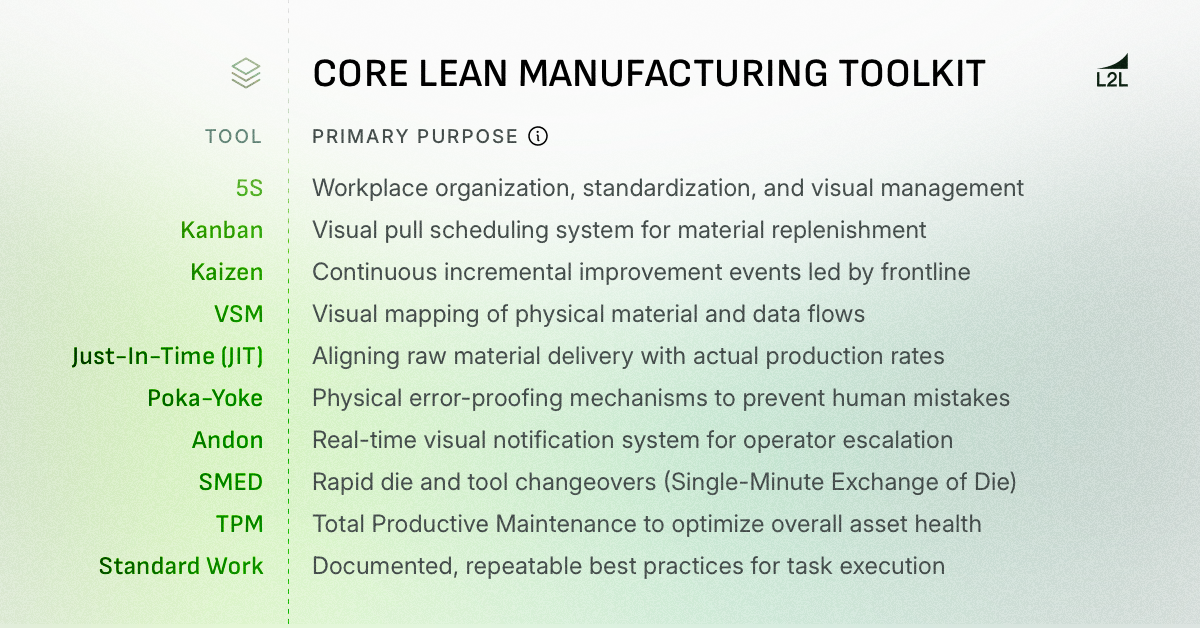
- 5S (Sort, Set in Order, Shine, Standardize, Sustain): A physical and visual organization system designed to maintain clean, efficient, and standardized work environments where tools and materials are always in their designated locations.
- Kanban: A visual signal system—traditionally utilizing physical cards or digital bins—that controls production flow and triggers JIT material replenishment based on real-time consumption.
- Kaizen: A continuous improvement philosophy centered on small, incremental, and frontline-led changes that cumulatively yield massive operational efficiency gains over time.
- Value Stream Mapping (VSM): An engineering diagnostic tool used to visually chart the flow of materials and information required to bring a product from supplier to customer.
- Just-In-Time (JIT): An inventory management strategy that synchronizes material deliveries directly with assembly schedules, ensuring parts arrive only as they're needed on the line.
- Poka-Yoke: Physical or digital error-proofing mechanisms built directly into assembly steps to prevent human mistakes from becoming quality defects.
- Andon: A visual signaling notification system on the production floor that alerts operators, supervisors, and maintenance technicians to anomalies or quality issues immediately.
- SMED (Single-Minute Exchange of Die): A methodology for drastically reducing machine setup and changeover times down to single digits (under 10 minutes), boosting production flexibility.
- Total Productive Maintenance (TPM): A holistic approach to equipment maintenance that engages machine operators in daily care, cleaning, and routine checks to maximize asset reliability.
- Standard Work: The documented, agreed-upon baseline of best practices that defines the most efficient sequence, timing, and methodology for performing a production task.
Lean manufacturing examples
Analyzing real-world applications highlights how lean principles adapt across different industries, plant scales, and technical architectures.
Example 1: The Toyota Production System (TPS)
Toyota remains the ultimate benchmark for traditional lean implementation. On Toyota assembly lines, every worker is empowered to pull an Andon cord to pause the line the moment a quality defect or safety abnormality is identified. Rather than penalizing line stops, Toyota leadership treats every pause as an opportunity for continuous improvement. By integrating JIT material staging, rapid tooling changeovers, and root-cause analysis (the 5 Whys), Toyota maintains lower inventory holding costs and higher reliability metrics than traditional mass-production automotive competitors.
Example 2: Enterprise Multi-Site Lean Standardization (Sonoco)
Global packaging manufacturer Sonoco illustrates how enterprise organizations modernize lean across complex multi-site networks. Historically, individual plants tracked equipment downtime, maintenance tasks, and safety observations using paper logbooks and physical downtime boards. This manual process hid critical failure trends from leadership and made cross-plant benchmarking impossible.
By deploying a standardized digital operational framework across 12 facilities, Sonoco eliminated handwritten downtime notes and integrated real-time machine sensor data directly into automated technician dispatches. At their Columbus, Ohio facility, root-cause data revealed that dirty exhaust fan blades on curing ovens were generating micro-vibrations that dropped dirt onto lacquered products, creating scrap. By installing vibration sensors tied directly to automated maintenance dispatches, the plant moved to a predictive model—preventing product scrap and saving over $325,000 while improving overall line stability.
How to implement lean manufacturing
Successfully implementing lean requires a structured, phased roadmap. Attempting to deploy every tool simultaneously leads to initiative fatigue and resistance from frontline operators. Follow this 5-step operational framework:
Step 1: Map the value stream and establish a trusted baseline
Begin by documenting your physical material and information flows as they currently operate. Avoid mapping what should happen; capture what actually happens on the floor. Establish baseline metrics for cycle times, changeover windows, scrap rates, and Overall Equipment Effectiveness (OEE).
Step 2: Target the single largest waste category (Pareto focus)
Avoid trying to fix every inefficiency at once. Apply the Pareto principle (the 80/20 rule) to identify the single largest source of shop-floor waste—whether it's long changeover times, chronic minor machine stops, or excessive waiting for maintenance dispatches. Focus your initial continuous improvement resources exclusively on stabilizing this bottleneck.
Step 3: Standardize optimal workflows
Once an efficient process solution is identified through frontline trial and error, lock in the gains immediately by updating your Standard Work documents. Replace outdated paper manuals with interactive digital work instructions to ensure every operator on every shift executes the task according to the established gold standard.
Step 4: Make waste visible in real time
Transition your shop-floor communication away from paper clipboards, end-of-shift spreadsheets, and whiteboards. Implement visual management tools that give operators, maintenance technicians, and plant managers instant, real-time visibility into production targets, machine states, and line abnormalities as they happen.
Step 5: Establish daily management cadences to sustain gains
Build a disciplined operational review structure—such as daily tier meetings and weekly Kaizen reviews. Use live, objective floor data rather than subjective opinions to evaluate performance, assign corrective actions, and verify that past process improvements are holding firm.
Why lean initiatives fail & how to sustain them
Industry studies indicate that over 70% of traditional lean transformation projects fail to achieve or sustain their intended ROI. Understanding the common structural failure modes allows leadership teams to build defensive strategies:
- Tool-chasing without cultural alignment: Treating lean as a checklist of tools (e.g., executing a 5S audit just to check a box) rather than an operational culture focused on frontline empowerment guarantees short-lived results.
- Lack of daily management governance: Without structured daily tier meetings and real-time accountability, plant floor habits quickly revert to old, reactive firefighting routines once consultants or continuous improvement engineers leave the area.
- Failing to standardize process improvements: If a Kaizen event discovers a faster changeover method or a superior repair technique, but that fix isn't immediately documented into standardized digital workflows, the operational gain leaves the building when the shift ends.
- Keeping operational waste invisible on paper: Relying on paper clipboards or end-of-shift transcription creates a massive data lag. When waste metrics are reviewed 24 hours after the event, the opportunity to make mid-process corrections has already passed.
- Leadership isolation from shop-floor realities: When C-suite and plant leadership make capital allocation or operational strategy decisions without access to transparent, objective shop-floor execution data, corporate targets clash directly with daily plant capabilities.
Modern lean: Digitizing continuous improvement
The fundamental goals of lean manufacturing haven't changed since Taiichi Ohno designed the Toyota Production System, but the operational landscape has evolved dramatically. Modern manufacturing facilities are no longer constrained by physical whiteboards, paper standard operating procedures, or manual stopwatch audits.
In a high-complexity industrial environment, analog lean decays rapidly. Paper checklists get "pencil-whipped," downtime reason codes transcribed into spreadsheets hours after a shift ends are notoriously inaccurate, and critical tribal knowledge walks out the door as veteran workers retire.
This is where a Connected Manufacturing Operations Platform fundamentally modernizes continuous improvement. Rather than acting as another passive system of record that merely reports on yesterday's failures, a modern operational platform acts as a live, automated system of action:
- Real-Time Abnormality Capture: The moment an asset experiences a speed loss, quality defect, or line stop, the platform detects the anomaly instantly, eliminating the communication lag inherent in walkie-talkies or physical Andon boards.
- Automated Smart Dispatching: Rather than leaving problem resolution to chance, the platform uses intelligent routing logic to automatically dispatch the nearest qualified technician, supplying them with exact machine failure histories and required replacement parts.
- Digital Standard Work: Static paper manuals are replaced by interactive, tablet-based work instructions that require mandatory validation steps, ensuring every worker on every shift adheres to current standard operating procedures.
- Democratized Frontline Knowledge: Frontline operators can capture repair video snippets, document tribal knowledge, and trigger Kaizen improvement tickets directly from mobile interfaces on the floor.
- Connected Tech Stack: By serving as the operational connective tissue between enterprise planning software (ERP) and shop-floor hardware, a connected operations platform ensures that maintenance logs, quality metrics, and production counts share one synchronized source of truth.
By digitizing waste identification and closing the loop between a shop floor issue and its ultimate resolution, modern platforms ensure that lean initiatives don't plateau at a 60% OEE baseline, but continuously scale across global manufacturing footprints.
Frequently asked questions about lean manufacturing
What is lean manufacturing?
Lean manufacturing is an operational methodology focused on systematically identifying and eliminating non-value-added activities (muda) across production workflows. Originating from the Toyota Production System, lean optimizes process flow, improves product quality, and lowers operating costs by delivering maximum customer value using the minimum necessary resources.
What are the 5 principles of lean manufacturing?
The five core principles of lean manufacturing are: (1) Identify Value from the customer's perspective, (2) Map the Value Stream to reveal operational waste, (3) Create Flow to keep production moving smoothly, (4) Establish Pull driven by actual demand, and (5) Pursue Perfection through continuous frontline improvement.
What are the 8 wastes of lean?
The eight wastes of lean are summarized by the DOWNTIME acronym: Defects, Overproduction, Waiting, Non-utilized talent, Transportation, Inventory, Motion, and Extra-processing. Eliminating these non-value-added activities increases operational throughput and reduces manufacturing costs.
What's the difference between lean and Six Sigma?
Lean focuses primarily on waste elimination, lead time reduction, and improving workflow velocity. Six Sigma focuses on reducing process variation, eliminating defects, and establishing statistical quality control. Modern manufacturing facilities frequently combine both approaches into a unified Lean Six Sigma operational framework.
Which lean tools should I start with?
Most manufacturing teams begin their lean journey with 5S to establish workplace organization and Value Stream Mapping to locate their primary operational bottlenecks. From there, facilities layer in Standard Work, Kanban pull signals, and automated Andon escalation systems to stabilize shop-floor workflows.
Ready to transform static lean tools into real-time frontline action?
Discover how a connected operations platform removes the administrative friction blocking your shop floor's potential.
[See how L2L digitizes continuous improvement for global manufacturers]

"What makes L2L so unique is the fact that the product was developed by real manufacturing users. People that truly understand the day-to-day issues and concerns that drive the production floor."
Looking to replace your Lean Manufacturing software entirely?
Read More About Lean Manufacturing






Their words speak for us.