



.svg)
 Shop floor execution
 Maintenance
 Production
 Skills
.png?width=60&height=60&name=chart-line-up%20(1).png) Manufacturing Intelligence
Manufacturing Intelligence
 Automotive
 Building materials
 Packaging
 CMMS/EAM
 MES
MES
 Connected Worker
 Manufacturing Intelligence
 Case studies
 Blog
Blog
 Ebooks & Guides
 Webinars
 Events
.svg) OEE Calculator
OEE Calculator
 Downtime Cost Calculator
 About Us
 Partners
 Newsroom
 Support
 Careers
 Trust center


.svg)


Unplanned downtime can cost manufacturers hundreds of thousands of dollars per hour. In today’s industry of razor-thin margins and stiff competition, accurately measuring manufacturing efficiency is an operational requirement.
Most plants only discover efficiency losses days after a shift ends, highlighting a systemic issue: true efficiency is not a backward-looking metric calculated at the end of the week, but a live indicator that needs to be tracked in real time. This framework is built for plant managers, operations directors, and continuous improvement leaders who already maintain efficiency dashboards but suspect the current numbers fail to reflect shop floor realities.
What you’ll learn in this article:
- Real-time execution over post-mortems: Efficiency must be calculated continuously within the shift; waiting for next-day reports means ignoring active profit leaks.
- The metric triad: Plants must evaluate overall equipment effectiveness (OEE), throughput, and first pass yield together instead of relying on a single KPI.
- Actionable data deployment: Measurement only delivers an operational return when clean data lands directly in front of frontline operators within minutes of an event.
What is manufacturing efficiency?
Measuring manufacturing efficiency requires a clear, standard mathematical baseline. Manufacturing efficiency is the operational ratio that evaluates how well a plant converts inputs into finished goods against an established baseline.
Here’s how to calculate it:
Manufacturing efficiency = (actual output / standard output) × 100
Industrial operations frequently confuse efficiency with other core performance terms. To maintain data integrity, leadership must distinguish between three distinct concepts:
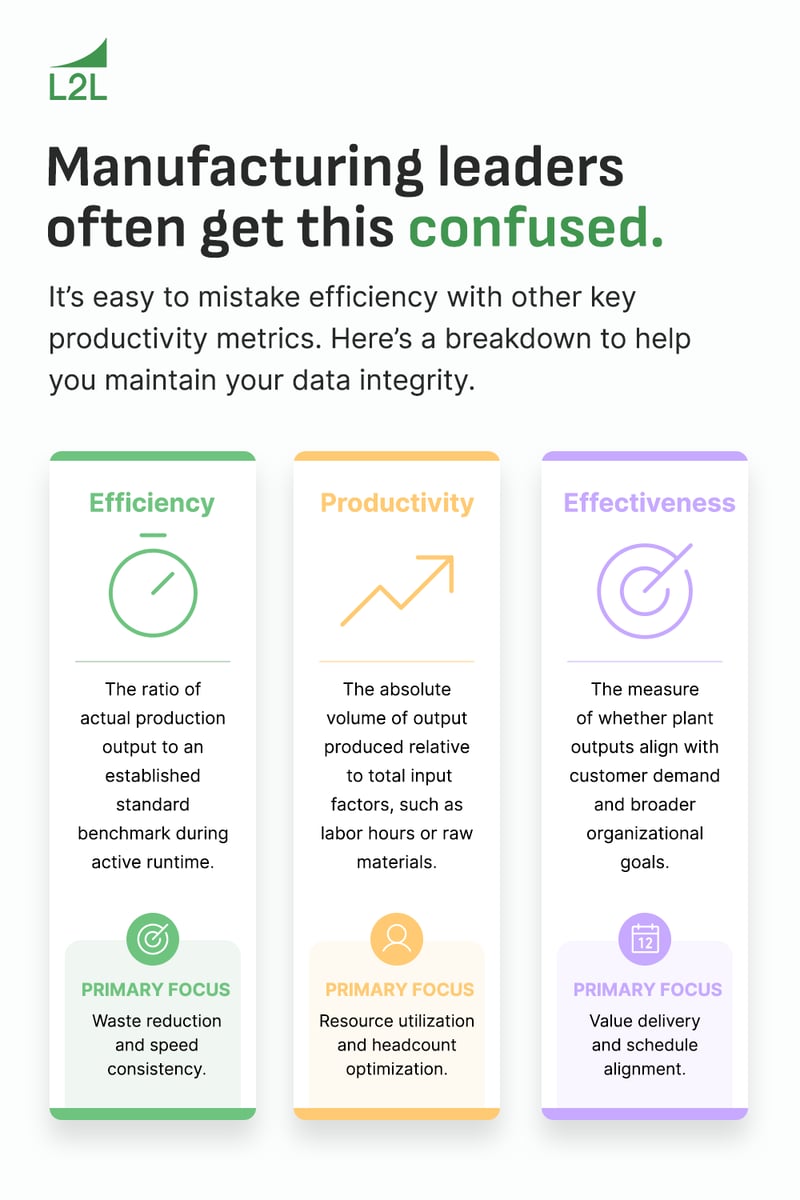
When establishing the standard output for these calculations, teams need to use realistic historical plant performance data rather than original equipment manufacturer nameplate specifications. Nameplate specifications represent an idealized environment that almost always fails to account for real-world variables, leading to skewed efficiency targets.
The financial cost of improper efficiency measurement
When production facilities track performance data incorrectly, they introduce three distinct operational blind spots that actively drain profitability:
End-of-shift measurement lags: Compiling performance metrics only at the conclusion of a shift ensures that minor mechanical or process deviations run unchecked for hours before supervisors can intervene.
Micro-stoppages: Relying on highly aggregated hourly logs obscures small stops. A machine that experiences a 90-second stoppage twelve times during a shift looks like it achieved 100% utilization in a lagging shift report, yet it has leaked substantial capacity.
Outdated cycle-time standards: Failing to update the baseline cycle-time inputs within tracking systems after a tool, material, or process modification distorts calculation accuracy completely.
The gap between perceived performance and actual shop floor reality is wider than most leaders recognize. Industry data indicates that the average machine utilization in mid-market discrete manufacturing hovers around 28%. Most manufacturing teams routinely overestimate their own utilization rates simply because their measurement tools fail to capture hidden losses.

The 6 KPIs that actually measure manufacturing efficiency
1. Overall Equipment Effectiveness (OEE)
OEE functions as a comprehensive metric calculated by multiplying Availability, Performance, and Quality together.
While a world-class OEE benchmark sits at 85%, most discrete manufacturing plants operate between 40% and 60%. OEE indicates total asset health, but the raw score alone hides specific operational failures. A plant can maintain a high quality rate while masking a severe availability issue, which is why teams must always display and analyze the three components separately.
2. Throughput
Throughput measures the total number of acceptable units produced by a specific line or process per unit of time, such as hourly counts or units per shift. It indicates the absolute speed of production execution. However, throughput is the easiest KPI to game. Operators can run machinery at unsafe speeds while generating high defect rates, which is why throughput must always be paired with quality metrics.
3. First Pass Yield (FPY)
FPY represents the percentage of units that successfully pass quality inspections on the first attempt without requiring offline rework, scrap disposal, or manual sorting. It reveals the true stability of a manufacturing process. FPY does not, however, indicate whether a machine is running at the correct speed or if the asset suffers from frequent mechanical breakdowns.
4. Mean Time Between Failures (MTBF)
MTBF is calculated by dividing the total active operating time of an asset by the total number of unplanned mechanical breakdowns during that identical period. It serves as a direct indicator of asset reliability and preventive maintenance effectiveness. It does not provide any insight into how long a machine remains offline once a failure occurs.
5. Mean Time To Repair (MTTR)
MTTR represents the average duration required for a maintenance team to troubleshoot, repair, and restart a piece of equipment after an unplanned stop. It evaluates the efficiency of the maintenance dispatch and repair workflow. MTTR drops rapidly when technicians receive automated dispatches on mobile devices instead of relying on paper work orders, but it does not track how frequently the asset fails.
6. Schedule attainment
Schedule attainment, often paired with on-time-in-full delivery metrics, tracks the percentage of time that a production line fulfills the exact product mix and volume promised within a scheduled timeframe. It acts as the primary customer-facing efficiency metric.
Schedule attainment can appear excellent even when internal OEE tanks. This is because plants often mask low internal efficiency by burning excessive overtime or incurring high scrap costs to meet shipping deadlines.
How to calculate manufacturing efficiency: an example by the numbers
To understand how these variables interact during a standard production window, consider a single shift on a single asset:
- Planned Production Time: 480 minutes
- Unplanned Downtime: 60 minutes (Machine ran for 420 minutes)
- Total Units Produced: 4,200 units
- Quality Defects: 180 units
- Theoretical Maximum Output: 6,000 units over 480 minutes (Ideal cycle time of 12.5 units per minute)
To determine the true OEE of this shift, the calculations must be executed step by step:
- Availability: 420 minutes / 480 minutes = 0.875
- This gives us an availability of 87.5%
- Performance: 4,200 units / 5,250 units = 0.80
- This means a performance of 80%
- Quality: 4,020 units / 4,200 units = 0.9571
- That leaves quality at 95.7%
Multiplying these three percentages together (0.875 x 0.80 x 0.957) reveals an OEE of approximately 67%.
This calculation required less than 30 seconds to execute when the datasets were clean and centralized. Conversely, most manufacturing plants require up to 30 hours to compile these identical metrics because the necessary data remains trapped across five separate spreadsheets, paper logs, and disconnected tools.
[CTA OEE Calculator]
Real-world impacts of accurate efficiency measurement
Transitioning from delayed, retrospective reporting to live operational clarity has delivered measurable turnarounds across various manufacturing environments.
ADAC Automotive
ADAC Automotive encountered significant operational blind spots due to isolated packets of data and paper-based tracking methods. After standardizing data collection across more than 200 production lines, stakeholders gained a single source of truth. This transformation allowed the plant to see live metrics clearly, resulting in a 15% increase in OEE and a 62% reduction in major downtime events.
West Liberty Foods
Faced with the challenges of legacy data tracking and fragmented record management, West Liberty Foods migrated to a centralized digital framework. By replacing paper binders and disorganized filing systems with standardized asset records, the company achieved a $2 million reduction in total maintenance costs while driving a 10% increase in overall Operational Availability.
Oetiker
To prevent minor stops from eroding throughput, Oetiker focused on tracking live response and repair metrics across production zones. By moving away from delayed reporting, their maintenance and production teams reduced their Mean Time to Repair (MTTR) by 23%.
The hidden problem: Most plants measure too late
Efficiency measurement only pays an operational dividend when the data loop closes inside the active shift. End-of-shift dashboards function merely as a post-mortem, detailing structural losses that can no longer be avoided or repaired. What value does an efficiency report deliver if it arrives after the financial loss is already permanent?
The average machine utilization baseline of approximately 28% highlights that the performance gap in manufacturing is frequently a measurement gap, not an execution failure. Legacy systems—such as paper checklists, manual logs, and disconnected spreadsheets—report efficiency on a delay measured in hours or days, by which time the shift has concluded and profitability has already been eroded.
How to start measuring efficiency in real time
Transitioning from delayed data to continuous visibility requires a structured roadmap:
- Instrument critical assets first: Do not attempt to track every machine simultaneously; focus exclusively on the top three critical bottleneck assets that dictate line throughput.
- Capture stop reasons, not just durations: A timestamp indicating that a machine stopped for ten minutes is useless without an operator-entered reason code explaining why it stopped.
- Display metrics on the plant floor: Position real-time performance dashboards directly in production cells where operators can see them clearly, rather than hiding them in management offices.
- Link every stoppage to an active workflow: Every significant drop in efficiency must automatically trigger an alert or a work order to ensure immediate root cause analysis.
- Execute cross-functional weekly reviews: Review the collected efficiency datasets weekly with a team comprising production, maintenance, and quality leadership to drive continuous improvement.
Real-time efficiency measurement requires the seamless intersection of production execution data, maintenance metrics, and operator inputs, which is precisely the capability delivered by a modern connected manufacturing operations platform.
How L2L helps measure manufacturing efficiency
L2L functions as a Connected Manufacturing Operations Platform that unifies CMMS, MES, Connected Worker, and Manufacturing Intelligence capabilities within a single intuitive solution.
This means that OEE, MTTR, FPY, and throughput are calculated automatically from the exact same source of truth, eliminating the need to manually stitch together disparate data from disconnected software applications.
By capturing machine states natively and allowing frontline teams to log reason codes directly at the source, L2L converts static records into dynamic workflows. Operations leaders gain immediate visibility into active workloads, shift performance, and hidden micro-stops before they undermine daily profitability. This connected approach ensures that tracking efficiency directly drives floor-level execution.
Frequently asked questions
What is a good manufacturing efficiency rate?
Target rates depend heavily on the specific industry sector; however, discrete manufacturing operations typically target an OEE score of 70% or greater, while a score of 85% represents the world-class benchmark. Most plants currently operate between 40% and 60% due to unmeasured losses.
What is the difference between efficiency and OEE?
Efficiency is a single, isolated ratio comparing actual output against a standard benchmark. OEE is a holistic, diagnostic composite metric that multiplies three distinct operational ratios together: availability, performance, and quality.
How often should you measure manufacturing efficiency?
Efficiency must be tracked continuously in real time on the active production line, monitored hourly at the cell level, reviewed daily at the plant level, and audited weekly during leadership reviews to prevent issues from running unchecked.
What software is used to measure manufacturing efficiency?
Plants traditionally rely on a CMMS to measure maintenance efficiency metrics like MTTR and MTBF, alongside an MES to track production metrics like throughput and FPY. Modern operations increasingly adopt connected manufacturing operations platforms that integrate both domains into a single interface.
Conclusion: Measure what gets fixed in the shift
To reverse declining industrial productivity, manufacturing leaders must recognize that true efficiency is a function of live execution rather than retrospective reporting. Measuring efficiency is only valuable when the resulting data arrives fast enough to alter the outcome of the active shift.
Want to learn more about accurately measuring your operational efficiency? Get in contact with us here.