


.svg)
 Shop floor execution
 Maintenance
 Production
 Skills
.png?width=60&height=60&name=chart-line-up%20(1).png) Manufacturing Intelligence
Manufacturing Intelligence
 Automotive
 Building materials
 Packaging
 CMMS/EAM
 MES
MES
 Connected Worker
 Manufacturing Intelligence
 Case studies
 Blog
Blog
 Ebooks & Guides
 Webinars
 Events
.svg) OEE Calculator
OEE Calculator
 Downtime Cost Calculator
 About Us
 Partners
 Newsroom
 Support
 Careers
 Trust center


.svg)


Manufacturing productivity has seen a steady decline since 2011, largely because plants have added complexity without updating the systems used to manage it. Organizations currently lose approximately $1.4 trillion to downtime annually. To stop this financial leak, companies must move from reactive systems of maintenance to systems that are truly predictive and proactive.
Equipment failure prediction is the next logical step for manufacturers aiming to move beyond the limitations of traditional maintenance schedules. In a modern factory, reactive maintenance focuses on a machine that has already stopped, while preventive maintenance services it on a predetermined calendar or usage interval, whether service is required or not.
Equipment failure prediction offers a more efficient alternative by using data to identify exactly when a machine is nearing a failure state, allowing maintenance teams to intervene at the most opportune moment. We’ll explore how this practice works, its major benefits, where traditional approaches fail, and much more.
What is equipment failure prediction?
Equipment failure prediction is the use of sensor data, historical failure patterns, and analytical or machine learning models to forecast when a piece of equipment is likely to fail before the failure occurs. This allows maintenance to be scheduled proactively based on the actual condition of the asset rather than a generic calendar interval.
While the following terms are often used to describe equipment failure prediction, it’s helpful to distinguish between related concepts:
- Condition Monitoring: The data layer that involves real-time tracking of parameters like heat, vibration, or thermography.
- Predictive Maintenance: The broader organizational strategy of using data to plan and execute repairs.
- Remaining Useful Life (RUL): The specific output of many prediction models, estimating the amount of time an asset can continue to operate before failing.
Why traditional maintenance approaches fall short
Maintenance teams often find themselves trapped in a cycle of chronic reactive firefighting. Traditional approaches struggle to break this cycle for several reasons.
The cost of reactive maintenance
Reactive maintenance, or run-to-failure, appears cheap on a per-event basis because it requires no upfront planning. However, it is usually the most expensive strategy in total. Unplanned downtime in the automotive sector, for example, can cost an average of $38,000 per minute. These failures also lead to excessive overtime, material scrap, and lost production capacity.
The inefficiency of calendar-based PMs
Preventive maintenance based on a calendar or cycle count attempts to solve the downtime problem but introduces new inefficiencies. Organizations often service healthy equipment unnecessarily, which wastes labor hours and spare parts. Furthermore, failures that develop between service intervals—such as those caused by sudden component defects or operator error—remain hidden until the line stops.
Equipment failure prediction sits in the middle of these extremes. It ensures that technicians intervene when a failure is genuinely imminent, leaving healthy equipment alone while preventing the "Code Red" events that disrupt production.

How equipment failure prediction works
Building a predictive capability requires three integrated layers: sensors, models, and a response protocol.
1. Sensor data: the early warning signs
Modern equipment exposes physical signals that indicate deterioration long before a human can detect it. These signals include:
- Vibration Patterns: This is the primary method for catching failures in rotating equipment like motors, pumps, and gearboxes.
- Temperature: Overheating often indicates lubrication issues or electrical resistance.
- Motor Current Draw: Load anomalies can signal that a machine is working harder than usual due to internal friction.
- Acoustic Emissions: Specialized sensors can detect high-frequency sounds associated with cavitation or bearing friction.
- Pressure and Flow: These changes often correlate with seal degradation or filter clogs.
2. Models: from rules to machine learning
The data captured by sensors must be processed through models to become actionable. There are three levels of sophistication in these models:
- Threshold Rules: These are simple and effective. If a vibration reading exceeds a specific value (X), the system triggers an alert.
- Anomaly Detection: This level flags when current behavior deviates significantly from a historical "normal" state, even if specific thresholds have not been crossed yet.
- Machine Learning (ML): Advanced architectures like hybrid CNN-LSTM (Convolutional Neural Network - Long Short-Term Memory) models can predict Remaining Useful Life with high accuracy.
The accuracy of these models depends entirely on the volume and quality of historical data. If a plant has inconsistent maintenance records, advanced models will struggle to provide value.
3. Response protocol: the missing link
A prediction without a defined response is merely an expensive dashboard. A truly predictive operation ensures that every alert automatically triggers a specific sequence:
- A work order is created instantly.
- A technician is assigned based on their specific skills.
- The necessary spare parts are identified and staged.
- An intervention window is agreed upon with production to minimize the impact on the schedule.
Without this "closed-loop" response, predictions are frequently ignored until they become actual breakdowns.
When does failure prediction make sense?
Organizations should not attempt to predict failures for every asset in the facility. Equipment failure prediction is most effective when three criteria are met:
- Criticality: The asset must be critical to operations, meaning its downtime causes significant financial loss or stalls downstream lines.
- Detectability: The failure mode must be gradual enough to be detectable. Sudden electrical failures from a lightning strike, for instance, cannot be predicted through vibration analysis.
- Lead Time: There must be enough room to intervene. If a part takes four weeks to arrive, a prediction that fires only 24 hours before failure is of limited value.
Conversely, for cheap, redundant, or non-critical equipment, a run-to-failure strategy remains the most cost-effective choice.
The benefits: what plants actually achieve
When implemented correctly, organizations see measurable improvements in operational excellence:
- Reduction in Unplanned Downtime: Instrumented assets often see a 30% to 50% reduction in unplanned stops.
- Extended Asset Life: By preventing catastrophic failures, companies can extend the useful life of expensive machinery by 20% to 40%.
- Maintenance Spend Optimization: Reducing emergency repairs and overtime can lower total maintenance spend by 10% to 20%.
- Improved Safety: Predicting failures prevents the sudden mechanical breakdowns that often lead to workplace safety incidents.
Prediction is not the goal. The true objective is intervention at the precise moment required—neither too early to waste resources, nor too late to prevent a stop.
Common pitfalls in equipment failure prediction
Many organizations fail to see a significant return on investment because they attempt to deploy advanced machine learning before establishing a reliable foundation of preventive maintenance and accurate failure history.
Another common mistake involves the impulse to instrument every asset in the plant, which causes implementation costs to balloon without providing a proportional return. Instead, successful initiatives focus resources on the top 20% of equipment where downtime causes the most significant financial loss.
Failure prediction efforts also fail when organizations treat alerts as merely advisory rather than mandatory triggers for action. Without a closed loop that ties predictions directly into the work order system, these insights are frequently ignored until a breakdown occurs.
Finally, teams must guard against false-positive fatigue, as technicians will eventually stop trusting a system if alerts fire too frequently for non-issues. To maintain confidence, manufacturers must tune thresholds against actual performance outcomes.
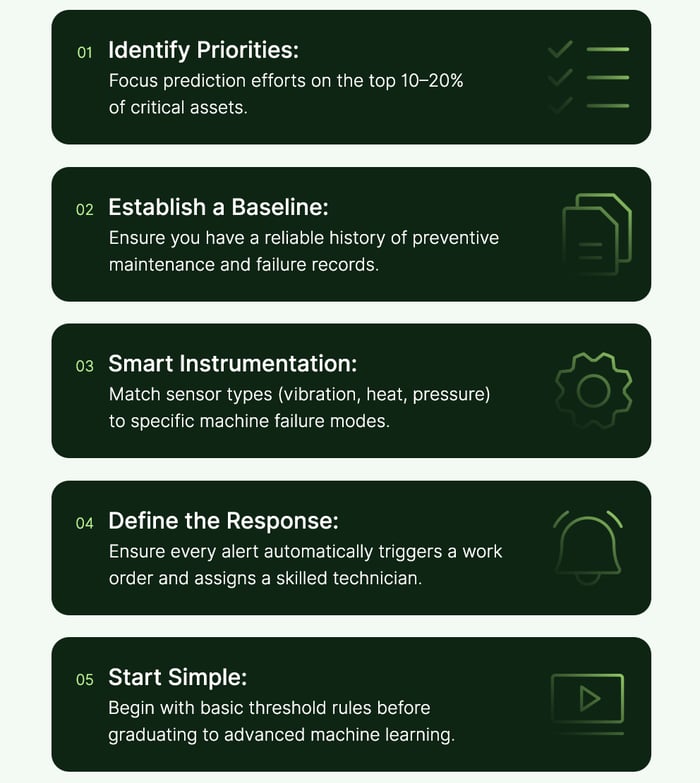
How to start with failure prediction: a 5-step roadmap
Organizations can begin their journey toward predictive capabilities by following a structured, step-by-step approach.
How L2L supports predictive maintenance
Predictive maintenance only delivers value when alerts are converted into actionable work. L2L provides the necessary Connected Manufacturing Operations Platform to serve as the foundation for this practice.
Closing the gap between data and action
While many tools can detect an anomaly, the "analytical bottleneck" often prevents that data from reaching the floor in time. L2L acts as a System of Action, where sensor signals or anomaly alerts trigger a digital work order containing the asset’s full history and required parts. This ensures that the right technician is dispatched with the right information at the right time.
Driving continuous improvement with Execution AI
L2L Execution AI bridges the gap between seeing a problem and knowing what to do next. When an issue is detected, the platform surfaces recommended next actions based on historical failure patterns and proven "Solves". Over time, the high-quality data captured in L2L creates the "Digital DNA" needed to refine maintenance strategies and move closer to a state of stable, proactive execution.
Frequently asked questions
What is the difference between predictive maintenance and failure prediction?
Failure prediction is the technical capability—the "engine" that forecasts when an asset is likely to break. Predictive maintenance is the broader strategy and practice of using those forecasts to schedule and execute maintenance tasks proactively.
How accurate is AI-driven failure prediction?
Modern models can reach 90% accuracy on rich datasets. However, real-world accuracy is limited by the quality of historical failure data. If the history is low-quality, the predictions will be as well.
Do I need IIoT sensors to predict failures?
For highly accurate, automated prediction, yes. However, organizations can get meaningful results by analyzing existing PLC tags and operator-reported abnormalities before investing in additional hardware.
Which assets benefit most from failure prediction?
Critical, high-cost rotating equipment like pumps, motors, compressors, and conveyors. Assets with long-lead-time spare parts also see amplified value because the prediction provides the necessary time to source components before the line stops.
Effective prediction is intervention timing
The technology for equipment failure prediction is now widely accessible, but the success of the strategy depends on organizational discipline. A prediction is only valuable if it leads to an execution. By building a solid foundation of standardized work and reliable data capture, organizations can transform their maintenance from a reactive headache into a competitive advantage.
Is your organization ready to move from post-mortems to real-time execution? See how the L2L Method helps plants stabilize and optimize their operations, or contact our experts for a demonstration of the platform in action.