



.svg)
 Shop floor execution
 Maintenance
 Production
 Skills
.png?width=60&height=60&name=chart-line-up%20(1).png) Manufacturing Intelligence
Manufacturing Intelligence
 Automotive
 Building materials
 Packaging
 CMMS/EAM
 MES
MES
 Connected Worker
 Manufacturing Intelligence
 Case studies
 Blog
Blog
 Ebooks & Guides
 Webinars
 Events
.svg) OEE Calculator
OEE Calculator
 Downtime Cost Calculator
 About Us
 Partners
 Newsroom
 Support
 Careers
 Trust center


.svg)


Unplanned downtime is as expensive as it is universal in the manufacturing industry.
Global manufacturing organizations lose approximately $1.4 trillion annually to downtime. For most organizations, the effort to reduce unplanned downtime is the single most important factor in protecting the profit and loss statement. Research suggests that the average industrial plant pays three to nine times more for unplanned maintenance activities than for planned service. These unscheduled stops represent the highest controllable cost in modern production environments.
We’ll outline five strategies that manufacturing leaders can use to reclaim lost hours and stabilize their operations. Rather than providing generic advice, this analysis focuses on the expected impact of each strategy and the structural changes required for successful implementation.
Planned vs. Unplanned Downtime: The Cost Difference
Downtime in manufacturing is categorized into two distinct types: planned and unplanned.
Planned downtime is scheduled, predictable, and typically occurs during off-shifts or dedicated maintenance windows. It allows the maintenance team to prepare the necessary tools, parts, and personnel in advance, ensuring that the work is completed efficiently.
Unplanned downtime is unscheduled and reactive. These events are expensive because they often require:
- - Overtime labor to address the crisis immediately.
- - Expedited shipping for missing spare parts.
- - Lost production volume that cannot be recovered.
- - Quality issues like sudden stops that can create scrap and rework.
Because unplanned maintenance costs exponentially more than planned work, eliminating these events is the single highest-return action a maintenance team can take.

What Actually Causes Unplanned Downtime?
Many organizations treat downtime as an equipment problem, but research involving hundreds of industry professionals suggests it is often a communications or systems crisis. Five recurring root causes frequently drive these events:
- Reactive Maintenance Culture: Organizations that rely on a run-to-failure strategy wait for a breakdown before taking action, ensuring that every repair is a high-cost emergency.
- Skipped Preventive Maintenance (PM): When PM schedules are ignored or consistently overdue, equipment reliability suffers, leading to catastrophic failures.
- Inefficient Spare Parts Management: Approximately half of the time spent on repairs is often lost waiting for parts. When the right spares are not available or are difficult to locate, the duration of the stop increases significantly.
- Unclear Technician Dispatch: Without a structured system to notify the right person when a failure occurs, response times lag. Organizations often lose hours simply trying to find a technician with the correct skills for the specific machine.
- Lack of Failure History: When organizations do not capture the root cause of every stop, the same problems recur. Teams end up fixing the same symptoms repeatedly because the underlying pattern remains hidden.
If the same asset stops twice in a single quarter and the organization cannot identify the specific reason why, it does not have a downtime problem. t has a data problem.
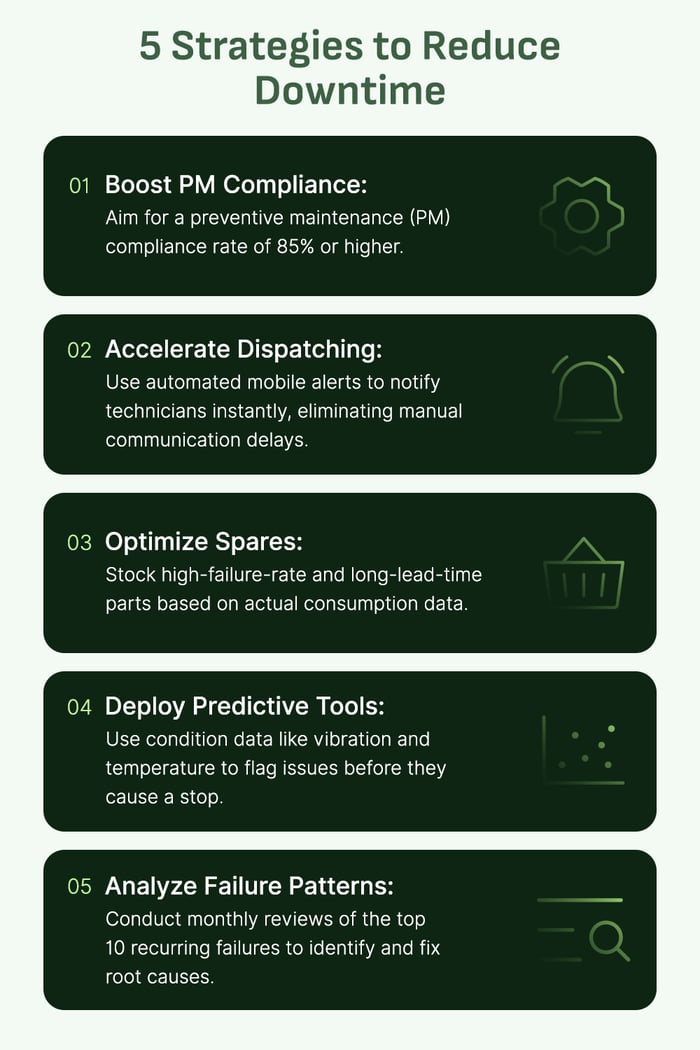
5 Proven Ways to Reduce Unplanned Downtime
1. Move From Reactive to Preventive Maintenance
Preventive maintenance is the essential foundation of equipment reliability. Manufacturers should aim for PM compliance above 85%. This is the threshold where unplanned events begin to decrease noticeably. When compliance falls below 70%, unplanned stops remain common and disruptive.
To reach this goal, organizations should:
- Tie schedules to actual usage: Instead of using a simple calendar, launch PMs based on machine cycles or run-time.
- Digitize standard work: Provide technicians with mobile, visual work instructions to ensure every task is done right the first time.
- Audit compliance weekly: Supervisors must review overdue items and reallocate resources to prevent a backlog of service tasks.
2. Add Predictive Monitoring on Critical Assets
Predictive maintenance uses condition data, such as vibration, temperature, or current draw, to flag an impending failure before it causes a stop. Because this technology requires an investment in sensors and edge computing, it is not necessary for every piece of equipment. Efforts should focus on the top 10–20% of assets that drive the highest downtime costs.
When a sensor detects an abnormality, the system should trigger an immediate alert and a clear response protocol. This prevents small issues from escalating into catastrophic mechanical failures.
3. Fix the Spare Parts Problem
A major portion of downtime is often caused by the time spent hunting for parts. Successful manufacturers identify high-failure-rate and long-lead-time spares and stock them strategically.
By connecting every repair to the specific parts consumed, organizations can create a reliable demand forecast, minimizing unnecessary spare parts inventory costs in the process. Automating the reordering process when stock falls below a certain threshold ensures that critical components are always available when a technician arrives at the machine.
4. Speed Up Technician Response
Reducing the time it takes to notify and deploy a technician is one of the fastest ways to improve operational availability. Manufacturers should eliminate manual steps, such as using radios or walking to a central office to receive a work order.
For example, an automated dispatch system can send alerts directly to a technician's mobile device based on their specific skills and current location. Providing the asset's full repair history and digital manuals at the point of need allows the technician to start working immediately with the correct context.
5. Capture Failure History and Act on Patterns
Every time a stop is resolved, the technician must record the root cause and the specific action taken. This creates a comprehensive database of failure patterns.
Management teams should conduct a monthly review of the top 10 recurring failures. By using a Pareto analysis to identify which chronic issues are draining the most hours, the maintenance team can build a continuous improvement backlog that addresses the source of the problem rather than just the symptoms.
Key Performance Indicators (KPIs) to Track
To reduce unplanned downtime, organizations must measure the right metrics on a weekly basis. The following six KPIs provide a clear view of operational health:
|
Metric |
Target Goal |
|
Unplanned Downtime % |
Trend down toward 5–10% of total available time |
|
MTTR (Mean Time to Repair) |
25–40% reduction year over year |
|
MTBF (Mean Time Between Failure) |
20% or greater increase |
|
Repeat Failure Rate |
30% reduction within 6 months |
|
PM Compliance |
Consistent performance at 85% or higher |
|
Emergency Overtime Cost |
40% or greater reduction |
Common Downtime Reduction Myths
Myth 1: Predictive maintenance fixes everything.
Reality: Predictive technology is only effective if the organization's preventive maintenance (PM) foundation is already strong. Attempting to use advanced sensors while ignoring basic service schedules is a frequent cause of project failure.
Myth 2: We just need a maintenance software system.
Reality: A software platform is merely a tool. The actual reduction in downtime comes from the adoption of new workflows and the discipline to follow standardized processes.
Myth 3: Run-to-failure is cheaper for non-critical assets.
Reality: This is only true if an asset has zero impact on downstream processes and can be repaired instantly. Most plants underestimate the ripple effect that a minor stop has on the rest of the production floor.
Real-World Success Stories
ADAC Automotive
ADAC Automotive, a manufacturer of vehicle access systems, needed to respond faster to production flow interruptions. By moving from manual, paper-based processes to a unified digital platform, the organization achieved a 62% reduction in major downtime events. Rick Vande Kopple, VP of Quality at ADAC, noted that the transition ensured the right people were at the right place at the right time.
Worthington Industries
Worthington Industries relied on spreadsheets and whiteboards that were erased daily, leading to lost data and slow responses to bottlenecks. After implementing a real-time orchestration system, the company achieved a $1,000,000 cost avoidance of machine downtime and a reduction of over 350 hours of unplanned stops.
Oetiker
Oetiker, a global leader in high-end connecting solutions, struggled with a lack of visibility into production practices across its plants. By standardizing data and collaboration, the company achieved a 23% reduction in Mean Time to Repair (MTTR) at its pilot facility in just six months.
Frequently Asked Questions
What is the average unplanned downtime in manufacturing?
Discrete manufacturers typically experience 10% to 20% unplanned downtime. World-class operations maintain this figure below 5%. For high-throughput facilities, the cost of these stops can reach hundreds of thousands of dollars per hour.
How quickly can maintenance software reduce unplanned downtime?
Plants that transition from spreadsheets to a structured maintenance management system often reduce unplanned downtime by 20% to 32% within the first 90 days, provided the adoption rate among frontline workers is high.
Is predictive maintenance worth it for every asset?
No. Predictive monitoring is generally justified for the top 10% to 20% of assets by downtime cost. For the remaining equipment, a well-executed preventive maintenance program is more cost-effective.
What is the difference between unplanned downtime and breakdown maintenance?
Unplanned downtime is the symptom—it is the state of the line being stopped without warning. Breakdown maintenance is the strategy—it is the decision to fix equipment only after it fails. Reducing the former requires moving away from the latter.
How L2L Helps Reduce Unplanned Downtime
L2L is the only Connected Manufacturing Operations Platform that unifies maintenance, production, and workforce management into a single "System of Action." Unlike legacy systems that only chronicle past failures, L2L proactively guides the frontline team through the fastest path to resolution.
The platform addresses every cause of unplanned downtime in a single workflow:
- Automated Dispatching: It instantly alerts the correct personnel when an event occurs, eliminating the "information chase" that wastes 50% of the average worker's week.
- Intelligent PM Scheduling: It automates preventive maintenance based on usage, condition, or time intervals to ensure assets stay healthy.
- Real-Time Visibility: Plant leaders gain an accurate pulse of the entire floor, allowing them to spot failure patterns and bottlenecks before they escalate.
By digitizing institutional knowledge and orchestrating floor-level actions, manufacturers can move from reactive firefighting to a state of stable, continuous growth. Organizations typically see a measurable return on investment in as little as 16 weeks.