 Automotive
 Industrial materials
 Packaging
 CMMS/EAM
 MES
MES
 Connected Worker
 Manufacturing Intelligence
 Maintenance
 Continuous Improvement
 Operations
 IT
IT
 Executive Leadership
 Case studies
 Blog
Blog
 Ebooks & Guides
 Webinars
 Events
.svg) OEE Calculator
OEE Calculator
 Downtime Cost Calculator
 About Us
 Partners
 Newsroom
 Support
 Careers
 Trust center


.svg)

Leader Standard Work: Examples, Template, and How to Implement It
What is leader standard work (LSW)?
Leader standard work is a structured system of daily, weekly, and monthly routines that management executes to maintain continuous improvement and ensure operational processes run consistently.
Why do operational gains fade over time in many manufacturing plants? Without structured supervisory routines, improvements degrade as daily disruptions draw attention away from core standards.
LSW shifts management focus from reactive firefighting to proactive process verification. Standard work for operators focuses on repeatable physical actions required to build a product on the assembly line. In contrast, leader standard work standardizes supervisory behaviors, such as auditing processes, coaching operators, and reviewing production metrics. When leaders consistently follow these management routines, organizations build accountability and maintain production gains across every shift.
Key operational benefits of implementing leader standard work include:
- Higher consistency in daily process execution across shifts
- Faster identification and resolution of root-cause quality issues
- Greater accountability for site leadership and supervisory teams
- Stronger alignment between strategic plant goals and daily shop-floor actions

Leader Standard Work at different management levels
Leader Standard Work isn't identical across management ranks. Operational focus shifts as responsibilities move from the shop floor to executive offices.
Frontline supervisors and team leads sit closest to the manufacturing line. Their daily routines focus heavily on physical process checks, shift handovers, and immediate problem-solving. Approximately 70 to 80 percent of a team lead's work consists of standardized routines.
Middle managers and site leaders oversee broader systems across multiple lines or departments. Their standard work focuses on process auditing, cross-functional coordination, and coaching supervisors. Standard routines make up roughly 30 to 50 percent of a middle manager's daily work, leaving room for structured problem-solving and project management.
Executive leaders focus on strategic direction, resource allocation, and long-term plant performance. Their standard routines account for 10 to 20 percent of their schedule, covering monthly performance reviews, strategy deployment checks, and board reporting.
Examples of Leader Standard Work in manufacturing
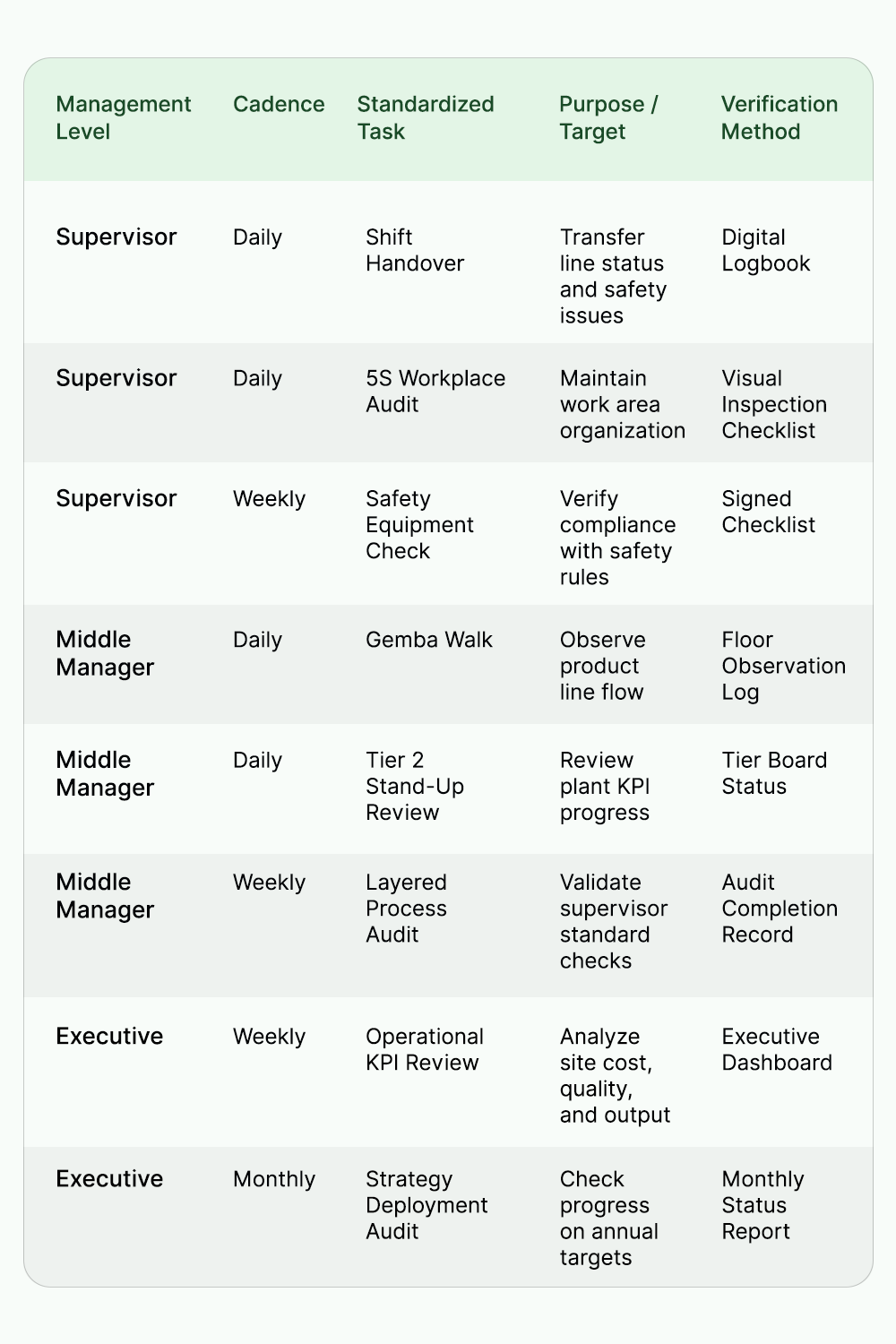
Standardized routines vary by operational level, but every role requires defined cadences and verification methods.
LSW for team leads and supervisors
Frontline supervisors focus on routines that keep production lines running safely and efficiently during a shift:
- Shift handovers: Documenting line performance, quality issues, and safety observations for incoming supervisors.
- Routine line checks: Verifying that line operators follow documented standard work instructions.
- 5S audits: Checking work areas at set times to maintain organization, cleanliness, and tool placement.
- Safety inspections: Verifying that operators wear proper protective equipment and follow ergonomic guidelines.
Middle manager and site leader standard work
Department and plant managers execute broader routines designed to verify systems and develop leadership talent:
- Layered process audits: Auditing production lines weekly to verify supervisor check compliance and standard adherence.
- Gemba walks: Walking the production floor daily to observe processes, talk with operators, and identify waste.
- Daily tiered management meetings: Leading stand-up reviews with supervisors to review safety, quality, delivery, and cost metrics.
- Coaching sessions: Providing weekly structured feedback to supervisors on root-cause problem-solving techniques.
LSW for directors and executives
Executive leaders establish routines that align facility operations with broader business strategies:
- Strategic planning reviews: Conducting monthly evaluations of site performance against long-term operational targets.
- Strategy deployment audits: Reviewing quarterly progress on major operational improvement initiatives across plants.
- Stakeholder engagement: Hosting structured town hall meetings or plant-wide briefings to communicate plant performance.
Examples of Leader Standard Work in Practice
Many global manufacturers use leader standard work to sustain high operational performance. At some sites, facility leaders use structured daily management cadences as part of their in-house operating system. Plant managers conduct scheduled gemba walks and tiered stand-up meetings to review metrics across safety, delivery, and cost. This structured routine ensures issues escalate quickly from frontline supervisors to plant directors.
Other organizations incorporate leader standard work into their own production systems. Frontline supervisors follow defined daily checklists to verify that operators adhere to assembly standards. If an operator misses a quality step, the Leader Standard Work framework requires the supervisor to initiate immediate root-cause analysis rather than applying a temporary fix.
For example, in the famous Toyota Production System, plants rely on leader standard work at every supervisory tier. Group leaders execute hourly visual checks on production status boards. If line output drops behind target, standard supervisory routines mandate immediate frontline support to assist operators and clear bottlenecks.
Leader standard work template
A Leader Standard Work template organizes management routines into distinct cadences. The template defines the task, execution frequency, operational target, and verification step.
How to implement leader standard work
Implementing leader standard work across a manufacturing facility requires a methodical rollout to gain leadership buy-in and sustain participation.
1. Define and document LSW
Manufacturing organizations must identify current management routines and determine which tasks add direct value to floor operations. Leaders break these tasks down into daily, weekly, and monthly cadences. Documenting these routines clearly ensures leaders know what tasks to perform and when to perform them.
2. Train leaders on new standards
Supervisors and managers require training on how to complete standard routines effectively. Training shouldn't focus only on checking boxes. It must teach leaders how to conduct effective gemba walks, ask diagnostic questions, and coach frontline workers during routine inspections.
3. Monitor leader standard work execution
Tracking task completion rates helps organizations identify operational friction early. Plant managers should monitor whether supervisors execute standard routines consistently. Visual management tools and tracking systems highlight missed tasks so managers can address workload imbalances or scheduling conflicts.
4. Conduct regular audits and reviews
Self-assessments and peer audits verify that leadership routines deliver real operational value. Higher-level managers audit lower-level LSW execution to ensure that checks remain thorough and meaningful rather than superficial routines.
5. Foster a culture of continuous improvement
As manufacturing processes evolve, leadership routines must adapt. Management teams capture feedback from shop-floor workers, evaluate task effectiveness against plant key performance indicators, and update LSW tasks periodically to focus on current operational bottlenecks.
Modernizing Leader Standard Work with a Connected Manufacturing Operations platform
Paper checklists and physical clipboards make leader standard work difficult to track across large manufacturing facilities. Paper sheets get lost, task completion data remains static, and plant leaders lack real-time visibility into whether supervisors actually complete scheduled audits. When audit records remain stored in physical binders, tracking trend data across shifts becomes slow and cumbersome.
Modernizing Leader Standard Work with a Connected Manufacturing Operations platform resolves these operational challenges. Digital LSW solutions replace paper clipboards with mobile checklists that supervisors access directly on smart devices on the shop floor. When supervisors perform 5S checks or safety audits digitally, completion data updates immediately in centralized systems.
Connecting Leader Standard Work to a manufacturing operations system and manufacturing execution system (MES) integrates leadership routines directly into plant operations. If a supervisor identifies a machine malfunction or safety hazard during a daily gemba walk, the digital platform can trigger an automated work order in the maintenance system immediately. Tiered daily management dashboards aggregate completion rates, allowing plant directors to spot missed supervisory audits across facilities instantly.
Modern, digital LSW practices turn supervisory routines into actionable operational data that sustains long-term manufacturing excellence.
Frequently asked questions about leader standard work
What is leader standard work?
Leader Standard Work is a set of recurring tasks, routines, and procedures that leadership performs on a defined cadence to sustain operational best practices and continuous improvement. It creates accountability, aligns site objectives across shifts, and establishes structured management behaviors often described as kaizen for managers.
What are examples of Leader Standard Work?
Examples of Leader Standard Work include shift handovers, routine safety inspections, and 5S audits for frontline supervisors. Middle managers perform layered process audits, gemba walks, and structured coaching sessions. Executive leader standard work includes strategic planning reviews, policy deployment checks, and stakeholder engagement meetings.
What should a Leader Standard Work template include?
A leader standard work template should include specific recurring management tasks organized into daily, weekly, and monthly cadences. It details the operational standard, required completion frequency, task location, and verification mechanism, tailored specifically to the management level and responsibility of the leader.
How is LSW different from standard work?
Standard work defines the repeatable steps that production operators follow to manufacture products safely and consistently. Leader Standard Work standardizes the management routines, such as audits, coaching sessions, and operational reviews, that verify operator standards and support continuous shop floor improvements.
What are the benefits of Leader Standard Work?
The benefits of Leader Standard Work include a sustained culture of continuous improvement, consistent product quality, clear accountability across management levels, improved shift-to-shift communication, reduced operational variance, and a focus on high-value leadership activities that eliminate waste on the manufacturing floor.