


.svg)
 Shop floor execution
 Maintenance
 Production
 Skills
.png?width=60&height=60&name=chart-line-up%20(1).png) Manufacturing Intelligence
Manufacturing Intelligence
 Automotive
 Building materials
 Packaging
 CMMS/EAM
 MES
MES
 Connected Worker
 Manufacturing Intelligence
 Case studies
 Blog
Blog
 Ebooks & Guides
 Webinars
 Events
.svg) OEE Calculator
OEE Calculator
 Downtime Cost Calculator
 About Us
 Partners
 Newsroom
 Support
 Careers
 Trust center


.svg)

 Rick Franzosa
Rick Franzosa
Rick Franzosa
The manufacturing industry is at a visible crossroads. For more than a decade, organizations have invested heavily in automation, advanced sensors, and cloud infrastructure.
Yet data show that industrial productivity has largely plateaued since 2011. Frontline and technical teams still spend up to 50% of their workweeks on the "information chase"—searching for the data they need rather than implementing solutions. This visibility and coordination gap translates into a staggering $1.4 trillion in annual global costs from unplanned downtime, leaving roughly 40% of production capacity on the table. Overall Equipment Effectiveness (OEE) typically hovers around 60%.
There is, of course, significant interest in advanced technology, particularly AI. This interest is not just AI hype; much of it stems from dissatisfaction with the limitations of Manufacturing Execution Systems (MES) and Manufacturing Operations Management (MOM) platforms, including QMS, Scheduling, CMMS, and WMS.
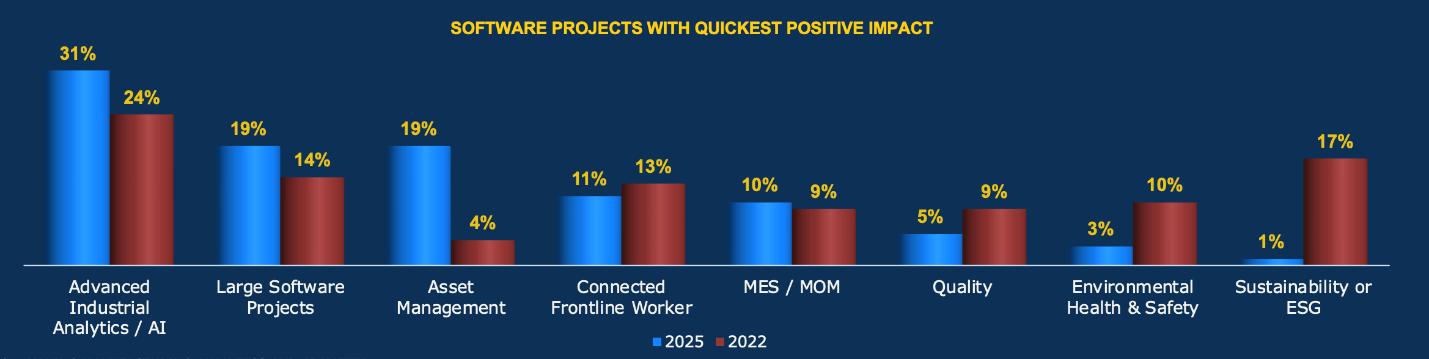
According to Tech-Clarity and MESA International’s 2025 research, “Making Manufacturing Analytics and AI Matter,” analytics projects are delivering significant benefits that support key drivers and help address challenges. All 432 respondents (100%) report benefits from analytics programs. Advanced analytics also ranks as the top technology category for delivering rapid ROI. Both end users and software providers are enhancing their MES/MOM functionality with AI. A recent study found that AI adoption in manufacturing, which stood at 18% in 2023, has now reached 53%.
Yet if everyone is benefiting from advanced analytics and AI momentum is growing, why hasn't broad adoption triggered an industry-wide operational transformation?
The answer lies in operational and data readiness and in addressing system fragmentation. Transitioning to AI-ready operations is not a technical issue; it is a solvable leadership challenge.
AI blocker 1: system fragmentation
One of the most significant challenges to getting the most out of AI is the inherent fragmentation of manufacturing systems. Manufacturers often implement applications piecemeal as needs arise for plant maintenance (CMMS), manufacturing planning (APS), manufacturing execution (MES), and so on. For all the right reasons, these solutions are best-in-class, developed by experts in their respective domains.
Is it better to buy a suite from an enterprise software vendor? Most mega-suite vendors in the ERP and PLM space have grown their impressive suites by acquiring best-in-class software vendors. This creates a boatload of individual data models that the acquiring vendor must stitch together behind the scenes. Tech-Clarity’s research on autonomous operations indicates that even Top Performers rate their ability to move data seamlessly across IT and OT layers as ranging from "not at all" to "OK."
This fragmentation leads to a lack of data readiness. It fosters incomplete, outdated, and conflicting data from multiple sources, which is the primary barrier to AI success. L2L’s research among 600 manufacturing leaders in the U.S. found that 64% of respondents describe their current technology stack as fragmented, and nearly all (98%) struggle with data issues. AI systems cannot be expected to make sound recommendations and judgments when critical data sources are siloed and differ in syntax, semantics, and data definitions.
AI blocker 2: focusing solely on systems of record
Historically, manufacturing software was used primarily to create a repository of key manufacturing information. Systems were designed to remove paper from manufacturing processes, creating a “digital filing cabinet.” Reducing paper led to immediate savings by eliminating non-value-added tasks and reducing errors. However, these systems, with more of an archival data-hub approach, had limitations as well. I recall speaking to a plant manager 30 years ago who complained that his MRP system (yes, THAT long ago) could only tell him what had happened, offering zero insight. There was no insight into what actions he could have taken or should have taken next.
Decades later, that fundamental limitation persists, even as the stakes have grown. What has changed is our capability: modern facilities now possess the mechanisms, from IIoT sensors to advanced analytics, to capture real-time shop floor activity. Yet using these tools merely to keep a more detailed score misses the point. This ‘review-view-mirror’ model remains insufficient to keep pace with modern manufacturing. True AI readiness requires moving beyond data collection and supplementing traditional Systems of Record with Systems of Action.
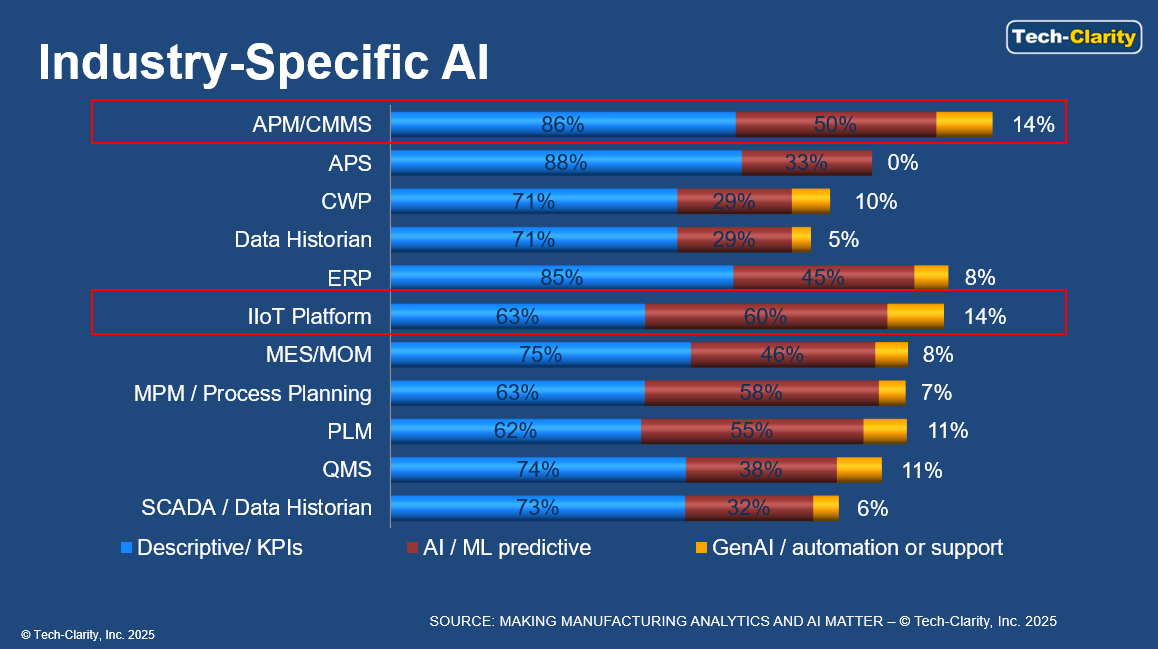
We know that a traditional system of record captures what went wrong after the fact. We also know that even before AI adoption, there were areas in manufacturing where the system of record data had been used effectively with a system of action. The advent of IIoT and condition-based maintenance over the last decades has produced solid benefits. Tech-Clarity’s 2025 survey also noted that the technologies with the highest percentage of AI adoption were IIoT platforms and Asset Performance Management (APM).
Yet because these systems are ‘rear-view-mirror’ focused, simply collecting sensor data is not enough. Even when data is logged, traditional systems struggle to transform telemetry streams into root-cause understanding. They often miss events when there are delays in reporting initial problems. As a result, L2L’s data show that only 9% of manufacturing leaders can currently identify the root causes of shop-floor issues in real time. Three-quarters of managers surveyed reported that delays in reporting initial problems are the primary catalysts for full-facility shutdowns.
Bolting an AI layer onto a traditional system of record will not deliver the transformational benefits AI is expected to provide. This may be why manufacturers' investment in AI began to slow in 2026. Initial pilots failed to demonstrate the expected benefits. AI delivers the greatest value when it has immediate access to a data platform that orchestrates real-time execution.
AI blocker 3: overcoming the skills and disruption challenge
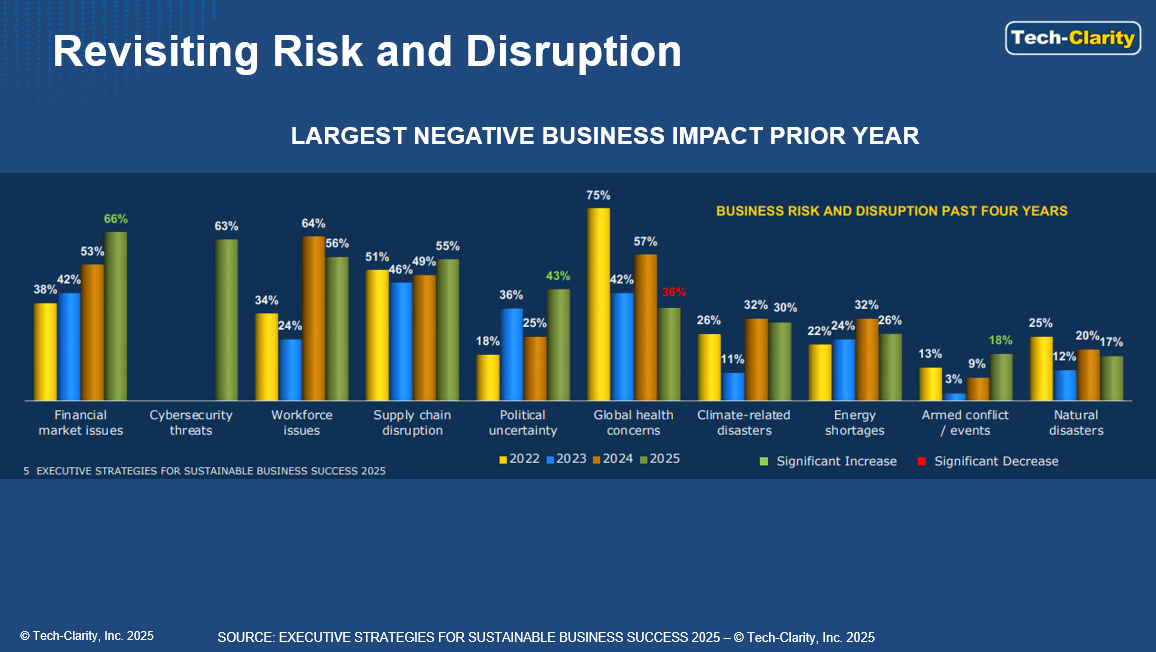
Behind this transformation are both external and internal business pressures. Tech-Clarity’s “Executive Strategies for Sustainable Business Success 2025” identified areas of increased concern, including financial and tariff-related risks (up 24%) and political uncertainty (up 74%). Workforce issues, supply chain disruptions, and cybersecurity continue to rank highly as risks.
One of the biggest concerns is the workforce transition and the knowledge lost when the current generation retires. This is not new; it was a hot topic when I began my engineering career in 1974! However, transferring information from generation to generation has always been hit or miss. The difference is that we now have AI technology that can be configured to digitize insights and best practices from veteran staff and embed them directly into standard operating procedures (SOPs), enabling the system to actively guide the workforce's next moves.
What top performers do differently
The size of a company's technology budget does not determine success. Top performers, as defined in Tech-Clarity/MESA’s survey, prioritize use cases based on clear business value, not technical novelty. They focus on stabilizing processes, strengthening their data foundation, and making critical decisions with an eye toward how process rationalization, data management, and technological advancement will support and enhance the end-user experience, which in turn will improve productivity and reduce costs. Operationally, they avoid the trap of chasing advanced optimization before stabilizing their environment.
By unifying core domains such as maintenance, production, quality, and skills into a single action-oriented platform, organizations can minimize delays caused by data fragmentation and time- and access-related barriers across multiple systems of record. The availability of cloud-native platforms and a purpose-built edge layer ensures scalability and availability. This, in turn, supports the advanced analytics and deterministic reliability required to realize significant benefits from AI.
The leadership roadmap
Top performers tend to follow the same roadmap. The important tasks do not include the sexy new technology. These are the hard work elements that are the precursor to AI success.
- Stabilize and unify: Eliminate point-solution friction by consolidating maintenance, production, and workforce tracking into a unified operational whole.
- Standardize workflows: Capture tribal knowledge digitally, transforming individual expertise into institutionalized, repeatable systems of action.
- Optimize with AI: Deploy execution AI on top of that clean, unified data foundation to orchestrate real-time responses on the floor.
Organizations that follow this structured path can achieve measurable operational improvements. In three years, the competitive divide will not be between companies with AI and those without. It will be between manufacturers that chased technology and Top Performers who did the hard work and built a unified, actionable data model to leverage a fully connected System of Action—resilient, agile, and thoroughly prepared for the next industrial disruption.