


.svg)
 Shop floor execution
 Maintenance
 Production
 Skills
.png?width=60&height=60&name=chart-line-up%20(1).png) Manufacturing Intelligence
Manufacturing Intelligence
 Automotive
 Building materials
 Packaging
 CMMS/EAM
 MES
MES
 Connected Worker
 Manufacturing Intelligence
 Case studies
 Blog
Blog
 Ebooks & Guides
 Webinars
 Events
.svg) OEE Calculator
OEE Calculator
 Downtime Cost Calculator
 About Us
 Partners
 Newsroom
 Support
 Careers
 Trust center


.svg)

The choice between a CMMS vs ERP shouldn't be an operational battlefield. Yet, it's the exact question maintenance managers face from finance teams every quarter: “We already have SAP, Oracle, or Microsoft Dynamics, so why do we need a separate CMMS?” This article provides a clear architecture for answering that question and bridges the functional gap between corporate business planning and shop floor execution.
When organizations fail to recognize the fundamental difference between CMMS and ERP platforms, they inadvertently force technicians to use software designed for accountants. The results are predictable: plummeting user adoption, unreliable data, and a rise in reactive firefighting on the production floor.
TL;DR: The strategic breakdown
- Core mandate: ERP manages the business; CMMS manages the equipment.
- The floor reality: Most ERP "maintenance modules" cover basic cost tracking but weren't designed for fast-paced, mobile workflows used by technicians on the plant floor.
- The ideal architecture: Modern manufacturers run both systems concurrently. The CMMS operates at the asset level to optimize uptime, while the ERP operates at the enterprise level, with a clean data handshake connecting them.
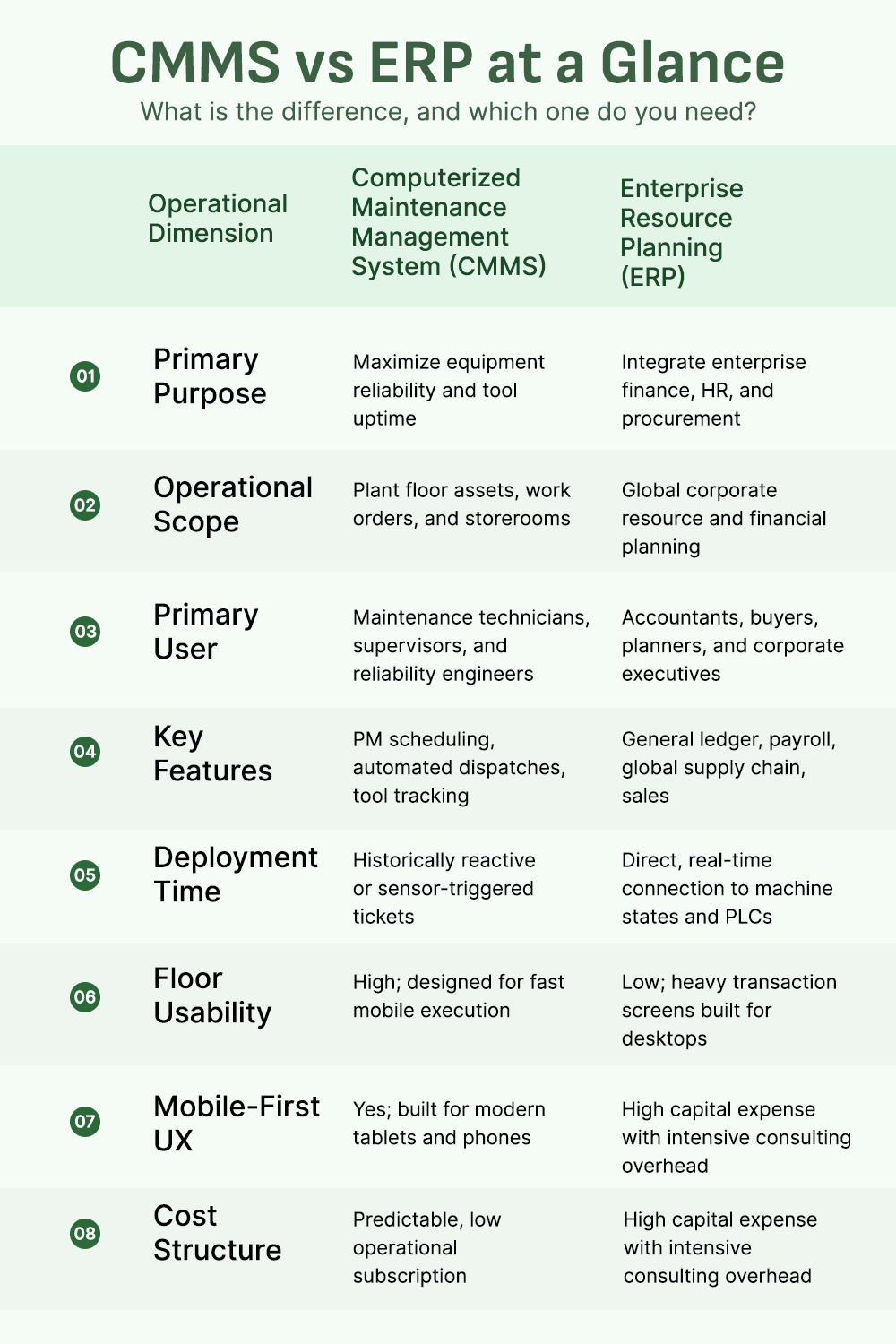
ERP answers “How is the business performing?” while CMMS answers “Is our equipment reliable, and how do we keep it running?”
What is a CMMS?
A Computerized Maintenance Management System (CMMS) is software built specifically for maintenance teams to organize, track, and optimize daily operations. It acts as the execution layer for asset management, handling real-time work orders, preventive maintenance (PM) schedules, component hierarchies, spare parts tracking, and mobile technician workflows.
What is an ERP?
Enterprise Resource Planning (ERP) is a holistic software platform that integrates core business processes—including finance, procurement, human resources, supply chain logistics, production planning, and sales—into a single database. It serves as the enterprise system of record, focusing on managing the corporate business structure rather than physical machine health. Major legacy providers include SAP, Oracle, and Microsoft Dynamics.
CMMS vs ERP: 5 key differences
1. Who actually uses the system
An ERP belongs to corporate planners, procurement specialists, and finance teams who work at desks. A CMMS belongs to maintenance technicians, shift supervisors, and reliability engineers who spend their day walking production lines.
Technicians don’t have the time to navigate complex corporate accounting screens while working on a machine with gloves on. They need a mobile interface that lets them log a problem in seconds.
2. Depth of maintenance functionality
While an ERP maintenance module can generate a basic work order or register an asset name, it lacks the operational depth required to drive reliability. It doesn’t support advanced condition-based PM triggers, interactive digital work instructions, workbench parts staging, or built-in root cause analysis (RCA) workflows.
For instance, platforms like SAP PM are technically robust for asset tracking, but their user experience is strictly aligned with rigid corporate transaction models. They lack the automated, rapid dispatch systems that floor teams need during a critical line stop.
3. Time to value
A cloud-native CMMS can be deployed in a matter of weeks, moving from initial configuration to the first live floor dispatch rapidly. Conversely, configuring an ERP maintenance module is an intensive IT undertaking. Because it alters shared enterprise master data, it usually consumes existing IT project capacity for over a year, and it's frequently deferred indefinitely due to the sheer complexity of customization.
4. Mobile and offline capability
Modern manufacturing requires a mobile-first approach. A true CMMS is built to work natively on mobile devices, allowing technicians to upload photos of worn components, use voice-to-text for repair logs, and scan asset barcodes. Furthermore, a CMMS features offline capabilities that ensure work execution data isn’t lost when a technician is working 200 meters away from the nearest network desk or inside a reinforced facility structure. ERP modules are almost exclusively online-only and desktop-first.
5. The depth of the data
An ERP holds high-level financial asset records, such as original purchase price, corporate depreciation schedules, and physical facility location for tax mapping. A CMMS houses deep operational data. It tracks the exact failure history, component-level sub-hierarchies, current Mean Time to Repair (MTTR), and cross-referenced spare parts consumption. They track entirely different data sets to inform entirely different business decisions.

Do I need a CMMS if I already have an ERP?
In almost every active manufacturing facility, the answer is yes. Relying solely on an ERP maintenance module to run floor operations means you're tracking the financial cost of maintenance without actually supporting the work itself.
There are three clear signals that a plant has outgrown its ERP maintenance module:
- Parallel Excel tracking: Teams keep a shadow calendar in Excel to track actual preventive maintenance because nobody trusts or uses the ERP's scheduling engine.
- Post-incident logging: Technicians refuse to use the ERP system directly. Instead, supervisors manually type work orders into the software days after the repair happened just to satisfy compliance.
- Analytical bottlenecks: Plant leadership can't get an accurate MTTR or PM compliance report without pulling a specialized financial analyst away from their core job to build custom pivot tables.
Operational reality: If you can only afford to optimize one layer of your maintenance operation this year, start with user adoption. Maintenance pain is the loudest pain on the floor, and you can’t solve it with software that technicians refuse to use.
How CMMS and ERP work together
A world-class digital manufacturing stack doesn’t force a choice between these two platforms; it syncs them. The standard integration model leaves the operational workflow inside the CMMS while using the ERP for global financial and procurement governance.
For instance, when a technician pulls a bearing from the storeroom, the CMMS logs the immediate operational deduction. It then sends a clean data message to the ERP via a secure REST API to capture the cost against the plant’s operational budget and trigger an automated reorder workflow through procurement. This keeps master data aligned without slowing down the floor.
How L2L fits with your ERP
This is where the paradigm shifts away from traditional, siloed point solutions. Rather than forcing you to stitch disparate systems together with custom code, L2L functions as a comprehensive Connected Manufacturing Operations Platform that complements your corporate ERP perfectly. It sits directly above the shop floor, capturing the real-time operational execution data that your ERP needs but simply cannot collect on its own.
L2L provides pre-built integration connectors for major enterprise applications, including SAP, Oracle, and Microsoft Dynamics. This ensures your global corporate asset records remain clean and updated while your frontline staff gets an intuitive system of action that actually makes their daily jobs easier.
Global manufacturers utilize this combined architecture to drive immediate, measurable financial results. For example, L2L customers like ADAC Automotive achieved a 62% reduction in operational downtime after moving away from disconnected tracking profiles.
Explore L2L’s pre-built enterprise software connectors and architecture profiles.
Frequently Asked Questions
Is SAP PM a CMMS?
Functionally, yes. SAP PM contains the standard features found in a traditional CMMS. However, deployment-wise, it remains an embedded module within a massive ERP ecosystem. This means it shares rigid database architectures with finance and corporate compliance, which often limits its user experience and flexibility compared to a dedicated, standalone CMMS platform.
Can a CMMS replace an ERP?
No. A CMMS doesn't manage corporate general ledgers, human resource payroll, customer relationship management (CRM), or top-level sales forecasting. It's a specialized execution solution built to run side-by-side with an ERP, not replace it.
How much does a CMMS cost vs. an ERP module?
A cloud-native CMMS uses a predictable per-user fee model and deploys rapidly without heavy consulting retainers. While an ERP maintenance module might seem “free” because it's bundled into your existing corporate enterprise license, the true cost hides in the heavy customization charges and the steep loss of productivity caused by low technician adoption rates.
Does L2L integrate with SAP natively?
Yes. L2L features verified, stable integration pathways with SAP, Oracle, and Microsoft Dynamics environments. The L2L Technical Services team directly handles the initial pipeline connection and handles ongoing software maintenance, so your internal IT team doesn’t have to manage custom middleware.
ERP runs the business. CMMS runs the equipment.
Smart manufacturing requires clear delineation of responsibilities across your technology stack. Trying to force an enterprise resource planning tool down to a specialized mechanical workflow doesn’t create efficiency. It creates administrative friction that halts production lines. Both systems have a defined home in a modern manufacturing organization. By pairing a global corporate system of record with an agile shop floor system of action, you give your finance team the numbers they need while giving your maintenance team the tools they deserve.
Align your floor performance with your corporate ledger
Stop letting fragile integration layers or low user adoption bottleneck your plant's potential. See how a modern system of action fills the gaps in your enterprise software array.
Talk to an expert about how L2L connects your plant floor to your ERP system.