



.svg)
 Shop floor execution
 Maintenance
 Production
 Skills
.png?width=60&height=60&name=chart-line-up%20(1).png) Manufacturing Intelligence
Manufacturing Intelligence
 Automotive
 Building materials
 Packaging
 CMMS/EAM
 MES
MES
 Connected Worker
 Manufacturing Intelligence
 Case studies
 Blog
Blog
 Ebooks & Guides
 Webinars
 Events
.svg) OEE Calculator
OEE Calculator
 Downtime Cost Calculator
 About Us
 Partners
 Newsroom
 Support
 Careers
 Trust center


.svg)


Even in modern manufacturing, scrap is often considered a predictable byproduct of production.
However, manufacturing leaders who look beneath the surface understand that scrap is a significant operational failure that directly erodes profit margins. The costs of defective parts are never limited to raw materials alone. Organizations also lose the labor hours invested in those parts, the energy consumed during their production, and the significant environmental and financial costs associated with disposal.
In fact, every rejected component represents a blocker to total plant capacity and a missed opportunity for value creation.
Achieving effective scrap reduction in manufacturing requires a shift in how organizations perceive waste. It should not be viewed as an unavoidable expense, but as a symptom of a disconnected system. When processes are not stabilized and standardized, scrap becomes the default outcome of the shift.
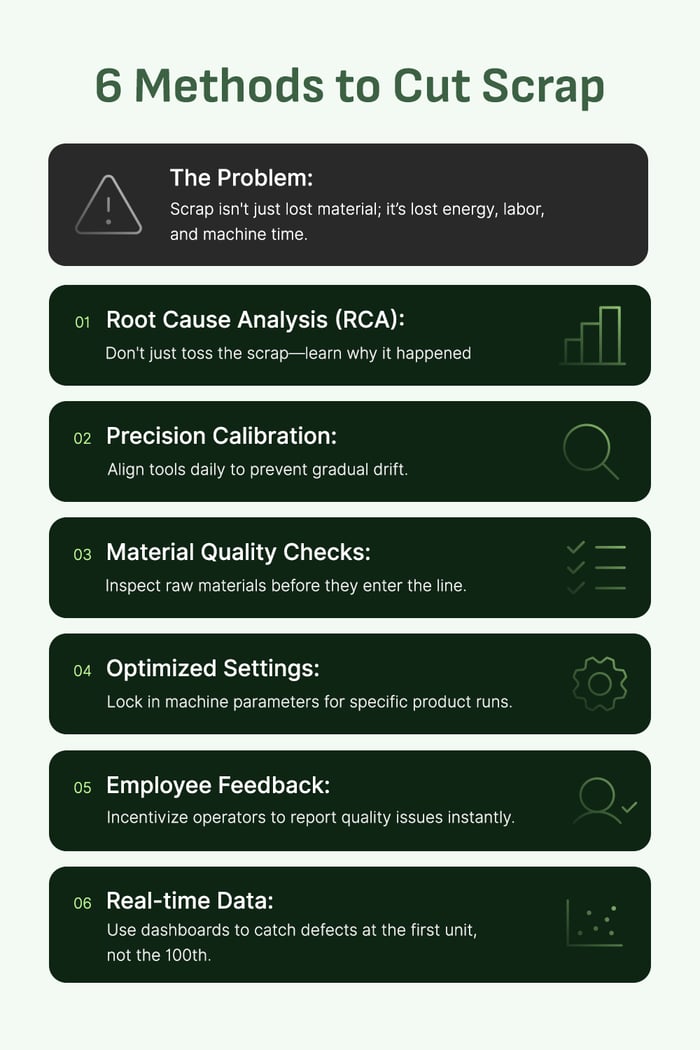
Why end-of-shift reporting is too late
Traditional manufacturing operations often rely on manual logging, where operators record scrap amounts at the end of a shift or during a weekly quality audit. This manual approach is inherently flawed because it provides a post-mortem rather than a plan for action. By the time a supervisor reviews a paper log or a spreadsheet, hours of production have already been wasted on defective goods.
Manufacturing organizations that want to eliminate these blockers must transition to real-time digital tracking. When data is captured at the moment a defect occurs, it provides immediate visibility. This allows maintenance and production teams to intervene before a minor process variation escalates into a large-scale quality crisis. Real-time data turns a passive report into an active guide for the shop floor.
Strategy 1: Connect machine health to quality outcomes
There is an unbreakable link between equipment maintenance and quality. Unplanned downtime and defective parts often share the same root causes: excessive vibration, motor heat, or mechanical wear. When a machine operates outside its optimal parameters, it inevitably produces off-spec parts.
Manufacturing leaders can adopt zero loss thinking to align maintenance activities with quality outcomes. Instead of waiting for a total mechanical failure, teams should monitor machine health indicators. For instance, if a bearing is beginning to fail, the resulting misalignment might cause subtle defects long before the machine stops running. By stabilizing equipment through proactive maintenance, companies prevent the defects from occurring in the first place.

Strategy 2: Implement digital poka-yoke (error proofing)
Human error remains a primary driver of scrap, particularly during complex assembly or high-SKU production runs. Digital work instructions provide a modern form of poka-yoke, or error proofing. These systems guide operators through mandatory checkpoints where data entry is required before the next production step can begin.
If an operator attempts to move a part to the next stage without meeting specific quality criteria, a digital system can prevent the transition. This ensures that a defective component does not continue down the line, where it would consume more labor and resources. Standardizing these digital workflows reduces the reliance on tribal knowledge and ensures consistent quality regardless of the operator's experience level.
Strategy 3: Leverage sensors and AI for predictive process monitoring
A process that was stable at the start of a shift can easily drift into non-compliance due to environmental changes or material inconsistencies. Modern manufacturers now utilize IoT sensors to monitor physical variables such as spindle vibration, heat, or hydraulic pressure in real time. When these sensors are integrated into a connected platform, they act as an early warning system for process drift.
By coupling these sensors with a comprehensive AI solution, the system can detect subtle anomalies that a human operator or a basic alarm might miss. These AI models analyze historical production data to identify the specific conditions that historically lead to scrap. When the current process begins to mirror those conditions, the system automatically alerts supervisors or maintenance technicians. This allows teams to correct the drift before the first scrap part is even produced, moving the organization from reactive quality control to predictive quality assurance.
Strategy 4: Use Pareto analysis to target bad actor processes
It is difficult for organizations to resolve every quality issue simultaneously. Digital audit trails allow companies to use Pareto analysis to identify the 20% of causes responsible for 80% of their scrap. These bad actor processes are often hidden in manual logs but become clear once data is unified.
Once these high-impact areas are identified, teams can perform data-driven root cause analysis (RCA). By focusing on the most significant sources of waste, manufacturers achieve the greatest improvements in their Overall Equipment Effectiveness (OEE) and profit margins. Fact-based analysis replaces opinion-based guessing, ensuring that resources are deployed where they will have the most significant impact.
Strategy 5: Empower operators with autonomous quality tools
Frontline workers are the first to encounter a quality problem, yet they are often the last to be consulted for their input. Organizations should provide operators with mobile tools that allow them to log why a part failed in real time.
When an operator can immediately categorize a defect—whether it is a material flaw, a machine jam, or a tool breakage—engineering teams receive higher-quality data. Giving operators the ability to contribute digitally ensures that issues are not lost during shift handoffs. This frontline intelligence is far more valuable than a vague end-of-week report. Empowering the workforce in this way builds a culture of accountability and continuous improvement.
Strategy 6: Optimize material flow and changeover precision
A significant portion of manufacturing scrap occurs during startups and product changeovers. If machine settings are not precisely calibrated for a new product, the first several parts are typically rejected.
Standardized digital checklists ensure that every changeover is performed with precision. By following a digital roadmap, maintenance technicians and operators ensure that first-part-right becomes the operational norm. This precision reduces the material waste and time lost during the transition between products, protecting the bottom line from the changeover penalty.
Real-world examples of scrap reduction
Many global manufacturers have seen measurable results by implementing these strategies:
- Sonoco: CPG manufacturer Sonoco used root-cause analysis to identify that dirty exhaust fans were causing vibrations in ovens. These vibrations led to dirt falling on semi-dry products, creating scrap and rework. By integrating sensors with their operations platform, they automated maintenance dispatches and saved the plant over $325,000.
- Oetiker: This leading vehicle solutions manufacturer reduced quality losses by replacing local, disconnected documents with standardized digital procedures across ten global facilities. This provided the visibility needed to identify and resolve quality blockers, resulting in an 11% OEE increase in just six months.
- Automotive Industry Trends: Many automotive suppliers have adopted digital error-proofing to manage the increasing complexity of electric and hybrid vehicle components. By requiring digital validation at each workstation, they have significantly reduced the scrap associated with assembly errors and the rising part counts of modern vehicles.
Making scrap reduction a competitive advantage
Effective scrap reduction in manufacturing demands continuous visibility. When an organization eliminates waste, it does more than just save money - it increases total capacity and enhances the sustainability of the plant.
L2L is a Connected Manufacturing Operations platform designed to eliminate the operational blockers that cause waste. By unifying maintenance, production, and quality data into a single source of truth, L2L provides the visibility needed to drive a zero-scrap culture.
Key features that support scrap reduction:
- Execution AI: Synthesizes floor data to identify failure patterns and provide immediate, actionable recommendations to prevent scrap.
- Real-time Dispatch: Automatically alerts the correct personnel the moment a quality abnormality is logged, reducing the window of defective production.
- Digital Work Instructions: Standardizes complex tasks and changeovers to ensure first-part-right outcomes and reduce human error.
- Standardized Checklists: Enables digital audits and quality checks that make tribal knowledge a permanent part of the organization's digital DNA.
By connecting the frontline to real-time data with L2L, manufacturers can stabilize their processes, standardize their best practices, and optimize their overall production capacity for long-term success.