



.svg)
 Shop floor execution
 Maintenance
 Production
 Skills
.png?width=60&height=60&name=chart-line-up%20(1).png) Manufacturing Intelligence
Manufacturing Intelligence
 Automotive
 Building materials
 Packaging
 CMMS/EAM
 MES
MES
 Connected Worker
 Manufacturing Intelligence
 Case studies
 Blog
Blog
 Ebooks & Guides
 Webinars
 Events
.svg) OEE Calculator
OEE Calculator
 Downtime Cost Calculator
 About Us
 Partners
 Newsroom
 Support
 Careers
 Trust center


.svg)


Manufacturing is an industry centered on machines.
But when faced with financial pressure companies often face financial pressure, the maintenance budget is often the first area targeted for reduction.
It’s all too common for leadership to mandate a standard percentage cut across all departments to meet immediate financial goals. But reducing maintenance costs in manufacturing by a flat percentage without addressing operational inefficiencies can be a critical blow to the long-term cost-effectiveness and productivity of a plant.
Maintenance costs aren't an arbitrary expense, but rather a direct consequence of how effectively a facility is managed. To achieve sustainable cost reductions, manufacturers need to focus on the underlying systems that drive these expenses rather than simply lowering the available budget.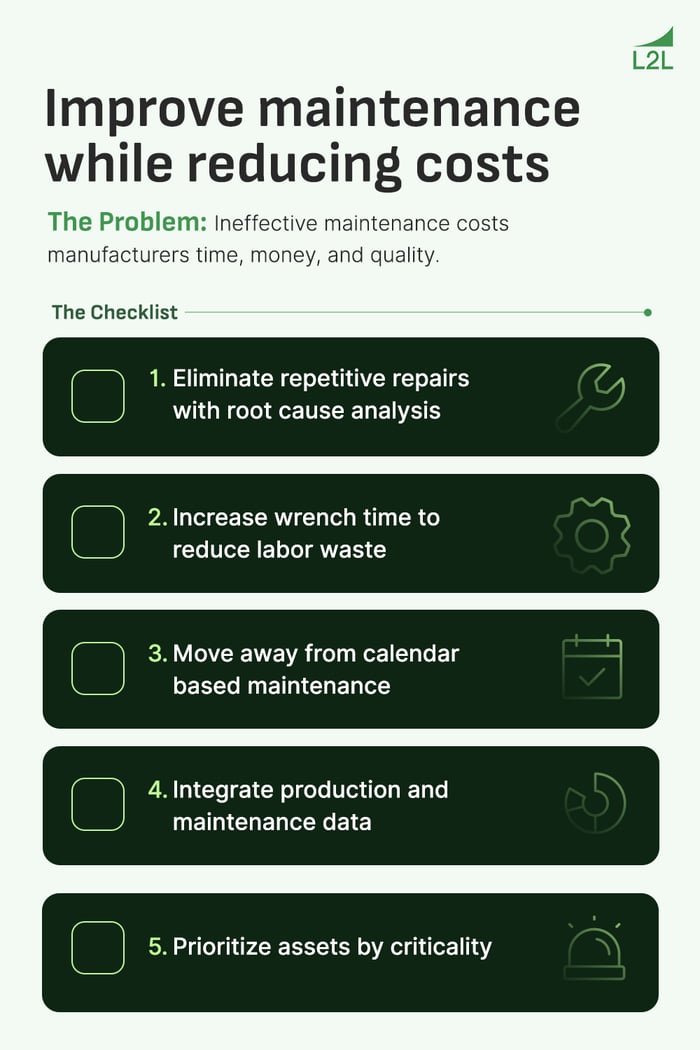
1. Eliminate repetitive repairs with root cause analysis
A significant portion of maintenance spending is often directed toward equipment that requires frequent, identical repairs. Maintenance teams that focus on immediate fixes rather than investigating the source of a failure engage in a cycle of repetitive spending. This approach incurs high costs through both accumulated labor hours and the continuous consumption of spare parts. Why do some machines fail every month while others run for years without an issue? The answer usually lies in a technical root cause that hasn't been addressed.
By utilizing root cause analysis, companies can identify why a specific asset fails and implement a permanent solution. This process is comparable to a doctor treating a disease rather than just the symptoms. Addressing the source of the problem ensures that the failure doesn't return, which preserves both capital and labor capacity for other tasks.
Example: Creating a standardized, scalable fix at Sonoco
A facility operated by Sonoco - the global CPG manufacturer behind the ubiquitous red Solo cup - experienced repeated issues with an oven exhaust fan that led to downtime and scrap. By analyzing historical performance data, the team discovered that specific vibrations were the primary driver of the failure. Instead of continuing to replace the fan motor every time it burned out, the team addressed the technical source of the vibration.
This eliminated the need for constant emergency repairs and resulted in significant financial savings for that facility. From here, Sonoco was able to standardize and repeat this process (and the savings) across other sites within across their global network.
2. Increase wrench time to reduce labor waste
Labor is a primary component of maintenance expenses, but high costs in this area don't always indicate a need for a smaller workforce. Instead, high labor costs are often driven by time spent on activities that don't involve actual repairs. Technicians frequently spend a large portion of their shifts searching for paper manuals, waiting for safety permits, or looking for the correct tools. This unproductive time is often referred to as a lack of wrench time. It keeps the cost per hour high while the volume of completed work remains low.
Improving the efficiency of a maintenance team is a direct way to lower costs without reducing staff. Providing technicians with instant digital access to repair histories and technical documents allows them to begin work immediately. When a technician has everything they need at the point of work, they can complete more tasks in a single shift, which reduces the need for overtime or outside contractors.
Example: Standardizing digital procedures at Oetiker
Oetiker, a global automotive component manufacturer, improved its operational efficiency by standardizing digital procedures and instructions across its sites. Before this change, technicians spent significant time gathering information before they could start a repair.
By digitizing these workflows, the company reduced the time required for technicians to complete tasks and decreased quality losses. Better access to information directly impacts the maintenance budget by maximizing the value of every labor hour.
3. Move away from calendar-based maintenance
Many plants follow a rigid schedule for component replacement based on the calendar. This method assumes that parts wear out at a predictable rate regardless of how often the machine actually runs. It's comparable to changing the oil in a car every three months even if the vehicle hasn't been driven. This leads to the unnecessary replacement of functional parts, which inflates inventory costs and introduces the risk of errors during the installation of new components.
Manufacturing leaders can reduce waste by moving to a maintenance model based on actual equipment usage or condition data. This ensures that technicians only perform work when the state of the machinery requires it. This transition preserves the life of expensive spare parts and allows the maintenance team to focus their efforts on assets that actually need attention. Transitioning away from arbitrary schedules prevents the waste of both materials and man-hours.

4. Integrate production and maintenance data
High maintenance costs are often a symptom of poor communication between the production and maintenance departments. When these two teams operate in isolation, maintenance work is frequently reactive. Reactive maintenance is significantly more expensive than planned work because it often involves paying overtime to technicians and using expedited shipping for emergency parts. How can a maintenance team plan their work if they don't know when the machines will be available?
When companies share real-time production and maintenance data, maintenance teams can see when a machine is beginning to deviate from standard performance levels. This allows repairs to be scheduled during natural gaps in the production cycle, avoiding unplanned stoppages. This alignment reduces the friction that leads to emergency spending and ensures that both teams are working toward the same goal of maximum output at the lowest cost.
5. Prioritize assets by criticality
A common driver of excessive maintenance spending is the tendency to treat all equipment as having equal importance. In a facility with limited resources, a failure on a non-essential conveyor belt shouldn't receive the same priority or budget as a failure on the primary production line. Treating every asset the same way leads to a misallocation of expensive parts and highly skilled labor. Why should a company spend the same amount of money maintaining a backup pump as they do on the main turbine?
Manufacturers can improve their return on investment by establishing an asset criticality index. This system ranks equipment based on the financial impact of its failure, safety implications, and its role in the production process. By focusing the majority of the budget and the most experienced technicians on the most critical assets, companies ensure that their spending is always aligned with business priorities. This strategic allocation protects the most valuable parts of the operation while preventing over-spending on secondary equipment.
Example: Power plant maintenance
A power generation facility utilized a criticality matrix to categorize its assets into high, medium, and low priority groups. They discovered they were performing the same level of preventive maintenance on low-priority cooling fans as they were on critical generators.
By reducing the frequency of maintenance on the low-priority fans and reallocating those resources to the generators, they improved overall plant reliability while simultaneously lowering their total maintenance expenditure.
Creating sustainable cost reduction
Sustainable cost reduction in maintenance requires a shift from viewing maintenance as an isolated expense to viewing it as a component of overall plant performance. By addressing root causes, improving labor efficiency, using actual equipment data, integrating departments, and prioritizing critical assets, manufacturing organizations can lower their costs while simultaneously improving the reliability and longevity of their facilities.
The L2L platform delivers real-time visibility to maintenance teams to catch slowdowns, missed handoffs, and breakdowns in communication before they escalate.