 Automotive
 Industrial materials
 Packaging
 CMMS/EAM
 MES
MES
 Connected Worker
 Manufacturing Intelligence
 Maintenance
 Continuous Improvement
 Operations
 IT
IT
 Executive Leadership
 Case studies
 Blog
Blog
 Ebooks & Guides
 Webinars
 Events
.svg) OEE Calculator
OEE Calculator
 Downtime Cost Calculator
 About Us
 Partners
 Newsroom
 Support
 Careers
 Trust center


.svg)

The definition of productivity is shifting in the modern manufacturing environment.
Traditionally, companies measured success by machine speed or total units produced. Today, leading organizations view productivity through the lens of effective output versus manual friction. Manual friction refers to any activity that forces an employee to stop value-added work to resolve administrative or logistical hurdles.
Research indicates that the average manufacturing employee can spend up to 50% of their work week simply chasing down information. This includes searching for tools, looking for paper manuals, or waiting for instructions from a supervisor. When half of the work week is lost to these activities, the primary goal for management is to improve workforce productivity by removing these barriers rather than simply asking for faster manual labor.
The engagement-productivity link in manufacturing
There is a direct correlation between employee engagement and operational efficiency. Operators who feel disconnected from the goals of the facility often perform tasks at a slower pace. However, the more significant risk of a disengaged workforce is the tendency to ignore minor abnormalities.
An engaged operator understands the value of their contribution and is more likely to report a small machine vibration or an unusual noise. When these minor issues are ignored, they typically escalate into major equipment failures. By focusing on engagement, manufacturers ensure that the frontline remains the first line of defense against unplanned downtime.
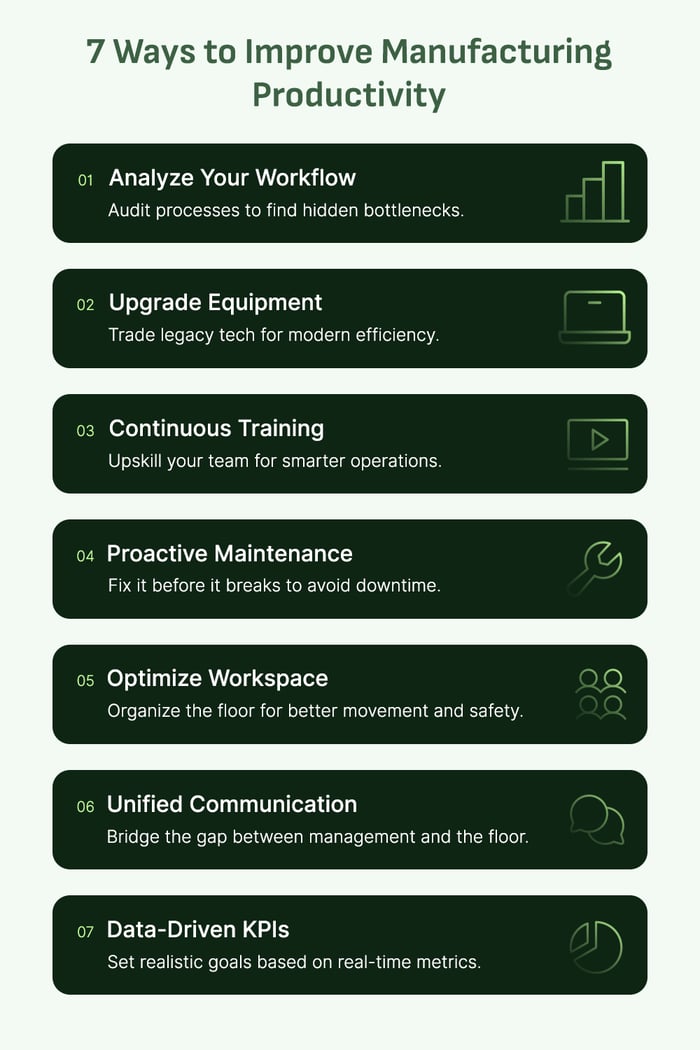
1. Transition from ‘boss’ to ‘coach’ with better data
Traditional manufacturing management often relies on micromanagement, where supervisors spend time checking up on workers to ensure tasks are being performed. This approach is inefficient for both the manager and the operator.
When organizations utilize real-time data, the role of the supervisor changes from a boss to a coach. Instead of performing random checks, managers can see exactly where production is stalled. This allows them to provide support only when and where the team needs it. Data-driven coaching empowers the frontline to make decisions within their specific areas, while managers focus on removing high-level obstacles to flow.
2. Eliminate paperwork fatigue
Manual documentation is one of the largest contributors to cognitive load on the shop floor. Frontline workers often spend 30 to 120 minutes every day filling out paper forms, logs, and reports. This administrative burden distracts from actual production and increases the likelihood of data entry errors.
Transitioning to digital, visual instructions on tablets reduces this cognitive load. When instructions are clear, visual, and available in the local language of the operator, workers perform tasks faster and with higher accuracy. Digital systems also ensure that the most current version of a procedure is always used, eliminating the risk associated with outdated paper binders.
3. Maximize wrench time with automated Dispatches
Wrench time refers to the amount of time maintenance technicians spend actually performing repairs or preventive maintenance. In many plants, this time is limited by inefficient communication. When a machine fails, an operator might have to physically find a supervisor, who then radios a maintenance lead, who then assigns a technician.
Automated Dispatches eliminate this delay. The second a machine abnormality is detected or reported, a notification is sent directly to the correct technician with the necessary parts and history of the asset. This reduces the time spent waiting for information and keeps the technical team focused on value-added repairs.

4. Encourage ownership with digital scoreboards
Workforce productivity improves when employees have a sense of purpose beyond punching a clock. Digital scoreboards that display Overall Equipment Effectiveness (OEE) and other key performance indicators (KPIs) in real-time provide this connection.
When operators see the immediate impact of their work on the shift goals, they begin to own the process. These scoreboards provide transparency, allowing teams to see if they are winning or losing the shift. This visibility fosters a competitive and collaborative culture where workers actively look for ways to keep the numbers in the green.
5. Democratize expertise with a digital knowledge base
The manufacturing industry is currently facing a significant loss of expertise as veteran technicians retire. This loss of tribal knowledge creates a productivity gap where new hires operate at a lower capacity for months while learning the quirks of legacy equipment.
Manufacturers can solve this by building a digital knowledge base. By capturing the specific repair methods and tricks used by senior staff and making them accessible via QR codes or searchable databases, companies ensure that any operator can handle a wide variety of tasks. This democratization of expertise facilitates cross-training and reduces dependency on a small number of veteran employees.
Example: Heineken - training time reduction
Heineken implemented digital standard work across its global breweries. By replacing manual training logs with digital instructions available in 52 languages, the company reduced onboarding and training time by 50%. This allowed new employees to reach competency levels faster and reduced errors on the production line.
6. Implement agile sprints on the floor
Agile methodologies, common in software development, are increasingly effective on the manufacturing floor. Rather than waiting for a monthly review to address bottlenecks, teams can implement daily digital stand-ups.
These short, focused meetings allow teams to analyze performance from the previous shift and identify micro-bottlenecks instantly. By treating each shift as a sprint, workers and leaders can make small, incremental improvements that lead to significant gains in throughput over time.
7. Recognize proactive smart work
Recognition is a powerful tool for reinforcing the behaviors that drive long-term productivity. Too often, recognition is reserved for the technician who fixes a major breakdown. While this is important, manufacturers should place equal emphasis on recognizing proactive work.
When an operator uses data to identify a failure pattern and prevents a stoppage before it occurs, that action should be celebrated. Reinforcing proactive behavior encourages the entire workforce to shift their mindset from reacting to problems to preventing them.
Reframing the equipment as a partner
Improving workforce productivity is not achieved by watching employees more closely, but by equipping them with better tools. Data should not be used as a monitor for performance but as a partner for execution. When companies provide the frontline with real-time visibility, digital guidance, and automated communication, they turn every worker into a problem solver. The goal is to create an environment where the path to success is standardized, visible, and free of manual friction.
L2L expands the frontline’s relationship with machinery by driving visibility with a shared view of machine health in real time, without the need for stacks of paperwork.