


.svg)
 Shop floor execution
 Maintenance
 Production
 Skills
.png?width=60&height=60&name=chart-line-up%20(1).png) Manufacturing Intelligence
Manufacturing Intelligence
 Automotive
 Building materials
 Packaging
 CMMS/EAM
 MES
MES
 Connected Worker
 Manufacturing Intelligence
 Case studies
 Blog
Blog
 Ebooks & Guides
 Webinars
 Events
.svg) OEE Calculator
OEE Calculator
 Downtime Cost Calculator
 About Us
 Partners
 Newsroom
 Support
 Careers
 Trust center


.svg)


There’s a lingering assumption in manufacturing that a machine’s life is dictated primarily by its depreciation schedule.
When an asset reaches the end of its useful life, it's often viewed as a liability waiting to happen. However, this perspective overlooks a fundamental reality of the shop floor: age is just a number, but maintenance quality is a definitive measurement of longevity.
An improved asset lifespan is rarely the result of luck or light usage. Instead, it is the product of a systemic shift in how an organization views its capital equipment. By moving away from rigid accounting definitions and toward a strategy of high-fidelity maintenance, manufacturers can keep assets running at peak performance well beyond their projected expiration dates.
Shifting from Calendar-Based to Usage-Based Reality
One of the most common obstacles to longevity is the calendar trap. Many maintenance teams still operate on fixed intervals—servicing a machine every 30 days regardless of whether it ran three shifts a day or sat idle for two weeks.
Maintaining equipment based solely on the date is inefficient and can actually be counterproductive. It is comparable to changing the oil in a vehicle every three months even if it never left the garage. Unnecessary interventions increase the risk of "infant mortality" for parts and introduce opportunities for human error.
To achieve an improved asset lifespan, manufacturing leaders are increasingly moving toward usage-based maintenance. By tracking actual cycles, hours of operation, or throughput, maintenance teams can intervene exactly when the equipment requires it. This ensures that high-demand assets receive the attention they need while preventing over-servicing on underutilized machines.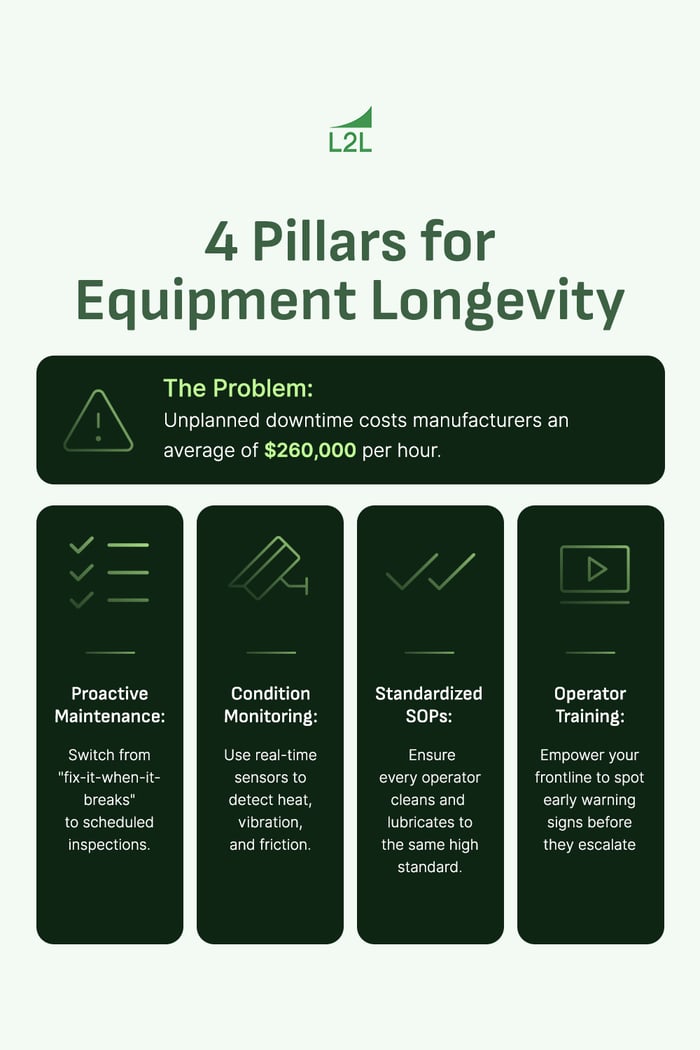
Why Firefighting is an Asset Killer
Reactive maintenance, often called "firefighting," is a primary driver of premature asset retirement. When a machine is allowed to run to failure, the resulting breakdown is often a high-energy event that causes physical trauma to the equipment. A catastrophic bearing failure, for example, doesn't just stop production - it can warp shafts, damage housings, and compromise the structural integrity of the entire unit.
Every time an asset crashes, its lifespan is shortened. Conversely, a connected manufacturing environment allows for "soft landings." When a system can detect early anomalies—such as a slight increase in vibration or a minor spike in temperature—maintenance can be performed before a failure occurs. Preventing these high-impact crashes preserves the machine's core components and extends its total service life.
Example: Scaling Proactive Maintenance at Pandrol
A leader in rail infrastructure, Pandrol needed a scalable strategy to make operational data useful for the frontline. By providing real-time visibility with a Connected Manufacturing Operations platform, they moved from reactive firefighting to a standardized model. This ensured that maintenance was performed based on actual need rather than guesswork.
And because this transformation was facilitated by a modern, digital solution, they were able to quickly standardize and implement this success at scale across their value chain.
The Human Factor: Standardizing Maintenance Quality
Poor maintenance can be more damaging than no maintenance at all. Without standardized procedures, the quality of a repair depends entirely on the individual technician’s experience. This can lead to technician-induced failures, where over-tightened bolts, improper lubricants, or skipped steps during a rebuild cause the machine to fail shortly after it was supposedly fixed.
Digital work instructions are a critical tool for standardizing the quality of care. When every maintenance action is guided by digital SOPs and OEM standards, the undocumented expert knowledge (sometimes called Tribal Knowledge) that often leads to shortcuts is replaced by institutional intelligence. Ensuring that every repair is done correctly the first time is essential for maintaining the long-term health of the asset.
Empowering Operators Through Autonomous Maintenance
Maintenance is too important to be left solely to the maintenance department. The foundation of asset longevity is often found in the daily habits of the people closest to the machines: the operators.
Autonomous maintenance programs, centered on principles like Clean, Inspect Lubricate, and Tighten (CILT), empower operators to take ownership of their equipment. In fact, they're scientifically proven to improve metrics like Overall Equipment Effectiveness (OEE).
When operators are equipped with mobile tools to perform daily checks, they become the first line of defense. They are the most likely to catch "micro-failures"—a loose bolt, a small oil leak, or an unusual sound—that, if ignored, would eventually lead to a catastrophic breakdown. Catching these small issues early is the most cost-effective way to ensure an improved asset lifespan.

Breaking the Repeat/Failure Cycle with Root Cause Analysis
Longevity is frequently undermined by chronic, repeating issues. If a machine suffers the same minor failure every three weeks, it is a sign that the symptoms are being treated rather than the cause. These repetitive injuries fatigue the equipment and drain maintenance resources.
Utilizing digital audit trails allows engineers to perform effective Root Cause Analysis (RCA). By looking at a complete history of work orders and repairs, teams can identify the underlying source of a problem. Solving the issue once, permanently, prevents the machine from suffering unnecessary wear and tear, allowing it to remain in service longer.
The Financial Benefit of Designing for Maintainability
An improved asset lifespan also requires a strategic approach to spare parts and planning. When repairs are rushed to meet a production deadline, shortcuts are taken. Gaskets aren't replaced, cheap generic parts are swapped for high-quality spares, and precision alignments are eyeballed.
Organizations that design for maintainability plan their maintenance windows during natural production breaks and invest in high-quality components. These planned windows ensure that technicians have the time to do the job right. This ensures that the asset returns to service in the best possible condition, protecting the company's capital investment for years to come.
Making Asset Health a Shared Goal
Ultimately, extending the life of a machine requires bridging the gap between production targets and maintenance requirements. A factory that is truly connected doesn't just focus on today's output; it preserves the capital that makes future production possible.
When leadership, maintenance, and production teams use a solution like L2L, they have more than just visibility into real-time data. It’s a way to enable a cultural shift to make asset health a shared responsibility. By stabilizing the shop floor and driving action with data, manufacturers can transform their equipment from depreciating assets into long-term engines of growth.