 Automotive
 Industrial materials
 Packaging
 CMMS/EAM
 MES
 Connected Worker
 Manufacturing Intelligence
 Maintenance
 Continuous Improvement
 Operations
 IT
 Executive Leadership
 Case studies
 Blog
 Ebooks & Guides
 Webinars
 Events
 OEE Calculator
 Downtime Cost Calculator
 About Us
 Partners
 Newsroom
 Support
 Careers
 Trust center




Today, manufacturers collect more plant data than ever. So why are most manufacturing leaders still asking the same question each year:
“What’s actually happening in our plants?”
It’s true that machines generate real-time signals. MES, ERP, CMMS, EAM, and other systems track everything from production output to maintenance activity, and dashboards give leaders increasingly sophisticated views of plant performance.
Yet greater visibility doesn’t automatically translate into greater productivity.
The problem is the manufacturing execution gap: the time and friction between identifying an operational issue and taking the right action to resolve it.
A manufacturer can know about a problem, but if that information doesn’t quickly reach the right person with the context needed to act, visibility alone creates little value. This problem-solving lag lets minor disruptions turn into prolonged downtime, lost production, increased scrap, and even missed delivery targets. Over time, it drives up operating costs, reduces productivity, and erodes margins.
That’s why manufacturing leaders focused on throughput, margins, and profitable growth must close this gap. Even though the cost of this slow action doesn’t directly appear in P&L reports, it’s a serious threat to long-term profitability.
Why more manufacturing data hasn't solved the productivity problem
For decades, manufacturers have invested in systems designed to collect, organize, and analyze operational information. But in spite of heavy investments in digital transformation, industrial productivity has been flattening since 2011.
It’s true that robust production systems, IIoT sensors, and sophisticated analytics tools all play important roles in collecting and organizing data. In fact, manufacturers have spent billions on connecting these technologies in hopes of gaining more visibility into their operations.
One reason for this decline is that many of these technologies primarily function as a system of record. They’re good at documenting what happened, but they aren't designed to coordinate the next steps. Moreover, systems of record often fragment data instead of connecting it in real time, making it difficult for leaders to understand performance consistently across plants and make informed decisions about capacity, capital allocation, and production.
But an even bigger reason for the industrial productivity decline is that manufacturers have spent billions on connecting machines but have failed to connect their frontline workforce. Operators, technicians, and site-level leaders—the people keeping plants running day to day—often don’t have the information they need to act quickly. In this scenario, fixes take hours instead of minutes, wasting precious production capacity.
And on a corporate level, this makes fully informed decision-making about capital allocation, order routing, and site-level investments impossible.
What does the manufacturing execution gap look like?
Consider a relatively minor equipment problem:
- A machine stops, and the operator recognizes something is wrong. However, they have to find a supervisor or contact maintenance via radio call.
- Someone determines which technician is available, and the technician arrives but needs more information about the problem.
- The technician may then need to find the appropriate documentation, parts, or another employee with experience troubleshooting that particular asset.
- The actual repair might take five minutes, but getting to the repair could require an hour of lost production.
That is the execution gap.
When highly-skilled technicians spend more time hunting for answers than what they’re paid to do best, companies end up with wasted time and frontline talent. Multiply that friction across hundreds of assets, shifts, production lines, and facilities, and seemingly small delays become an enterprise-level performance problem. Left unchecked, performance constraints erode profit margins and make it increasingly difficult to remain competitive.
Why the execution gap is an executive problem
At the plant level, execution gaps show up as downtime, longer mean time to repair, scrap, rework, missed production targets, and frustrated employees.
At the enterprise level, they become financial problems.
Lost production can require overtime or expedited freight to recover volume. Quality issues consume materials and labor. Uncaptured capacity can drive investment in additional equipment before existing assets are fully utilized. Inconsistent processes also make it harder to replicate strong performance across a manufacturing network.
This is why downtime shouldn't be viewed solely as a maintenance metric. Operational delays ultimately affect an organization's ability to profitably meet demand and protect margins.
For executives, the question therefore isn't, “Can we see what's happening in our plants?” but “How quickly can we make our organization more productive and profitable?”
From systems of record to a System of Action
Closing the execution gap requires more than another dashboard. It requires connecting operational visibility directly to frontline execution, using industrial AI to streamline processes directly at the point of work. That's the role of a “System of Action.”
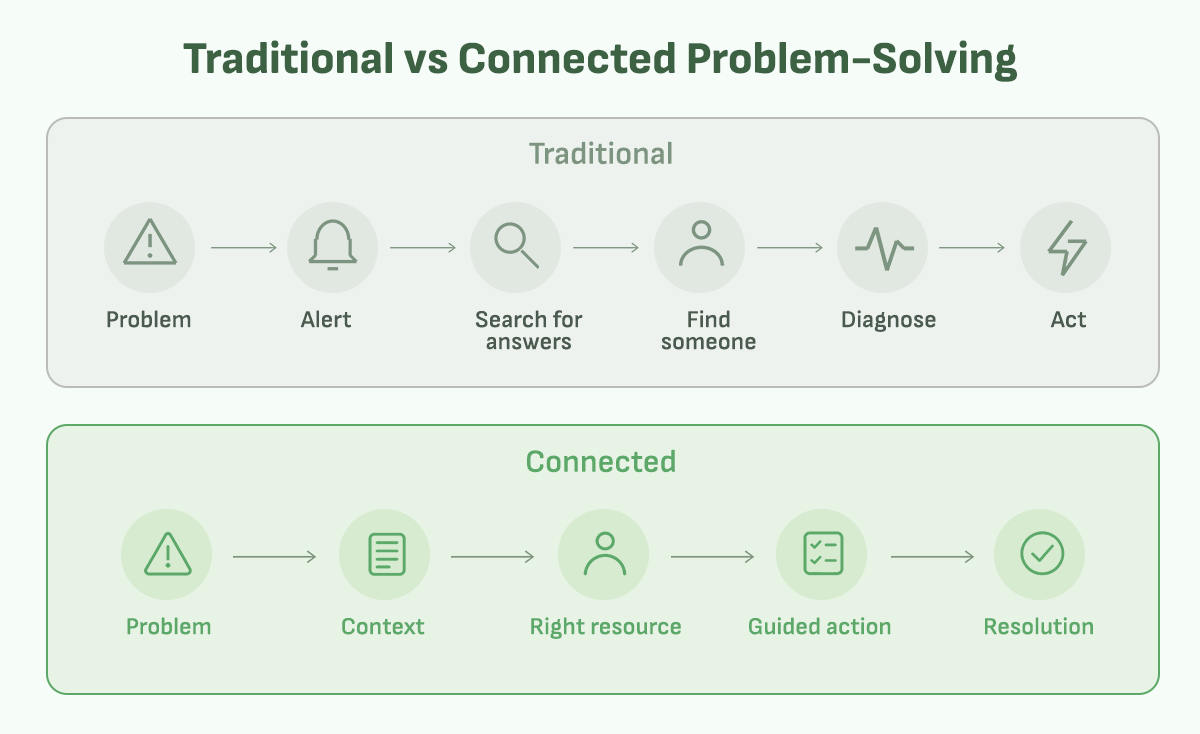
Whereas a system of record captures and stores information, a System of Action connects signals from machines, enterprise systems, and frontline workers and uses them to coordinate a response. It’s a shift from documenting actions to orchestrating them and improving operational performance, which is essential for maintaining healthy margins.
Unlike traditional manufacturing systems, a System of Action works like this:
-
An operational signal automatically triggers the appropriate workflow
-
Alerts or dispatches reach the right person immediately
-
AI provides relevant instructions and context
-
The outcome gets recorded automatically
This distinction matters because the value of operational data is how it can shorten the distance between knowing something is wrong and taking the correct steps to resolve the issue.
Turn operational visibility into action
The next stage of manufacturing transformation is about making existing data operational.
Download L2L's Connected Manufacturing Operations whitepaper to explore how a Conncted Manufacturing Operations Platform can close the execution gap, connect the frontline to real-time operational intelligence, and turn digital investments into measurable business value.