


.svg)
 Shop floor execution
 Maintenance
 Production
 Skills
.png?width=60&height=60&name=chart-line-up%20(1).png) Manufacturing Intelligence
Manufacturing Intelligence
 Automotive
 Building materials
 Packaging
 CMMS/EAM
 MES
MES
 Connected Worker
 Manufacturing Intelligence
 Case studies
 Blog
Blog
 Ebooks & Guides
 Webinars
 Events
.svg) OEE Calculator
OEE Calculator
 Downtime Cost Calculator
 About Us
 Partners
 Newsroom
 Support
 Careers
 Trust center


.svg)


Most manufacturing enterprises aren't short on data. They’re short on the real-time oversight required to make decisive calls.
Site-level reports lag by weeks. Standards vary wildly from plant to plant. By the time a margin leak finally shows up on the enterprise P&L, the window to correct it has already slammed shut.
As manufacturing networks expand, organically or through rapid M&A, executives face a widening disconnect between profitability targets and floor-level execution. The organizations pulling ahead aren't just reading static scorecards; their leadership teams actively drive live P&L priorities directly down to the shop floor.
Here are the five strategic shifts top global networks are making to eliminate performance drag, protect margins, and profitably drive growth at scale.
.png?width=600&height=780&name=Untitled%20(1000%20x%201300%20px).png)
1. Shift from Post-Mortem Productivity to Real-Time Profit
Plant managers track Overall Equipment Efficiency (OEE). Executives receive monthly financial scorecards. The critical flaw? Diagnostic lag. Periodic reports reveal margin hits long after the damage is done, without surfacing the underlying root cause. Every hour of downtime is a margin hit that never comes back.
- The Old Way: Explaining cost variances after the quarter closes.
- The New Way: Treating shop-floor signals as live financial inputs.
Closing the lag window gives executives the network-wide oversight needed to make strategic portfolio calls, prioritizing interventions on high-impact plants to maximize immediate ROI while systematically correcting root causes at lagging sites before operational drag erodes profitability.
2. Benchmark CapEx: Know Which Sites to Fund, Fix, or Close
Deciding which plants need capital investment, standardization, or complete divestment is the portfolio call keeping executives up at night. Without unified cross-site benchmarks, these decisions default to internal politics or guesswork.
Not every site deserves or requires the exact same fix.
Standardized performance data converts capital allocation into a defensible growth. The leadership teams making the smartest CapEx calls are those who can mathematically prove, plant by plant, which facilities yield the fastest payback.
3. Turn M&A Integration into Assets
Scaling through acquisitions is supposed to make the enterprise stronger. Too often, it delivers the opposite result: new facilities bring proprietary systems, disparate standards, and operational blind spots.
An acquired site can sit completely outside leadership’s visibility for months.
Key Takeaway: Adding a plant shouldn't mean adding a black box. The faster a facility adopts a unified operational standard, the faster it transitions from a high-risk liability to a value-generating asset.
Rapid, network-wide standardization is what makes scale a strategic advantage, turning newly added volume into actionable, enterprise-wide intelligence.
4. Reframe On-Time Delivery as a Revenue Line
A missed delivery commitment is rarely a localized shipping glitch. Repeated failures trigger customer dissatisfaction with severe contract penalties, forced account renegotiations, and lost customer lifetime value. The delay that destroys an account rarely happens at the plant you're monitoring closely, it happens at the one you aren't.
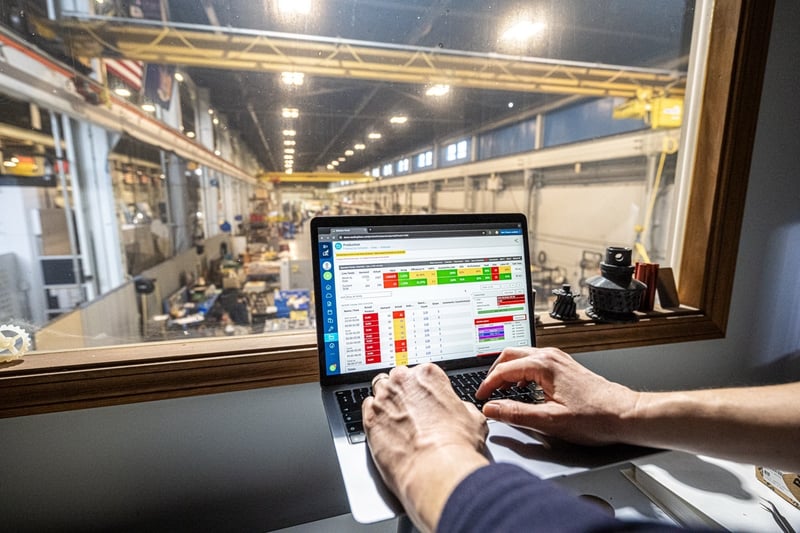
Catching floor-level bottlenecks in real time converts on-time delivery from a passive logistics metric into an actively protected revenue stream. When performance shortfalls surface, leaders need immediate clarity to fix localized constraints or reallocate production volume dynamically across the network.
5. Eliminate Process Friction to Maximize Existing Labor
Labor constraints are a permanent operational reality, not a temporary hiring challenge. Finance won't fund headcount additions to solve what is fundamentally a process flaw.
The most effective lever left? Extracting maximum value from the workforce already on the floor.
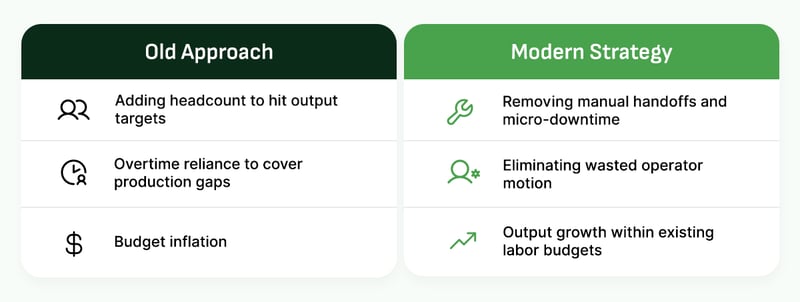
Removing operational friction protects your labor budget while delivering the output gains executive boards demand.
Moving From Passive Dashboards to Prescriptive Action
Seeing a performance gap between your flagship facilities and lagging sites is only step one. Market leaders don't settle for static visibility or passive dashboards, they use real-time operational oversight paired with AI to intervene before profit erodes.
Rather than simply flagging variances, intelligent solutions like L2L’s Connected Manufacturing Operations platform, delivers automated, prescriptive action directly to plant teams. By standardizing best-in-class workflows across every facility, executives can systematically eliminate operational blockers and scale best practices footprint-wide.
Proven Enterprise Impact
- $5B+ in downtime costs recovered for global manufacturers.
- <12 months average payback period.
- 500,000+ active users across 93 countries.
Ready to Eliminate Network Drag?
Stop managing margin leaks after the fact. Request a Portfolio Strategy Review today to evaluate your operational oversight and discover how L2L can optimize performance across your entire enterprise footprint.