


.svg)
 Shop floor execution
 Maintenance
 Production
 Skills
.png?width=60&height=60&name=chart-line-up%20(1).png) Manufacturing Intelligence
Manufacturing Intelligence
 Automotive
 Building materials
 Packaging
 CMMS/EAM
 MES
MES
 Connected Worker
 Manufacturing Intelligence
 Maintenance
 Continuous Improvement
 Operations
 IT
IT
 Executive Leadership
 Case studies
 Blog
Blog
 Ebooks & Guides
 Webinars
 Events
.svg) OEE Calculator
OEE Calculator
 Downtime Cost Calculator
 About Us
 Partners
 Newsroom
 Support
 Careers
 Trust center


.svg)

Artificial intelligence (AI) has officially moved past the hype phase in manufacturing intelligence.
Plant leaders aren't interested in whether AI sounds impressive. They want to know if it helps them hit their production targets, reduce downtime, and control variability. Simply put, they only care if using AI in production actually improves how they manage operations.
For many facilities, it does—when applied to the right problems and built on connected, reliable data.
Let’s take a look at the top ways manufacturers are using AI in production processes today.
The role of AI in production
In operational terms, AI is used in manufacturing production to analyze plant data and surface patterns, risks, or predictions that help teams make better decisions.
That data can include:
AI models evaluate this information at scale. They detect trends that aren’t obvious in static reports and flag emerging issues earlier than traditional dashboards.
The goal of using AI in production management is to enable stronger decision-making, fewer surprises mid-shift, and more informed trade-offs between output, maintenance, and quality. In fact, McKinsey & Company reports that manufacturers are seeing double-digit cost savings within 12 months of deploying industrial AI. Deloitte’s 2026 Industry Outlook cites scheduling, planning, and workforce management as key areas of AI investment for manufacturers.
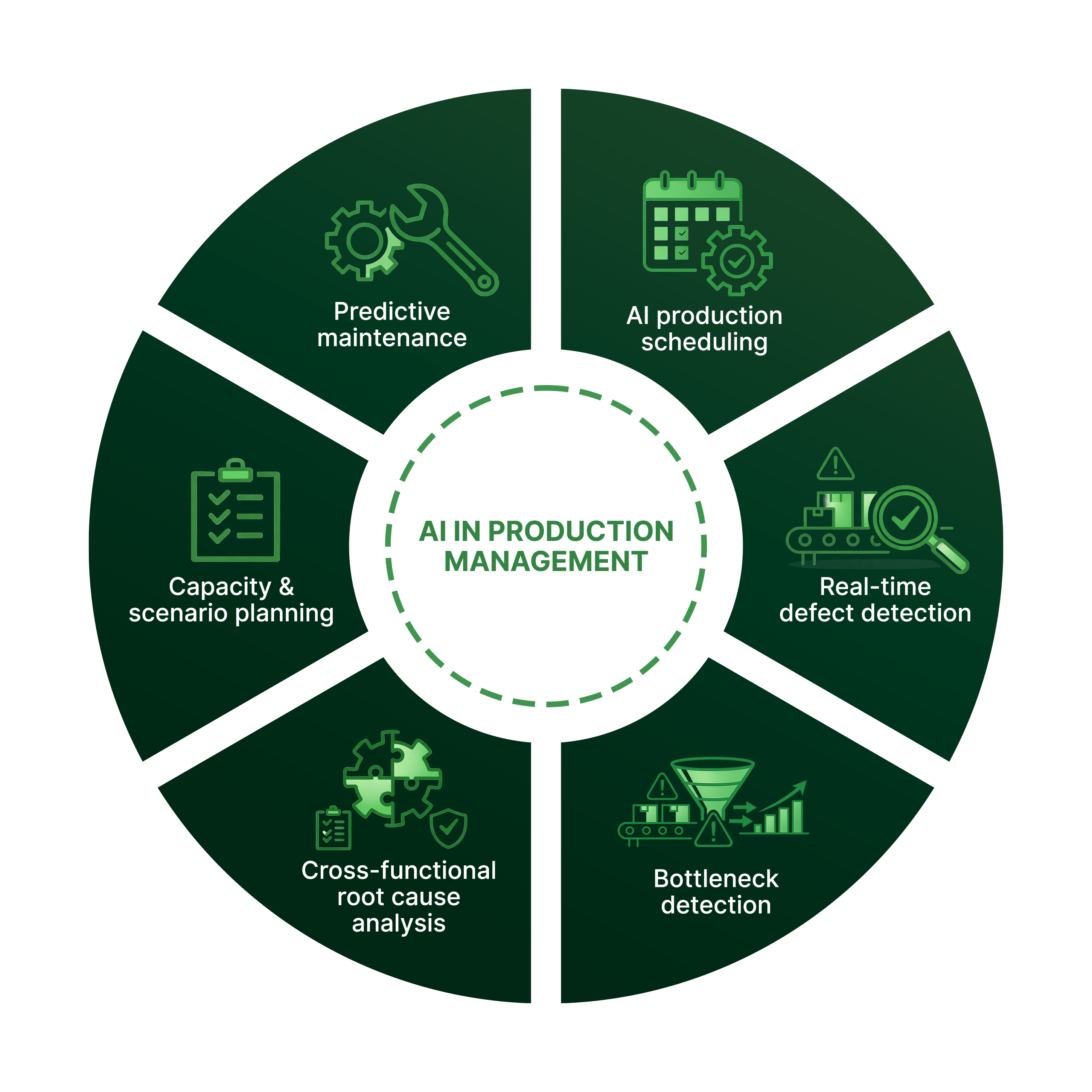
High-impact use cases for AI in production management
The pattern is clear: Industrial AI adoption is accelerating where it directly affects throughput, uptime, and quality. Here’s how loading manufacturers are putting AI to work in production.
1. Predictive maintenance to reduce unplanned downtime
Unplanned downtime remains one of the biggest constraints on production output.
In predictive maintenance, AI models analyze historical machine data, sensor signals, and failure patterns to predict breakdown risk. This allows maintenance teams to intervene during controlled windows rather than reacting to emergencies.
Predictive AI applications in maintenance provide powerful benefits for manufacturers, including:
- Better machine performance: Using artificial intelligence to predict potential equipment failures helps plant leaders optimize maintenance schedules and minimize disruptions.
- Improved asset lifespans: Predictive analytics not only helps prevent unplanned breakdowns but also mitigates excessive mechanical wear and tear.
- Cost and time savings: By optimizing production and maintenance schedules—plus spare parts inventory management—AI-powered maintenance saves companies both time and money.
For production managers, the ability to predict equipment failures translates to fewer unexpected schedule disruptions and more reliable throughput.
2. AI-enhanced production scheduling for flow optimization
Production scheduling in complex manufacturing environments is challenging because it must balance labor availability, machine capacity, material arrival times, and changeovers, all while responding to real-time variability.
AI systems can evaluate operational data continuously and spot trends that indicate potential schedule risk. In practice, this means a line that’s trending slow can be flagged early, workers can be reassigned, or sequencing changes can be tested before delays cascade across the plant.
A recent article in Scientific Reports about smart production management shows that AI-driven scheduling and real-time optimization are key priorities among manufacturers adopting intelligent systems. Predictive and adaptive scheduling models are considered essential for responsive operations, and their adoption rates are climbing relative to other AI applications.
While traditional scheduling relies on static data, AI brings dynamic insight that reflects what’s actually occurring on the floor. This enables planners and production managers to set more realistic expectations and react sooner when plan deviations emerge.
3. Real-time defect detection for enhanced quality control
Quality control has long been a labor-intensive and error-prone part of production management. AI-powered quality systems, especially computer vision models, can scan products as they move through the line and detect anomalies that human inspectors might miss. AI-based inspection tools have been shown to improve defect detection rates and reduce rework, enabling faster corrective action without slowing throughput.
Instead of relying on periodic sampling, real-time AI systems assess every component produced. This early detection identifies issues much sooner, which reduces scrap and enhances overall product consistency. Manufacturers using these models in quality containment processes find that fewer defects move downstream, which saves labor costs and improves first-pass yield.
Fast, automated quality checks can also reduce inspection backlogs. This gives quality teams time to focus on systemic process improvements rather than repetitive visual checks.
4. Intelligent bottleneck detection for throughput improvements
AI models can analyze production data to reveal patterns that aren’t always visible in daily reports, such as:
- Recurring slowdowns on specific machines
- Unusually long queue times during certain shifts
- Cumulative effects of minor stops
Applied to manufacturing production monitoring, real-time analytics and AI tools increase operational visibility and help teams detect bottlenecks before they erode throughput. These tools do more than just highlight process inefficiencies—they also surface when, where, and why performance is hurting.
For example, AI may find that a sequence of small delays on one machine adds up to a significant constraint over a shift. Managers can then prioritize interventions that unlock capacity and prevent downstream lines from starving. This kind of insight helps production leaders manage flow with greater confidence and calibrate resources more effectively.
5. Cross-functional root cause analysis
Production issues rarely happen in just one silo. A spike in scrap may be tied to a maintenance interval that slipped. Recurring downtime might align with a specific material batch. AI helps bring these factors into view by correlating data across quality, maintenance, and production domains.
Research on smart production management reveals that AI supports quality control, real-time decision-making, and supply chain synchronization, making it easier to discover relationships across operational functions that would otherwise require manual data sifting.

Tools like L2L's AI Insights help manufacturers quickly spot and solve production issues.
In practice, this improves corrective action efficiency. Instead of investigating issues in isolation (and repeatedly chasing symptoms), teams can link outcomes across datasets and address root causes directly. Over time, these insights can feed continuous improvement processes with fewer assumptions and more evidence-based direction.
6. Capacity planning and scenario evaluation
AI’s ability to analyze historical patterns and current conditions makes it useful for forecasting production capacity and evaluating “what if” scenarios.
Rather than relying on static averages or intuition, models can quantify how changes (e.g., a maintenance window, shift change, or product mix) could impact throughput. This form of dynamic forecasting supports planning conversations with sales, supply chain, and operations.
While advanced applications like full digital twins are still emerging, the underlying notion that AI improves forecasting accuracy is gaining traction in industry research into smart production.
For plant managers, these insights lead to more realistic commitments and better alignment between planned output and operational constraints. These benefits mean less friction between departments and better overall business responsiveness.
Why connected operations matter for AI in production
Despite strong use cases, AI projects often stall for one reason: disconnected data.
If maintenance logs, downtime events, scrap tracking, and production counts live in separate systems, AI models lack full context and insights become partial or unreliable. Recent research on industrial AI demonstrates that siloed data is perhaps the biggest barrier to successful AI implementation in production processes.
The bottom line: AI performs best when it has a unified, structured view of operations.
For AI in production management to deliver consistent results, production, maintenance, and quality data must live in one operational ecosystem.
A connected manufacturing operations platform ensures that:
- Downtime events are logged consistently
- Work orders link directly to production records
- Quality issues align with asset and shift data
- Performance metrics are standardized across departments
When plant data is unified, AI analytics become trustworthy and actionable. Without that foundation, even sophisticated models struggle to deliver value.
How L2L helps you get the most from AI in production
L2L brings production, maintenance, and quality data into a single real-time platform. Machine statuses, production schedules, work orders, and inventory levels are captured in one place instead of multiple disconnected systems.
That connected foundation creates the conditions where AI can deliver meaningful insights, whether you’re focused on improving maintenance programs, streamlining scheduling, quality control, or throughput forecasting.
Manufacturers that succeed with AI treat it as an operational capability, not a standalone project. Schedule a demo with L2L to see how you can unlock the full value of AI in production management.