 Automotive
 Industrial materials
 Packaging
 CMMS/EAM
 MES
MES
 Connected Worker
 Manufacturing Intelligence
 Maintenance
 Continuous Improvement
 Operations
 IT
IT
 Executive Leadership
 Case studies
 Blog
Blog
 Ebooks & Guides
 Webinars
 Events
.svg) OEE Calculator
OEE Calculator
 Downtime Cost Calculator
 About Us
 Partners
 Newsroom
 Support
 Careers
 Trust center


.svg)

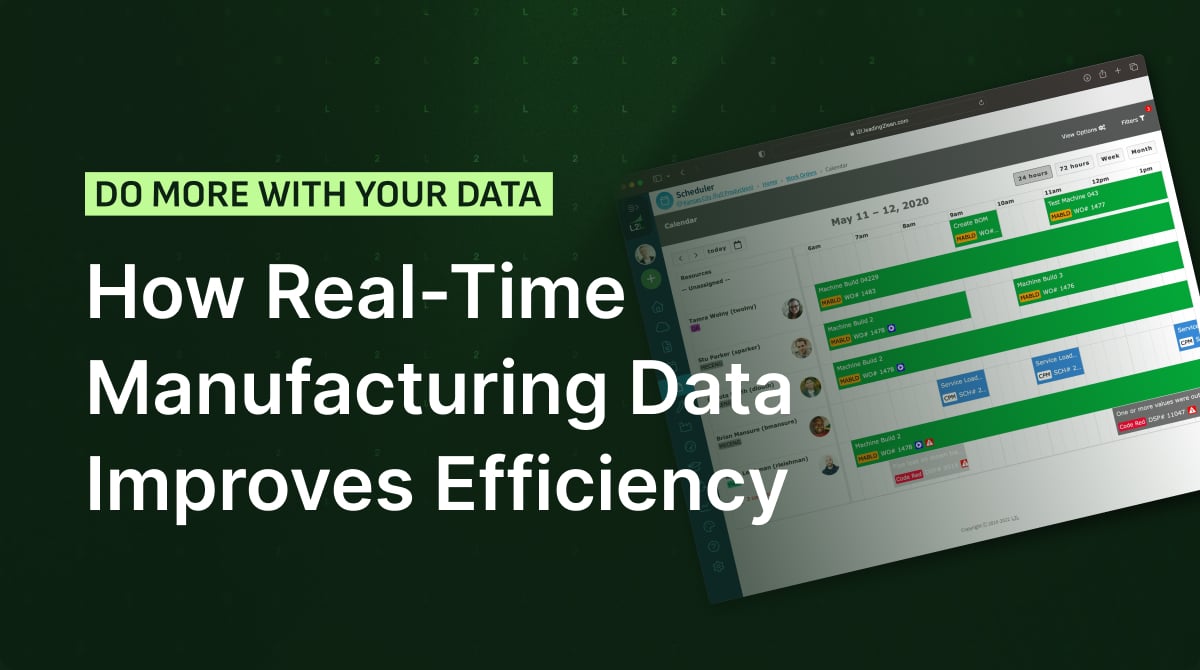
Today’s manufacturers often spend more time managing and analyzing their data than they do producing great products. Manufacturing data—whether it’s machine health, shift reports, maintenance orders, or employee skills—is the key to understanding and improving operations at scale. It provides the baseline for all future improvements.
But in 2026, it’s not enough for data to just be accurate. And it’s not enough for it to be available. Operational data needs to be accessible in real time to drive action and establish scalable, repeatable processes.
From eliminating manual work to maximizing machine uptime, check out these five ways that real-time manufacturing data improves your operational efficiency.

1. Reduce unplanned downtime and increase asset availability
By capturing and analyzing data as it happens, plants can drastically reduce downtime and ensure that their most valuable assets remain online and productive. Real-time data, delivered in a way that’s easy to use and easy to understand, allows manufacturing teams to take action before problems occur and deliver the correct fix every time.
Reducing MTTR: When an issue arises, technicians can reference historical data and recommended fixes. Maintenance teams arrive at the machine with the right tools and parts already in hand, significantly reducing Mean Time to Repair (MTTR).
Eliminating micro-stoppages: Small, frequent halts often go unrecorded in manual logs. Advanced tracking shines a light on these stoppages, allowing for process tweaks that improve uptime and efficiency.
Data-Driven OEE: Real-time insights provide an accurate, unfiltered look at Overall Equipment Effectiveness (OEE), helping leaders identify which assets are underperforming and why. This is the first step towards solving a number of issues like downtime, slow cycle times, and defects.
From reactive to predictive: Instead of waiting for a machine to fail, machine sensors detect anomalies, like abnormal vibrations or heat spikes. This allows maintenance teams to intervene before a breakdown occurs. Before predictive maintenance can be put into place, manufacturers first need to transition into a data-driven preventive maintenance model.
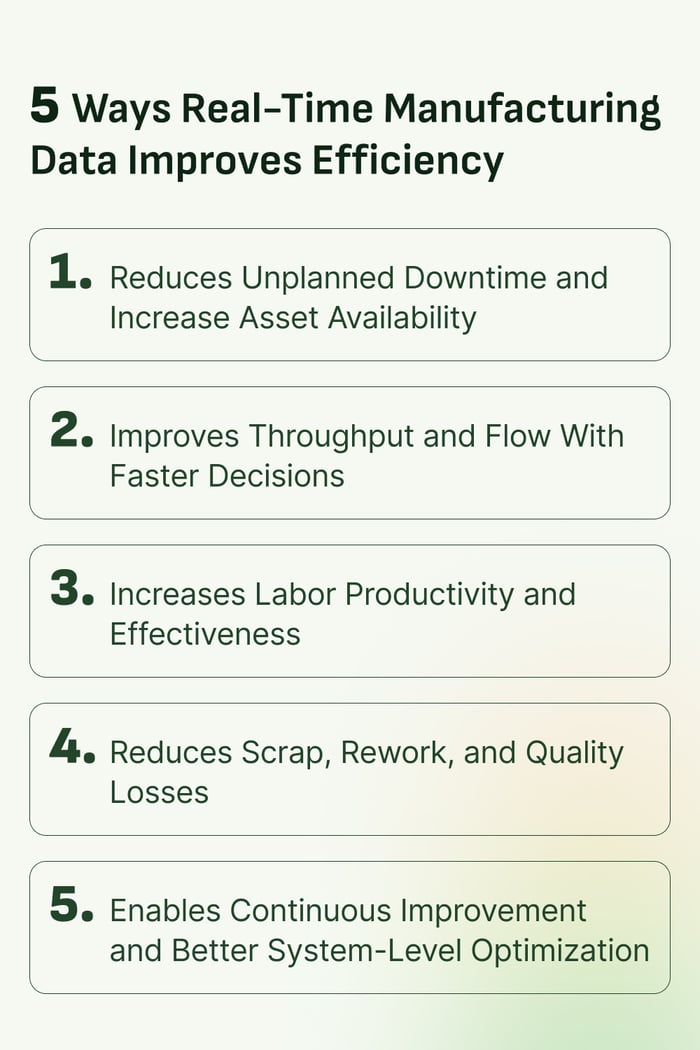
2. Improve throughput and flow with better visibility
Don’t wait until the end of the shift to identify bottlenecks. Shifting from passive data collection to real-time data dashboards gives leaders the visibility to better orchestrate production processes.
Identify bottlenecks: Live dashboards highlight exactly where a line is stalling. Instead of "walking the line" to find the problem, teams can see a backup in real time and reallocate labor or resources immediately to fix the problem.
Better frontline decisions: You can eliminate the "wait for the supervisor" lag by providing workers with live OEE and production targets on tablets or wearables. This makes it easier for teams to pivot, troubleshoot, and adjust settings in the flow of work.
Flow optimization: Real-time data allows for "on-the-fly" scheduling. If a machine’s performance dips, the system can automatically flag the risk and suggest sequence changes before the entire day’s maintenance schedule is compromised.
Synchronized supply and demand: When production data is live, upstream and downstream processes stay in sync. This prevents overproduction at one station and “starving” at another, creating a "pull" system that maximizes total plant output.
3. Increased frontline productivity and effectiveness.
Manufacturing skills gaps are often data gaps. Even in today’s modern facilities, frontline teams are often the last to know when things go wrong. Operators rely on experience, paper or Excel logs, and end-of-shift reports in order to understand how they’re performing on the shop floor.
Whether it’s a real-time skills management system or a tool that allows operators to instantly flag deviations, real-time data keeps operators connected to the resources they need to keep lines running at peak efficiency.
Eliminating administrative friction: Manual data entry and consulting with supervisors are huge productivity drains. Real-time systems automate data capture, allowing workers to spend their time on value-added tasks rather than filling out reports.
Democratizing expertise: With digital standard operating procedures (SOPs) and work instructions, even a new hire can perform like a seasoned employee. The "tribal knowledge" locked in the heads of a few is replaced by a digital repository of operational knowledge.
Instant feedback loops: When workers can see their performance against targets in real-time, it creates a sense of ownership and allows for micro-adjustments throughout the shift, preventing small deviations from turning into major quality or output issues.
Streamlined escalation: Real-time platforms allow for instant, data-backed escalations with tools like Dispatch, creating immediate visibility to deviations and ensuring the right support arrives with the right context on time.
Closing the skills gap in real-time: Modern skills management and development systems help teams identify and track skills gaps while proactively addressing them with reskilling initiatives and training.
4. Reduce scrap, rework, and quality losses
To stay competitive in today’s industry, manufacturers must pivot from a reactive way of working to a model powered by live, actionable data.
This data acts as a digital safety net, catching process drifts before they manifest as waste. Closing the gap between deviation and detection transforms initiatives from damage control to true quality assurance.
Automated quality controls: Digital workflows can enforce "stop-ship" alerts or machine interlocks the moment a quality threshold is breached. This prevents a batch of defective products from moving downstream and accumulating further value-added costs.
Contextual RCA: When a defect occurs, systems provide a "snapshot" of the exact machine conditions at that moment. This eliminates the guesswork of traditional post-mortems, helping teams fix the underlying process issue rather than just treating the symptom.
Standardized knowledge: Delivering SOPs, checklists, and work instructions via mobile technology on the shop floor means that every operator has access to the most up-to-date operational knowledge. This reduces human error and significantly reduces the administrative bottlenecks caused by updating out-of-date resources.
5. Enables continuous improvement and system-level optimization
Real-time data means that your ability to optimize doesn’t stop at a single machine, line, or site: improvements can be scaled effectively across your entire organization. This visibility provides the standardized insights needed to move beyond localized fixes and towards improvement at the enterprise level.
Validating hypotheses in real time: CI teams no longer have to wait weeks to see if a process change worked. With live feedback loops, you can pilot a change and see the impact on OEE or throughput within minutes, allowing for rapid "Plan-Do-Check-Act" (PDCA) cycles.
Uncovering the hidden factory: An effective dashboard exposes the micro-stoppages and minor process variances that never make it into paper logs. These small gains, when aggregated across a system, represent a significant untapped opportunity for margin growth.
Cross-site benchmarking: System-level optimization means looking at the big picture. Real-time platforms allow leadership to compare performance across multiple sites instantly, identifying high-performing plants and scaling their success across the entire organization.
Good data creates opportunities for action
The most effective systems for data are designed to scale and support change in your operations. The L2L platform doesn’t just deliver data. It provides guidance, insights, and suggestions to help teams make better decisions and improve day-by-day.
Start improving your productivity, reducing errors, and engaging your frontline teams with data and analytics that support action. Book a personalized demo with our digital transformation experts to learn how to get started.