 Automotive
 Industrial materials
 Packaging
 CMMS/EAM
 MES
MES
 Connected Worker
 Manufacturing Intelligence
 Maintenance
 Continuous Improvement
 Operations
 IT
IT
 Executive Leadership
 Case studies
 Blog
Blog
 Ebooks & Guides
 Webinars
 Events
.svg) OEE Calculator
OEE Calculator
 Downtime Cost Calculator
 About Us
 Partners
 Newsroom
 Support
 Careers
 Trust center


.svg)

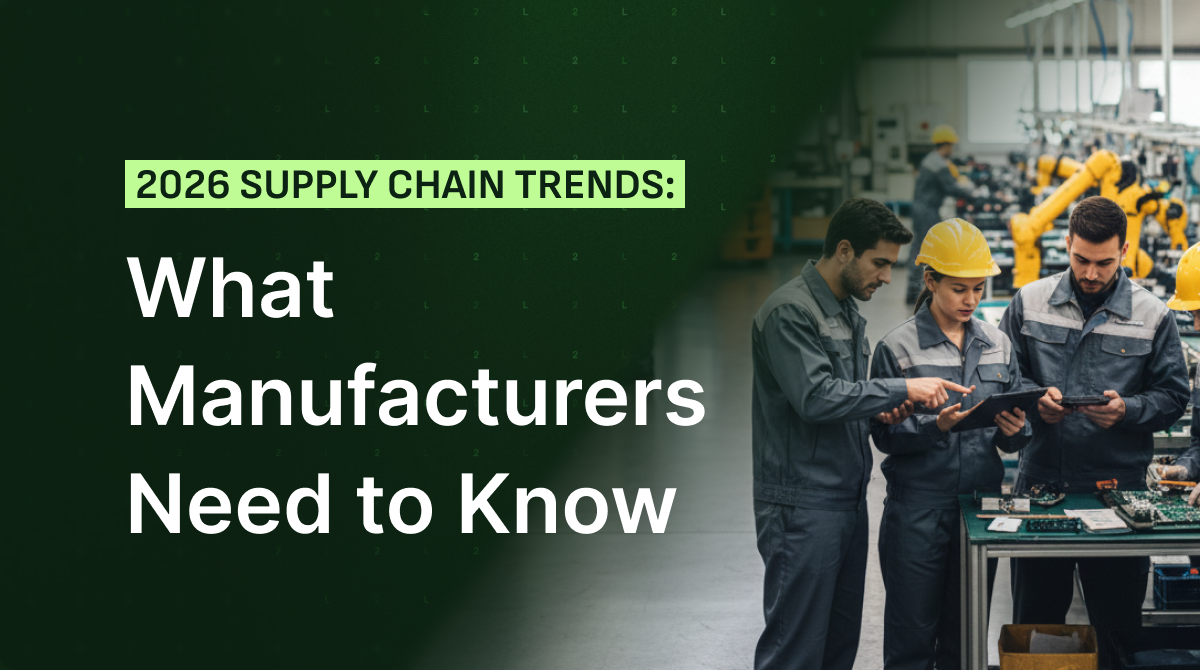
2025 presented a slew of supply chain challenges for manufacturers across the globe, from trade policy changes to accelerating AI adoption. And the disruptions won’t stop in 2026, which is shaping up to be a year laser-focused on risk mitigation.
Cost fluctuations, labor shortages, evolving customer expectations, and global uncertainty mean organizations must be able to sense, adapt, and respond to disruptions in real time. Here are the major trends shaping the 2026 supply chain landscape—and what they mean for manufacturing leaders.
1. Real-time visibility and actionable insights are a baseline
Real-time visibility is now the basic entry requirement. What truly matters is what organizations do with that data. Deloitte reports that industrial manufacturers are making targeted investments in digital and data foundations. This will help them drive innovation and mitigate supply chain challenges in 2026 and beyond.
Companies are shifting from passive dashboards to systems that provide context, highlighting what the data means, why it matters, and what actions should follow. Critical tasks like scenario planning, risk identification, and trade route optimization are commonly facilitated by AI-driven technology, according to a 2025 Thomas Reuters report.
For manufacturers, the shift from data analysis to data activation means integrating production systems, supplier signals, and logistics data into a single operational view. For example, when a shipment delay affects a specific work order, the system can automatically flag the risk, recommend alternatives, or adjust schedules long before the issue impacts production. The value isn’t the data itself, but the speed and clarity with which teams can act on it.
2. AI shifts from analyst to decision maker
Artificial intelligence (AI) is transitioning from an advisor to an operator. Instead of simply showing trends, AI systems will make and execute decisions automatically.
In 2026, we can expect AI agents to continuously analyze logistics flows, supplier reliability, inventory positions, and demand patterns. When disruptions arise, AI won’t wait for human review to maintain continuity. Instead, it will automatically reroute shipments, rebalance inventory, or even adjust production timing to keep output stable. These systems learn from every event, improving their accuracy and decision quality over time.
Agentic AI creates a major advantage for manufacturers. Rather than managing day-to-day fire drills and manual rework, teams can focus on things like:
- Strategic improvements
- Capacity planning
- Continuous improvement of existing processes
- Nurturing customer and supplier relationships
According to a 2025 survey by Prologis, 70% of companies now report advanced or transformational AI adoption in their supply chains, and companies expect AI to drive the majority of supply chain decisions by 2030. While AI won’t replace human expertise, it will amplify it by handling the repetitive, high-volume decisions that slow teams down.
3. Supply chains become modular and multimodal
Manufacturing supply chains now stretch across transport modes, geographies, and digital ecosystems. To improve resilience in 2026, companies are building modular networks that can reconfigure based on cost, risk, or customer needs.
In short, flexibility becomes the defining competitive advantage. Organizations are redesigning their supply chains to support reshoring, nearshoring, and multimodal routing strategies. Prologis shows that almost 9 in 10 companies experienced energy disruptions in the past year. Additionally, 90% said they would pay a premium for sites with reliable energy infrastructure.

As grids become more strained globally, the ability to reroute production, shift logistics flows, or activate backup capacity becomes a key resilience capability instead of a contingency.
Multimodal visibility—across ocean, air, rail, road, and warehouse transitions—helps manufacturers adjust production timelines based on where materials are and what bottlenecks are emerging. This level of transparency stabilizes output, reduces material shortages, and helps plants maintain consistent throughput.
4. Antifragility is the new resilience
In 2026, supply chain resilience will no longer be enough. Antifragility is now a bigger performance expectation. But what’s the difference?
Resilience is the ability of a supply chain to recover quickly from disruptions. Antifragility takes resilience a step further. It refers to the process of adapting to and ultimately improving in the wake of disruptions.
Instead of asking, “How did we respond?” manufacturers ask, “What did we learn and improve?” This shift encourages teams to build adaptive processes that evolve with every challenge.
Manufacturers are also adopting more sophisticated metrics:
- Time-to-detect: How quickly a disruption or abnormal condition is identified within the supply chain or production environment
- Time-to-adjust: How fast an organization can implement corrective actions, such as rescheduling, rerouting, or reallocating resources, after a disruption is detected
- Rerouting efficiency: How effectively orders or shipments can be directed to alternative routes or suppliers with minimal impact on supply chain costs, timelines, or operations
- Scenario-informed improvements: Measurable performance gains that come from analyzing past disruptions and applying those insights to strengthen future responses
These indicators show not just how well a supply chain survives volatility, but how effectively it adapts and reduces future exposure.
In fact, a recent survey found that 86.2% of respondents said they had worked to de-risk their supply chains in the past two years. This mindset pushes organizations toward proactive planning. Stress-testing supplier networks, using predictive analytics to uncover vulnerabilities, and automating responses helps companies turn disruptions create valuable insights.
5. Sustainability becomes a standard operational metric
As manufacturing EHS regulations become stricter across the globe, organizations will be expected to standardize sustainable practices in every area of their supply chain. This means that individual CO2 reports won’t be enough. Carbon data, ethical sourcing requirements, and regulatory compliance will be integrated into industrial workflows.
According to a 2025 MIT report, 85% of corporations surveyed said they planned to maintain or increase supply chain sustainability efforts. In 2026, manufacturers will increase investment in reducing supply chain carbon emissions through practices such as:
- Inputting emissions into production scheduling
- Optimizing transportation routes and methods for speed
- Using operational infrastructure more efficiently
With sustainability becoming a real-time operational requirement, manufacturers will likely increase their investments in emissions-tracking and supply chain optimization technologies.
6. Upskilling the workforce reaches mission-critical status
As supply chains become more digital and automated, workforce capability will be either a limiter or an accelerant. One study reveals that up to 1.9 million U.S. manufacturing jobs could go unfilled over the next decade if workforce skills gaps aren’t addressed, directly impacting supply chain operations.
Manufacturers now view upskilling as strategic instead of a “nice to have.” Workers need stronger digital skills (especially with AI-enabled tools) and the ability to interpret real-time data. At the same time, soft skills like problem‐solving, cross-functional communication, and adaptability are increasingly important.
According to L2L’s 2025 Manufacturing Skills Report, 83% of supervisors spend much of their working hours making up for skills deficiencies. Yet, only 22% of industrial employees think their organizations value upskilling.

To maintain a steady flow of high-quality goods, manufacturers are being forced to close this gap. An upskilled workforce reduces downtime, adopts new technologies quickly, and exhibits strong problem-solving capabilities. Moreover, improving skills boosts retention and empowers frontlines to engage with new systems and processes confidently.
Prepare your manufacturing operations for 2026 supply chain trends
Supply chains are becoming more connected, intelligent, and complex. Manufacturing leaders need systems that link plant floor performance with supplier and logistics data so teams can act quickly, consistently, and with confidence.
When you're ready to modernize your supply chain and strengthen your operational resilience, L2L’s connected manufacturing operations platform can help you unify data, automate workflows, and equip your teams to stay ahead of disruptions.
Discover how L2L boosts operational efficiency in as little as six weeks when you schedule a personalized demo with our manufacturing experts.