


.svg)
 Shop floor execution
 Maintenance
 Production
 Skills
.png?width=60&height=60&name=chart-line-up%20(1).png) Manufacturing Intelligence
Manufacturing Intelligence
 Automotive
 Building materials
 Packaging
 CMMS/EAM
 MES
MES
 Connected Worker
 Manufacturing Intelligence
 Case studies
 Blog
Blog
 Ebooks & Guides
 Webinars
 Events
.svg) OEE Calculator
OEE Calculator
 Downtime Cost Calculator
 About Us
 Partners
 Newsroom
 Support
 Careers
 Trust center


.svg)

Standard work. Processes. Procedures. Work instructions.
We’re betting you've talked about all of these terms often.
But what is actually the difference between them? Understanding them can make a difference in how you plan and execute your work to achieve predictable and consistent results.
What is standard work?
First and foremost: what is standard work?
→ Standard work = the combination of processes, procedures, and visual work instructions. It explains the best practices for performing a task according to standard in a consistent way - no matter who does it.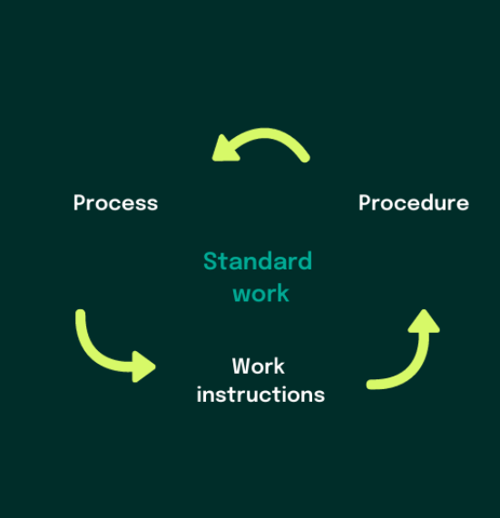
Standard work is the combination of processes, procedures, and work instructions.
Key elements of standard work.
Standard work comes down to three connected elements: takt time, work sequence, and standard work-in-process (WIP).
Takt time sets the pace. It aligns production with actual customer demand, so teams know exactly how fast they need to work, without guesswork or overproduction.
Work sequence defines the best-known way to complete each task, step by step. It captures not just what to do, but the precise order to do it in, ensuring consistency across operators, shifts, and sites.
Standard WIP establishes the minimum inventory needed to keep that sequence flowing smoothly. It’s the buffer that keeps operations stable without hiding inefficiencies.
Together, these elements create a repeatable, measurable baseline. When they’re clearly defined and digitally connected, teams can spot deviations instantly, sustain performance, and continuously improve without disrupting flow.
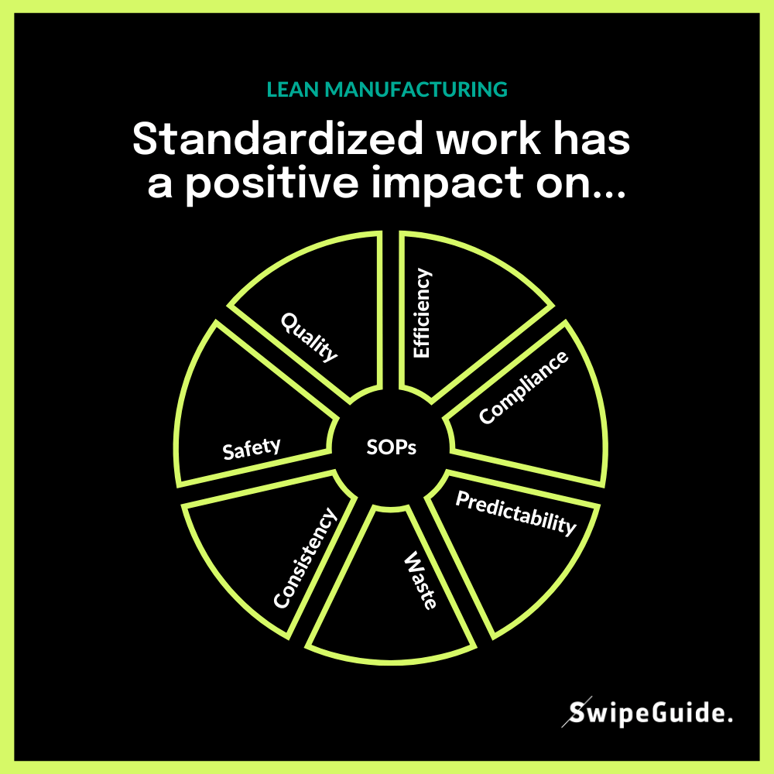
Reasons to love standard work.
- Predictability: Standardized work allows teams to meet industry standards and compliance goals, including ISO 9000 and ISO 9001.
- Consistency: Lean manufacturing and continuous improvement depend on consistency. This impacts your bottom line ($) and product quality.
- Safety: Having clear standardized procedures in place, you can avoid accidents and severe safety incidents from happening.
- Training: Standard work also ensures efficient onboarding and training of new team members.
- Reduce waste: Spare those resources. Standardize your processes.
What is process?
→Process = A set of related or interacting activities, which transform inputs into outputs.
In the most basic terms possible, processes outline the what of the shop floor. You can think of them as the rigid and thorough strategies that define the various moving parts of your manufacturing operations:
- Activities: What is being done?
- Roles: Who is involved in the process?
- Events: What steps need to be completed?
- End state: what will be accomplished when the process is completed
Processes are so important because they clearly define the big picture of your day-to-day operations. In fact, the other two terms in this post, procedures and work instructions, are systems put in place to ensure their success.
In addition to providing a thorough structure and way of working, processes play a critical role in ensuring compliance with international manufacturing standards such as ISO 9000 and ISO 9001.
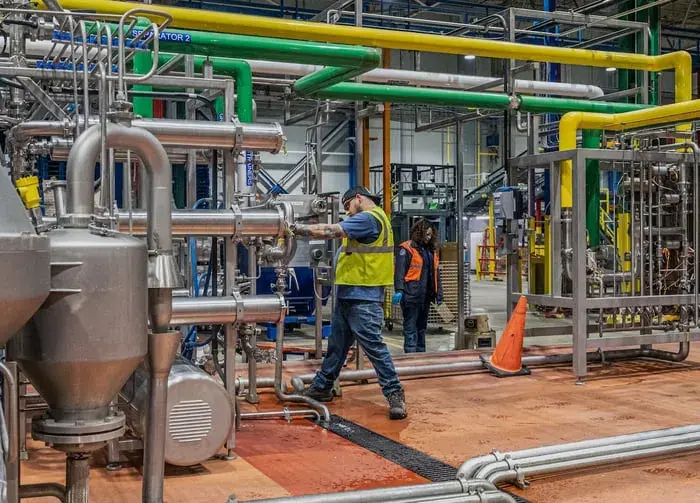
Processes outline WHAT needs to happen and are crucial in standard work.
Everything to know about procedure.
→Procedure = When you have a process that must happen in a specific way, and you specify how it happens, you have a procedure.
Procedures are the specific ways of working that allow manufacturers to effectively carry out processes. Think about it like this - if a process were a house, procedures would be the beams, walls, and bricks that hold it up.
Procedures are essential for effectively carrying out your larger processes on the shop floor. Standard operating procedures break down any process into a series of concrete steps that ensure the successful transition from input to output.
Example of a procedure in a bottling line:
Let's take a look at a common process within the food and beverage industry: bottling beer in a bottling line. In order to complete this successfully, several things need to happen in the correct order. A procedure will detail:
- The way in which an employee fills a bottle or places a label on a finished bottle of beer.
- The materials involved in this process
- Which tools and standards need to be involved and consistently checked during the completion of this activity.
- How the finished product should look.
- Any potential missteps or errors that need to be addressed.
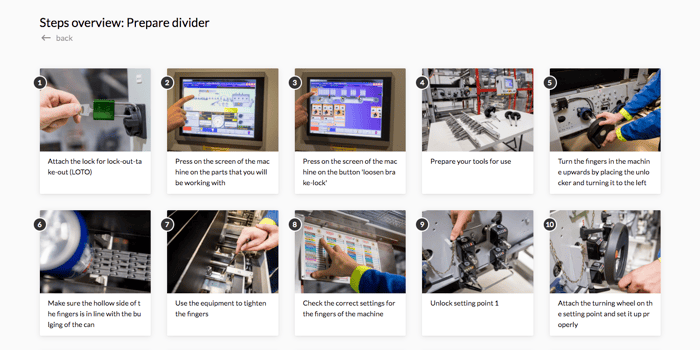
Procedures break down processes into a series of concrete steps.
Defining work instructions.
→Work instructions = instruct the best way to complete a specific procedure. They translate procedure into a human-centered way of working that allows any employee on the shop floor to complete a task at hand.
Why are good work instructions critical?
- Work instructions are the foundation upon which effective processes and procedures are built and ensure the successful performance of a procedure.
- They include all of the explicit information needed to carry out a task.
- They make task execution safe, efficient, and compliant.
Procedure vs work instructions.
If processes and procedures define the way of working, then work instructions are the critical link between standard work and the human element of manufacturing.
Nurturing the humans on the shop floor is absolutely critical to success and efficiency in manufacturing, according to lean thinking. Philosophies like Training Within Industry (TWI) demonstrate the power of creating user-centered programs to drive the continuous improvement of your processes and procedures.
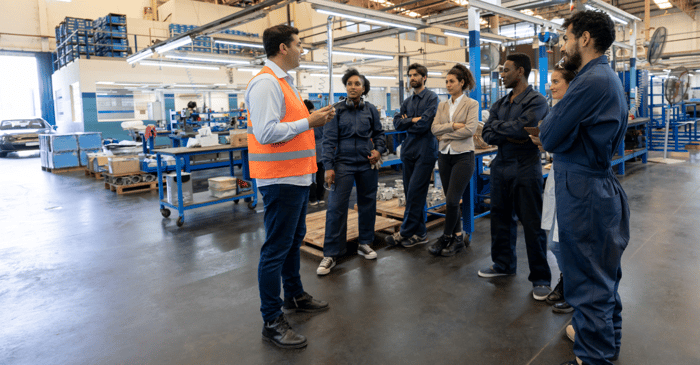
Accessible digital work instructions will help you get new team members up to speed.
Where to implement standard work.
Standard work should be implemented anywhere consistency, quality, and repeatability matter—which, in modern manufacturing, is nearly everywhere. But the highest impact starts on the frontline:
-
Critical production processes
-
Changeovers
-
Quality checks
-
Maintenance tasks where variation directly affects output
Focus first on areas with the most variability or risk: bottleneck operations, high-defect processes, and tasks that rely heavily on tribal knowledge. These are the places where standard work quickly drives measurable gains in throughput, quality, and safety.
From there, expand beyond the line. Standard work isn’t just for operators. It applies to supervisors managing escalations, engineers rolling out process changes, and maintenance teams responding to issues. When everyone works from a clear, shared standard, coordination improves and gaps disappear.
Digitally connected standard work makes this scalable. It ensures updates are instant, adoption is visible, and best practices don’t stay siloed. The result is a more aligned operation where every role, every process, and every site is working from the same playbook.
The difference between standard work and standardized work.
You'll hear both "standard work" and "standardized work" on the shop floor - often used to describe the same thing. However, there are subtle differences between the terms:
-
Standard work specifically pertains to individual tasks. The term describes things like documentation and established best practices of a particular job.
- Standardized work focuses on the process of maintaining standard procedures. It encompasses standard work plus the training of workers to follow standards and sustain best practices for continuous improvement.
Digital work instructions for the future.
Manufacturing is only becoming faster and more complex. Work instructions that effectively supported your processes and procedures 20 years ago simply won’t cut it today. Digitized factories, a rapidly changing and dynamic workforce, and fierce global competition mean that work instructions need to keep pace with Industry 4.0 and the factory floor of the future.
To read more about how great digital work instructions support standard work and make a difference on the shop floor, check out these additional resources:
👉 Ebook: "Create Better Work Instructions."
👉 Article: "SOP Best Practices & Guidelines"
👉 ROI whitepaper: "Maximize Efficiency and Minimize Waste