


.svg)
 Shop floor execution
 Maintenance
 Production
 Skills
.png?width=60&height=60&name=chart-line-up%20(1).png) Manufacturing Intelligence
Manufacturing Intelligence
 Automotive
 Building materials
 Packaging
 CMMS/EAM
 MES
MES
 Connected Worker
 Manufacturing Intelligence
 Case studies
 Blog
Blog
 Ebooks & Guides
 Webinars
 Events
.svg) OEE Calculator
OEE Calculator
 Downtime Cost Calculator
 About Us
 Partners
 Newsroom
 Support
 Careers
 Trust center


.svg)

It’s 7:00 AM on a Friday, and the first-shift production meeting is off to a chaotic start. Why did Line 4 lose nearly 40 minutes during the second shift? Did maintenance actually resolve the press issue, or did it carry over? Why is scrap climbing on the same part family?
If these questions sound familiar, you already know the frustrating reality: the answers are almost always trapped in siloed systems, paper shift handoffs, or scribbled on a whiteboard.
In the automotive industry, we often assume that margin erosion is driven by catastrophic equipment failures. But the truth is far more subtle—and far more costly. Plants aren't just losing money to broken machines; they are losing it to missed handoffs, trapped data, and small, undocumented stops that nobody is tracking.
The Non-Machine Friction Point
Vehicle production has never been more complex. Managing the simultaneous variation of internal combustion engines (ICE), hybrids, and electric vehicles (EVs) introduces a massive wave of part variations, specialized process steps, and intense changeover pressure.
Yet, data shows that 65% of shop floor friction actually comes from non-machine issues—such as weak communication and fragmented handoffs.
Consider the typical ripple effect:
- A tooling change occurs, and quality flags a minor defect. Because production doesn't get the update fast enough, the line keeps running, racking up expensive scrap.
- A critical setup note remains buried in a shift handoff spreadsheet. Operators start the next run with the wrong material specs, losing hours correcting a mistake that should have been avoided entirely.
When your production, maintenance, quality, and materials teams operate in disconnected siloes, a two-minute minor stoppage quickly snowballs. In an industry where unplanned downtime averages $2.3 million per hour, flying blind is a luxury no manufacturer can afford.

The Looming Knowledge Drain
Compounding this communication gap is an unprecedented labor challenge. Every single day, roughly 11,200 Baby Boomers reach retirement age. As they walk out the door, they take decades of institutional machine knowledge and specialized troubleshooting "tricks" with them.
Automotive plants are suddenly grappling with a double-edged sword: they have more data flowing from automated machinery than ever before, but fewer experienced people on the floor who actually know what it means.
While many organizations look to Artificial Intelligence (AI) as a silver bullet, AI only works if it reaches the frontline. Standard AI can generate a cleaner corporate report, but what plants actually need is AI that delivers digital standard work, guided workflows, and historical machine insights directly to a new technician the moment a machine acts up.
Turning Plant Data Into Frontline Action
To protect shrinking margins and remain JIT-compliant, automotive manufacturers must bridge the gap between their data and their people. Leading manufacturers like ADAC Automotive and Autoliv have proved that shifting from disconnected siloes to a single point of truth delivers massive operational dividends:
- ADAC Automotive replaced paper records and manual tracking with a unified platform across 200+ production lines, resulting in a 15% improvement in OEE and a 62% reduction in major downtime events.
- Autoliv transitioned from handwritten maintenance binders to a synchronized digital view, reducing equipment history review times from an entire day down to mere minutes.
Connected operations ensure that when a material shortage threatens a line or a quality defect repeats, the right person receives the right next step while the issue is still small enough to control.
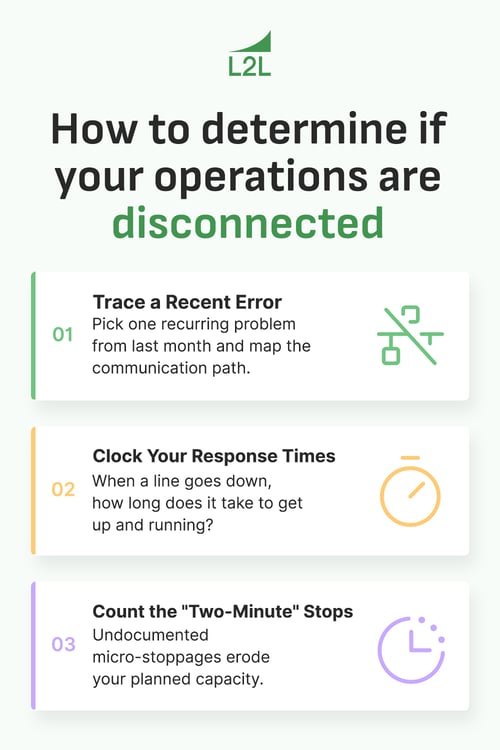
Is Your Shop Floor Disconnected?
In many cases the data you need to optimize your plant already exists—it’s just trapped. To find out where your operation might be losing time and margin, try auditing these quick operational areas:
- Trace a Recent Error: Pick one recurring problem from last month and map the communication path. Was it a mechanical failure, or did the information break down during a shift handoff?
- Clock Your Response Times: When a line goes down, how long does it take for a technician to get notified, pull the machine's history, and arrive on scene?
- Count the "Two-Minute" Stops: Micro-stoppages that go undocumented can quietly eat away 15% to 20% of your planned daily capacity.
Uncover the Hidden Costs on Your Shop Floor
Ready to eliminate the systemic blockers stalling your production? Dive deeper into the data, real-world case studies, and actionable roadmaps for modern automotive manufacturing.
Want to learn more? Download the full white paper here.