



.svg)
 Shop floor execution
 Maintenance
 Production
 Skills
.png?width=60&height=60&name=chart-line-up%20(1).png) Manufacturing Intelligence
Manufacturing Intelligence
 Automotive
 Building materials
 Packaging
 CMMS/EAM
 MES
MES
 Connected Worker
 Manufacturing Intelligence
 Case studies
 Blog
Blog
 Ebooks & Guides
 Webinars
 Events
.svg) OEE Calculator
OEE Calculator
 Downtime Cost Calculator
 About Us
 Partners
 Newsroom
 Support
 Careers
 Trust center


.svg)

 Gloria
Gloria
Gloria

Why is training in manufacturing so important?
Out of all industries, manufacturing has seen some of the biggest surges in resignations in the past years - an increase of 58%. Yes, employees are demanding higher pay. But money alone is not enough.
Most employees at the frontline feel disengaged and unhappy in their work. They want a safe and motivating work environment.
One of the most effective ways to drive motivation and uphold safe working practices on the shop floor is to build a scalable program for on-the-job-training in manufacturing that encourages team members to learn while doing.

Frontline training on-the-job: Avoid employee churn.
Why do young people leave their jobs?
- Values and company culture
- Lack of motivation
- No clear development path
- Salary mismatch
Often, frontline team members quit because they have a values mismatch with the organization. Younger employees are more likely to prioritize work culture over salary. Older employees are leaving due to the "silver tsunami" effect or technological gaps between the systems they are used to and the advanced tools implemented today.
On-the-job training vs. classroom training.
Classroom training often uses traditional practices like group lectures and textbooks. The problem? It’s not very engaging, and knowledge is quickly forgotten. On-the-job training uses hands-on experience. The employee learns by physically interacting with the subject, rather than memorizing abstract concepts.
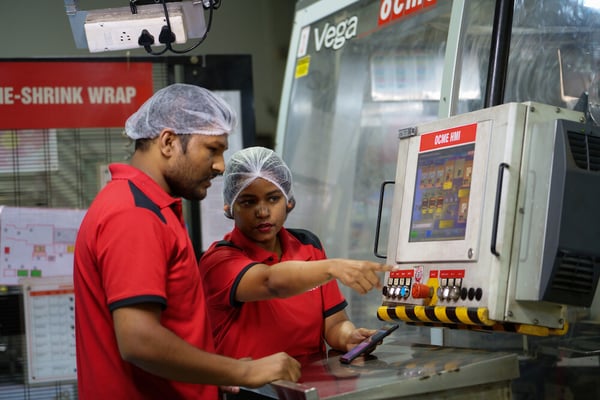
Promote learning-while-doing by delivering the relevant training in the production environment.
An added benefit? It makes them feel valued.
Working for an organization that sees you, hears you, and makes you feel valued boosts motivation to deliver better results. It makes the employee proud to be a part of the company, which positively affects overall motivation.
This isn’t everything that on-the-job training has to offer. In the next section, we'll talk about some other benefits that make this the most effective training method in the workplace.
Different types of on-the-job training.
- Cross-training: Prepares operators for multiple roles across a line.
- On-the-floor training: Happens directly in production using standard work.
- Apprenticeship: Pairs new employees with experienced team members.
- Shadowing: Observing workflows before performing them.
Why choose on-the-job training?
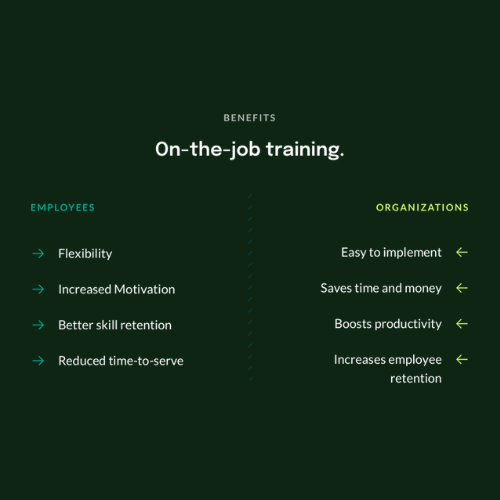
1. Easy implementation.
Digital job aids can be seamlessly integrated with existing LMS or other organizational platforms, accessible from any device.
2. Cost and time-efficient training.
Companies with formalized training programs have 218% higher income per employee. Read: How Thermon realized a 50% reduction in time-to-effectiveness.
3. Increased productivity.
Technical workers who receive hands-on experience become more productive than those with traditional classroom-based education.
4. Increased employee retention.
Good training and clear standards are proven to increase retention by providing a clear visual breakdown of all relevant aspects of the work.
Where to implement on-the-job training.
Implement it anywhere performance depends on real-world execution: production floor, maintenance, quality, and logistics. When training happens where the work happens, it becomes faster, more relevant, and easier to sustain.
Building a culture of learning.
As Peter Drucker said, “culture eats strategy for breakfast.” Building a learning culture ensures employees feel invested in and encouraged to perform at their best. They see that you are invested in their growth.
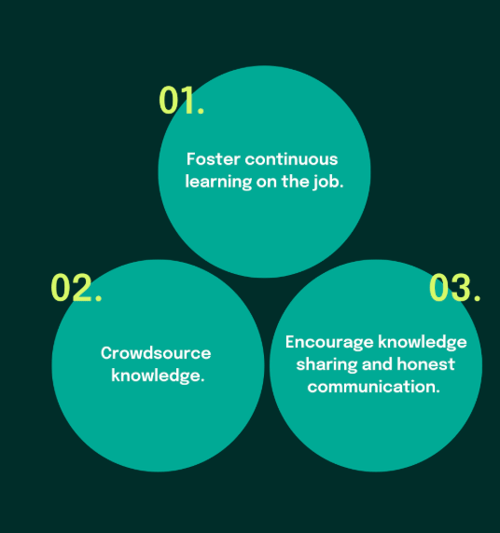
1. Foster continuous learning on the job.
Continuous improvement starts with continuous learning. Digitizing your SOPs makes them accessible when they need them most—while performing the task at hand.
2. Crowdsource knowledge for training.
The people on the frontline know the problems inside-out. Empower them by involving them in the knowledge creation process. This reduces the likelihood of churn.
3. Encourage knowledge sharing.
Start a mentoring program and reward those who drive knowledge sharing. Gather feedback to build better processes over time through honest communication.
A culture of learning and on-the-job training pays off.
- Retain valued employees.
- Increase productivity and product quality.
- Promote lasting and successful team relationships.
- Lower absenteeism and churn.
- Elevate your employer brand.
Want to learn more?
👉 Smooth frontline training programs
👉 Motivate frontline teams to perform at their best