



.svg)
 Shop floor execution
 Maintenance
 Production
 Skills
.png?width=60&height=60&name=chart-line-up%20(1).png) Manufacturing Intelligence
Manufacturing Intelligence
 Automotive
 Building materials
 Packaging
 CMMS/EAM
 MES
MES
 Connected Worker
 Manufacturing Intelligence
 Case studies
 Blog
Blog
 Ebooks & Guides
 Webinars
 Events
.svg) OEE Calculator
OEE Calculator
 Downtime Cost Calculator
 About Us
 Partners
 Newsroom
 Support
 Careers
 Trust center


.svg)

Achieving real-time production visibility is one of the most critical challenges facing modern manufacturing operations today.
Running a manufacturing plant without this capability is comparable to driving a vehicle without a speedometer: operators and management only know something is wrong when the vehicle has already run out of fuel. Within the first few moments of a shift, a lack of real-time production visibility can derail daily targets and obscure the root causes of operational friction.
Our recent research report, The Manufacturing Data Paradox, indicates that approximately 48% of manufacturers still rely on spreadsheets, and up to 70% use manual data collection methods. This massive visibility gap represents the single largest profit leak in mid-market manufacturing operations. When information is delayed, management remains entirely reactive, fixing problems hours or days after they occur.
What you’ll learn in this article:
- Real-time means seconds, not minutes (or hours): True visibility requires accurate data delivered within minutes of an event, not next-shift reports that look entirely backward.
- Visibility requires action: Dashboards alone aren’t effective if they do not automatically trigger immediate operational responses on the floor.
- The three-part foundation: Achieving success requires a combination of machine data, frontline operator input, and an automated workflow that closes the operational loop.
What is real-time production visibility?
Real-time production visibility is the continuous, accurate view of what is happening on the production floor: what is running, what has stopped, why it stopped, what is on schedule, what is behind, available to everyone who can act on it within minutes of the event.
To understand this capability, a clear distinction must be made between different data speeds in industrial environments:
Many plants operate under the belief that they possess real-time insights when, in reality, they are relying on backward-looking shift reports.
Why production visibility matters now more than ever
Manufacturers currently face three compounding macroeconomic pressure points that make operational transparency a baseline requirement for survival:
- The skilled labor shortage: With fewer eyes on the factory floor, supervisors cannot manually monitor every asset. Automated visibility must fill the gap left by reduced headcount.
- Supply chain volatility: Material arrival times and customer demands change daily. Manufacturing schedules must change just as fast, which is impossible without knowing the exact status of every line.
- Margin compression: Rising material and operational costs mean that small efficiency leaks now break the profit and loss statement.
As the industry grows more complex and global decisions are required to be made more quickly, accuracy and transparency are the new minimum.
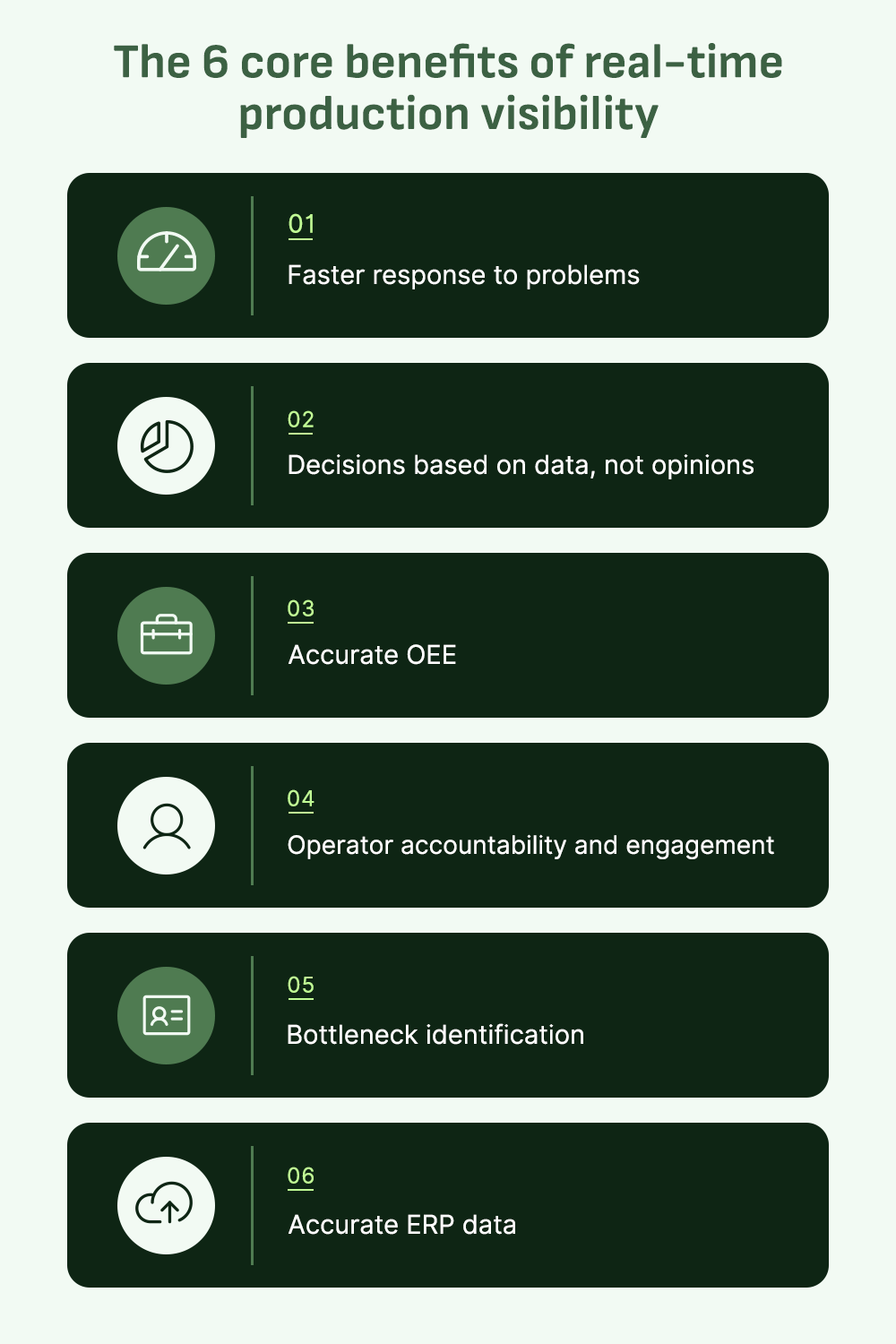
The 6 core benefits of real-time production visibility
1. Faster response to problems
When an asset stops for five minutes, real-time alerts ensure it receives immediate attention from maintenance teams instead of running idle or underperforming for an hour. Mean Time to Repair (MTTR) drops measurably when an automated notification lands on the correct mobile device within 30 seconds of a stoppage.
2. Decisions based on data, not opinions
Production meetings shouldn’t depend on memory or manually recorded notes about events that occurred on a shift. Live data delivers an objective record, allowing management to focus on resolving issues rather than debating them.
3. Accurate OEE
Overall Equipment Effectiveness (OEE) calculated from manual stop and start times is largely fiction. OEE calculated from automated machine signals combined with operator-confirmed reasons is real. Continuous visibility is the absolute precondition for OEE data that teams can actually act upon.
4. Operator accountability and engagement
When metrics are displayed transparently on the floor in real time, accountability is built directly into the daily workflow. Frontline operators see their own performance metrics instantly, supervisors detect patterns across shifts, and plant managers maintain a clear view of the entire facility.
5. Bottleneck identification
Production constraints are rarely static. They shift based on product mixes, material variations, and labor deployments. Live data makes these shifting bottlenecks visible the moment they appear, rather than weeks later during a retrospective Pareto analysis.
6. Accurate ERP data
When production status, scrap counts, and labor hours flow into an Enterprise Resource Planning (ERP) system continuously, downstream processes like pricing, invoicing, and scheduling become more accurate.
What’s required to make real-time visibility actually work
Building a functional visibility framework requires three distinct layers, implemented in a specific sequence:
- Machine data: At a minimum, this requires capturing the running or stopped state of every asset and, ideally, tracking cycle counts and programmable logic controller (PLC) tags.
- Operator input: Machines can log that they have stopped, but they cannot explain why the stoppage occurred. Operators must add context regarding stop reasons, quality events, and changeover challenges at the source.
- An automated workflow: The collected data must trigger an immediate operational action, not just alter a color on a screen.
Visibility without action isn’t helpful. A dashboard that nobody reacts to is worse than no dashboard at all, as it gives leadership the illusion of control while leaving floor-level inefficiencies completely unaddressed.
How to roll out real-time production visibility
Implementing this capability across an entire enterprise can be daunting. Manufacturers can avoid common deployment pitfalls by following five practical steps:
- Start with a single line: Rather than attempting to instrument an entire plant simultaneously, prove the process on one pilot line to build momentum and refine the data collection methodology.
- Instrument the top three critical assets first: Focus initial hardware and software resources on the primary bottlenecks that dictate the throughput of the entire line.
- Define the response protocol before installing sensors: Before a single data point is collected, establish clear rules for ownership. Management must determine exactly who gets notified when a specific machine stops, and how quickly that individual must respond.
- Put dashboards on the plant floor, not just in offices: Screens hidden away in executive boardrooms do nothing for the frontline workers who drive hourly output. Display performance data where operators can see it clearly.
- Review data weekly in a recurring forum: Visibility data is only useful if a formal, structured meeting exists to evaluate trends, assign corrective actions, and ensure continuous improvement.
Common deployment mistakes to avoid
Many organizations fail by attempting to track too many key performance indicators (KPIs) at the start, which overwhelms teams with data noise. Others ignore the friction that poorly designed software imposes on frontline operators, leading to inaccurate reason codes and abandoned tools.
Real-world impacts of production visibility
The transition from manual tracking to live operational clarity has delivered measurable turnarounds across various manufacturing environments.
Case Study: ADAC Automotive
ADAC Automotive, a manufacturer of vehicle access systems, struggled with paper-based production recording and siloed communication tools that made it difficult to distinguish between current and historical operational status. By implementing a unified digital platform with tablet and mobile access, the company established real-time performance monitoring across 200+ production lines. This immediate visibility allowed operators, maintenance, and supervisors to align resources instantly, resulting in a 62% reduction in major downtime events and a 15% increase in OEE.
Case Study: JELD-WEN
As a leading manufacturer of high-performance doors and windows, JELD-WEN faced severe operational friction caused by managing work via spreadsheets and manual paperwork. Keeping track of shop floor events was highly time-consuming, and managers spent hours simply gathering data. Transitioning to mobile-enabled, real-time insights allowed production managers to view active shift performance without digging through paperwork. This shift eliminated administrative delays, yielding a 53% overall performance improvement and saving up to two hours daily per employee on administrative tasks.
Where production visibility fits in the manufacturing tech stack
Production visibility is not a standalone software category; it is an operational capability that lives at the exact intersection of three core systems:
- Manufacturing Execution Systems (MES): Captures real-time machine data, cycle counts, and production status.
- Computerized Maintenance Management Systems (CMMS): Links downtime events to maintenance work orders and asset histories.
- Manufacturing Intelligence: Functions as the analytics and dashboard layer that visualizes trends for leadership.
In legacy technology stacks, these three systems operate as separate, disconnected products. Organizations are forced to fund complex, expensive integration projects to pass data between them, which often introduces data latency and errors. In a modern connected manufacturing operations platform, these capabilities live natively within a single architecture, ensuring that visibility automatically drives maintenance execution.
How L2L delivers real-time production visibility
L2L doesn't provide standalone visibility apart from production execution. Instead, the L2L Connected Manufacturing Operations Platform combines MES, CMMS, Connected Workforce, and Manufacturing Intelligence capabilities into one unified platform. Because the visibility layer, the maintenance response system, and the advanced analytics live in the exact same software, manufacturers can bypass the risk and expense of multi-vendor integration projects.
With L2L, machine data is captured natively from the floor while operator-confirmed reason codes are added directly at the source. The moment a machine signal indicates a critical stoppage, the platform automatically generates and routes a maintenance work order to the appropriate technician.
Furthermore, L2L features dashboards engineered specifically for the shop floor environment, and L2L Execution AI surfaces prescriptive guidance on what to do next rather than simply reporting what already happened. This closed-loop system is how global manufacturing sites eliminate operational blockers and reclaim lost capacity.
Frequently asked questions
How fast is "real-time" in manufacturing?
According to standard manufacturing convention, data is considered real-time when it refreshes within 30 seconds to two minutes for major performance metrics. Any information delayed beyond five minutes falls into the category of near-real-time, which limits a team's ability to stop a minor disruption from escalating.
Do manufacturers need new sensors to get real-time visibility?
Not necessarily. A significant number of modern production machines already expose their operational states via existing PLCs or OPC-UA protocols. For legacy equipment that lacks connectivity, low-cost retrofit sensors can easily handle basic running and stopped-state detection. Frontline operator input via digital interfaces quickly closes any remaining data gaps.
Is an MES required for real-time visibility?
For any serious manufacturing operation, yes. The MES layer is what directly captures real-time machine states and tracks production status against order targets. The strategic choice for management is whether to deploy a standalone, siloed MES or to implement a connected manufacturing operations platform that unifies production data with maintenance workflows.
What KPIs should a production visibility dashboard show?
To prevent information overload, floor dashboards should focus strictly on actionable metrics: OEE (broken down by availability, performance, and quality), actual throughput versus target rates, active downtime reasons, schedule attainment, and the top three active issues on the line.
Visibility that triggers action
True production visibility is never just about a dashboard. It’s about creating a functional, closed loop between shop floor data and maintenance action. The visual screen itself is the least expensive component of the strategy. Real operational value is generated only when a live data stream automatically orchestrates a rapid human or mechanical response.
Organizations looking to eliminate operational chaos, maximize asset utilization, and empower frontline teams can learn more by exploring the L2L Manufacturing Intelligence Platform or scheduling a dedicated assessment with a manufacturing expert via the L2L Contact Page.